d r a f t
Springfield College in Illinois/Benedictine University grads who took my cultural studies courses may be interested in this. We’re beginning to see orange T-shirts here and there at the end of September, especially in online spaces, and I think — hope might be a better word — we’re going to be seeing more and more of them as time goes by.
The shirts aren’t necessarily being worn by college football fans (although this Tennessee alum wears both, and a Canadian football team, the BC Lions in Vancouver, has adopted the orange-shirt movement). Instead, they’re part of a growing movement in Canada and the US to recognize the harm done to indigenous children by boarding schools in both countries.
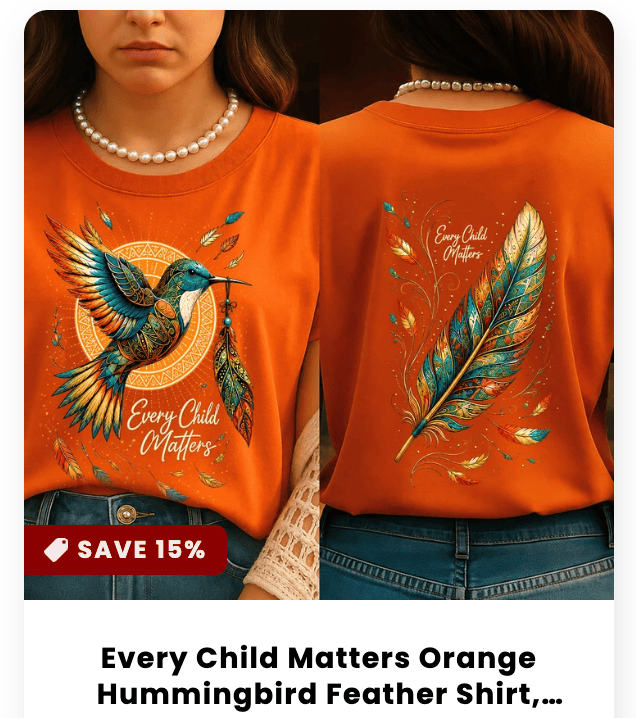
Emblazoned with indigenous designs and the legend “Every Child Matters,” the shirts call attention to American Indian and Alaska Native children who suffered multi-generational trauma at boarding schools in which they were forced to assimilate to majority white cultural norms. The movement started with First Nations advocates in Canada, where Sept. 30 is a National Day of Truth and Reconciliation, and it is spreading to the US.
In Canada, Sept. 30, or Orange Shirt Day, is a federally mandated “commemorative and educational event” and a government holiday in several western and northern provinces. In the US, it has been taken up by indigenous rights advocates and various church bodies, several of which sponsored boarding schools in the 19th and early to -mid20th centuries.
I learned about it from my Lutheran parish church ub Springfield, and I think it was made to order for people like me. I don’t have a drop of blood quantum, and I’m leery of cultural appropriation. But teaching that cultural studies course at Benedictine changed me, and I’m all in for the educational opportunities that Orange Shirt Day opens up.
I’ll get back to that in a minute or two. But first, a little background.
Orange Shirt Day began in 2013 when Phyllis Jack Webstad, a tribal citizen of the Stswecem’c Xgat’tem First Nation and residential school survivor, told her story at a reunion of the St. Joseph Mission school in British Columbia. When she started school at the age of 6, an orange shirt her grandmother gave her, was taken away. She never saw the shirt again, the memory rankled and she grew up to advocate for First Nations cultural renewal and human rights.
According to Wikipedia, which has an excellent article on the subject, Webstad’s advocacy inspired a growing movement “to promote awareness and education of the Canadian residential school system and the effect it has had on Indigenous communities for over a century” (links in the original). Levi Rickert of the Prairie Band Potawatomi Nation and publisher-editor of Native News Online picks up her story:
It was Sept. 30, 1973, the first day she attended St. Joseph’s Mission Residential School in British Columbia. Her grandmother had bought Webstad a brand-new shiny orange shirt to wear, adding to the young student’s first-day-of-school excitement.“I didn’t understand why they wouldn’t give it back to me, it was mine! The color orange has always reminded me of that and how my feelings didn’t matter, how no one cared and how I felt like I was worth nothing. All of us little children were crying, and no one cared,” Webstad said.
She never forgot the loss that turned into a hurt to her heart.
That loss turned into a gain, however, when Webstad grew up and inspired the Orange Shirt Society, a Canadian not-for-profit dedicated to “truth & reconciliation and commit to the enduring truth that ‘EVERY CHILD MATTERS,’ as the movement’s webpage puts it. It was never about nursing grievances. Instead, it defines its mission as to:
- Support Indian residential school reconciliation
- Create awareness of the individual, family, and community intergenerational impacts of Indian residential schools through Orange Shirt Society activitie
- Create awareness of the concept of “Every Child Matters”
In an interview with Native News Online, Webstad explained, “Wearing orange shirts are a symbol of defiance against those things that undermine children’s self-esteem, and of our commitment to anti-racism and anti-bullying in general.”
A big part of the program is to “set the stage for anti-racism and anti-bullying policies” in the Canadian schools. “Orange Shirt Day is also an opportunity for First Nations, local governments, schools and communities to come together in the spirit of reconciliation and hope for generations of children to come,” she added.
As a retired teacher, I am totally down with all of this!
My social media feed was filling up with ads promoting Orange Shirt Day T-shirts, so I ordered one. Webstad’s Orange Shirt Society allows others to apply for a license “to use the ‘Every Child Matters’ trademark on [their] products and support the Orange Shirt Society’s mission of raising awareness about residential school experiences.”
So I went online and bought a hummingbird sweatshirt by Native Pattern of Boulder, Colo., to wear to church at the end of September. Hummingbirds, Google’s AI Overview informs me, symbolize “joy, healing, timelessness, and resilience, often acting as a swift spiritual messenger between worlds.” But Google warns, I think wisely, that “tribal cultures span diverse regions, [so] specific meanings and stories vary widely by nation.”
I love the idea of hummingbirds as resilient little messengers from the spirit world (which meshes nicely with my desire to see God in all of God’s work), but I think Native Pattern’s take on Orange Shirt Day is more practical:
On September 30th – Orange Shirt Day, we wear orange to honor Indigenous children taken from their families and placed in residential schools. The shirt symbolizes loss of culture and identity, but also the strength and spirit of survivors.
This movement is about remembrance, solidarity, and reconciliation. By wearing orange, you stand with a growing call for justice – because every child deserves to be seen, heard, and loved. 🧡 Every Child Matters.
Also observing the occasion are the BC Lions of Vancouver, a professional club in the Canadian Football League. Phyllis Webstad will be an honored guest at their Sept. 25 game against the Saskatchewan Roughriders, and orange T-shirts will be given to the first 10,000 fans through the gate. In a Lions press release, Webstad said:
Reconciliation is built through action, education, and a shared commitment to remembering the truth. The BC Lions have shown that commitment by standing with survivors and their families, honouring the children who never came home and creating space for reflection and learning.
Their support sends a powerful message to communities and Nations across Canada that Every Child Matters and that we all have a role to play in reconciliation.
Also part of this year’s Orange Shirt Day observance is a halftime show featuring kids from a BC Lions Indigenous Youth Program and an Indigenous Marketplace, allowing vendors to promote and sell their products throughout the evening on the concourse.
So there won’t be as much pomp and circumstance when I wear my new orange sweatshirt to church Sunday down in Springfield, but I’ll feel like I’m part of a larger movement.
Let me be very clear about something. I’m no expert, and I have no Native American ancestry. Not even a mythical Cherokee princess! When I lived across the mountains in Tennessee, I did write some feature stories on the arts and crafts scene in Cherokee, NC, and I once had the honor of meeting the late Walker Calhoun, who did so much to reconstruct and revitalize traditional Cherokee music and dance. (He also played an awesomely good drop-thumb banjo.)1 My interest in indigenous cultures came late, and it was mostly academic.
In fact, I like to think of it as living proof of the aphorism that sometimes the best things in life are things you blunder into. It began about 25 years ago when SCI, a Catholic junior college where I was teaching English, went looking for courses that might attract more students. One that looked promising was a Native American history course we had on the books that hadn’t been taught for several years.
So I set about to revive it as an interdisciplinary cultural studies course, which I had the academic credentials to teach. It turned out the old syllabus, which consisted mostly of having the students read Dee Brown’s Bury My Heart at Wounded Knee, no longer met the criteria for transfer credit at Illinois’ four-year universities.
Which meant I had to learn a new field practically overnight. A couple of fields, in fact (history and cultural studies). Somehow, I managed. I revamped the old Wounded Knee syllabus into an interdisciplinary humanities course “designed specifically to examine aspects of human diversity within the United States,” and got it accepted by something called the Illinois Articulation Initiative. (I could be quite an academic bureaucrat back in the day.) The next fall, I started teaching the course, and it changed me.
In very short order, I got to be painfully aware that I didn’t have the lived experience to speak for the indigenous people we were studying. I was able to get around that, to some extent, by reaching into my bag of English teachers’ tricks and pulling out something called reader response theory, which focuses on a reader’s interaction with a text. That way, I could focus on my reaction to a Cherokee legend or Athabaskan dance and invite the kids to do the same. Somehow, perhaps in spite of ourselves, I think we learned something. I know I did.
At the same time, my wife was writing training manuals for the Alaska Domestic Violence Network. She’d go up to Anchorage or Fairbanks from time to time to roll out a new manual, and sometimes I’d tag along. There I met a variety of Alaska Native women, and I got fascinated with the way Russian Orthodox missionaries blended their theology and culture with those of the Tlingit, Aleut and Yu’pik people they ministered to. I also learned to like Inuit smoked salmon and muktuk, but I got much more than that out of these trips.
Ever the academic, I wrote up some of what I learned for our campus magazine under the title “Alaskan Liturgical Hymns Our Lady of Sitka and the ‘Presence of the Holy’ in Cross-town Traffic.” I don’t think it ever occurred to me before to look for the presence of God in the minutiae everyday life, but it came to life again in later years when I studied Jesuit spirituality. Again, learning something about Native cultures — and spirituality — changed me. For the better.
None of which makes me the least bit Native Alaskan or American Indian, of course. But it made me fall head-over-teakettle in love with the idea when folks at my parish church started talking about Orange Shirt Day. I immediately recalled an Inuit colleague of my wife’s who told her women of her generation had difficulty relating to their teenage children because generations of Native families had no experience with raising teenagers at home.
Like practically everybody else in the “Lower 48,” I have family-of-origin issues, but nothing like this. I can damn well wear a sweatshirt, however, to proclaim “Every Child Matters” and hopefully spark conversations. I imagine them starting like this:
Q. Nice sweatshirt. Where’d you get it?
A. I sent off for it. It’s to raise awareness about the Indian kids who were shipped off to boarding schools. …
There’s more to this than wearing a shirt, though. Andrea Landry, an Anishinaabe writer, spells it out for other First Nations families in the Canadian magazine Today’s Parent,:
This year, you need to do more than wear the orange shirt. Do more than observing a moment of silence or reflection. Talking with your kids about the truth of colonization and residential schools needs to happen year-round, not just on September 30. And as Indigenous parents and families, we need to see more. [Emphasis in the original.]
For the rest of us, Landry has some good advice. Two points especially stand out (quite literally, since Today’s Parent prints them in boldface headline type). They are:
- Don’t expect applause and gratitude from Indigenous people; and
- Do not behave like Indigenous peoples are victims and need someone to save them.
If that sounds harsh, we need to remember the forced assimilation of indigenous children at boarding schools in Canada and the US alike. The motto “Kill the Indian, Save the Man” attributed to founders of the influential Carlisle Indian Industrial School speaks for itself. It also tells us, even in a time of racist backlash (at least in the US), we need to take seriously accusations of cultural genocide.
I think Landry is especially eloquent when she warns people like me to avoid what she calls “a ‘white saviour’ mentality, which can be highly problematic.” She concludes:
The truth is, Indigenous people are organizing, advocating, strategizing, and creating solutions to the countless problems and issues that have held our people back due to colonization for hundreds of years. In the wake of the unearthing of generations of Indigenous kids who never got to grow up, we now have a generation of Indigenous children standing proud in who they are and where they come from. We do not need saving. We simply need partnership—when desired.
It takes work, time, and energy to do the learning that needs to be done, and to uncover the truth that was hidden in plain sight. Honour those who never made it home. Pray for their families, who never had a chance to meet their relative who was taken. And continue to do the work you need to do, beyond a one-day holiday.
Honour your side of the treaty relationship. Honour the peoples whose original lands you live on.
Daily.
There’s nothing I can add to that. Nor would I ever want to.
References
“BC Lions Commitment to Truth and Reconciliation,” BC Lions, Vancouver, [2023] https://bclions.com/truth-and-reconciliation/.
“BC Lions to Host Sixth Annual Orange Shirt Day Game,” BC Lions, Sept. 16, 2026 https://bclions.com/article/bc-lions-to-host-sixth-annual-orange-shirt-day-game.
Andrea Landry, “Wearing Orange Shirts On September 30 Is A Great Start – But You Can Do More,” Today’s Parent, Sept. 29, 2025 https://www.todaysparent.com/blogs/opinion/orange-shirt-day-is-a-great-start-but-you-can-do-more/.
Levi Rickert and Neely Bardwell, “Through the Eyes of a 6-Year-old Child, Orange Became a Symbol of an Indigenous Movement,” Native News Online, Sept. 20, 2025 https://nativenewsonline.net/currents/through-the-eyes-of-a-6-year-old-child-orange-became-a-symbol-of-an-indigenous-movement-4/.
Phyllis Webstad, “Orange Shirt Day – Truth and Reconciliation in Canada,” interview by BC Lions, YouTube, Sept. 28, 2021 https://www.youtube.com/watch?v=c3q7byZhbaI.
My musings in 2008 on Alaska Natives are available on this blog at “Alaskan Liturgical Hymns, Our Lady of Sitka and the ‘Presence of the Holy’ in Cross-town Traffic.” Ordinary Time https://ordinaryzenlutheran.com/our-lady-of-sitka/.
[Uplinked Sept. 21, 2026]

 Ordinary Time