Arwa Mahdawi of The Guardian is one of my favorite op ed writers. Born in London and an Oxford graduate (BA, honors in English), she lives in Philly now and writes a weekly column for the US edition of The Guardian, “covering everything,” in the words of her bio on the Royal Society of Arts website, “from politics to pop culture.” Her heritage is Palestinian, and she’s an avowed feminist, author of a book titled Strong Female Lead: Lessons from Women in Power.
Most important of all, in my book, Mahdawi is a shrewd observer of the American scene, with a gift for the kind of understated satire you come to expect from an English writer. She created a website named Rent-A-Minority, for example, which she calls “an Uber for diversity,” according to the RSA. “Yes,” adds Mahdawi (or her biographer), “before you ask, it’s satire.” The fact she’s British also gives her a detached perspective I find valuable.
So I read with interest her column on Guardian website about US Rep. Alexandria Ocasio-Cortez’ recent remarks on “Woke 1.0” and the phrase’s cultural appropriation by the Trump regime and various right-wing zealots. The way Mahdawi sets up the controversy over what she calls “Woke 1.0” is so sly and masterful, I’ll just quote it at length:
So what is this cursed phrase? There’s no official definition, but the term is largely being used to refer to the period between 2018 and 2021 when social justice language was at its peak in mainstream culture. Certain progressives, including Alexandria Ocasio-Cortez, have started to use “Woke 1” disparagingly, as a way to distance themselves from that period and signal that they stand for a new form of left-leaning politics that is more palatable to centrist Democrats. “Woke 2”, I suppose.
We can blame the New York City councilmember Chi Ossé for coining the phrase. Back in May, he wrote on X: “Woke 1 was crazyyyy.” This was in response to someone reminding him that, in 2021, he’d said: “A cis white man should not be the next speaker of the Council.”
Not that many people paid attention to the May post. But then Alexandria Ocasio-Cortez quoted it on a recent appearance on ABC News’s This Week when she was asked about some statements the Wisconsin gubernatorial candidate Francesca Hong had made. In 2020, Hong, who lost this week’s gubernatorial primary, tweeted that Thanksgiving should be cancelled. She also posted about defunding the police. AOC responded to a question about these “controversial” tweets by saying Hong had moved away from these positions.
The congresswoman then noted: “I have a local city councilman that has this saying: ‘Woke 1.0 was crazy.’” After laughing at the phrase, Ocasio-Cortez went on to add: “During the pandemic, the doors were really open in trying to entertain any and every policy that was going to get us to a better place. And I actually think that the discussions that were had in that time were quite fruitful … I think that, you know, during lockdown, of course, rhetoric in that time is not rhetoric that we would use today.” [Links and elipsis in the original.]
The reaction to this from the Trump regime was swift and predictable. It may have communicated more than intended, however. Mahdawi chose not to explore the racial animus behind the right wing’s misappropriation of the term, which derives from African American vernacular English, but it’s lurking in the background of her extended quotation from White House aide Stephen Miller, whose cultural bona fides are well known. Says Mahdawi:
When you look at AOC’s full quote about Woke 1.0, it’s pretty reasonable. However, it has been ripped out of context and is being willfully misinterpreted by some people to suggest that Ocasio-Cortez thinks the excesses of that period were funny.
Stephen Miller, for example, almost exploded on air after Fox News’s Will Cain played a clip of AOC talking about Woke 1 to him on air. Miller ranted for almost five minutes about how woke policies resulted in a “historic increase in murders”. (Gun violence surged in the US during Covid, but that wasn’t because of protests or because some people wanted you to say “folx” instead of “guys”. It was for myriad reasons that we are still trying to understand but include school closures in low-income areas.)
Miller added: “We’re all going to have a good laugh about that? ‘Sorry your husband was murdered.’ ‘Sorry your mom was killed.’ ‘Sorry your loved ones are six feet under the ground now.’ We’re going to have a good laugh about that? It’s sickening, it’s disgusting and the thing is, [Woke 1.0] never stopped.” [Links and parenthetical matter in the original.]
Miller isn’t the first denizen of Trump’s White House to evoke the image of scary Black or brown people, either Black Lives Matter protesters or Latino migrants. And he isn’t the first to use racist dog whistles, quoting — or misquoting — inflammatory language used by leftists, often white college students. Merriam Webster, defines woke as: “chiefly US slang : aware of and actively attentive to important societal facts and issues (especially issues of racial and social justice).” And Webster’s usage notes records:
Woke developed in African American English and has been used to describe a state of active attentiveness to issues of racial and social justice since the mid-late 20th century. It gained widespread use and attention beginning in 2014 as part of the Black Lives Matter movement, and eventually developed pejorative use describing people, policies, practices, etc., seen as too politically liberal or progressive.
But Webster also includes lengthy citations of pejorative uses of “woke.” And you’re more likely to see the word used in stories about campaigns to remove books by Black authors from public libraries and to denigrate legitimate endeavors like voter registration and diversity, equity and inclusion initiatives in general.
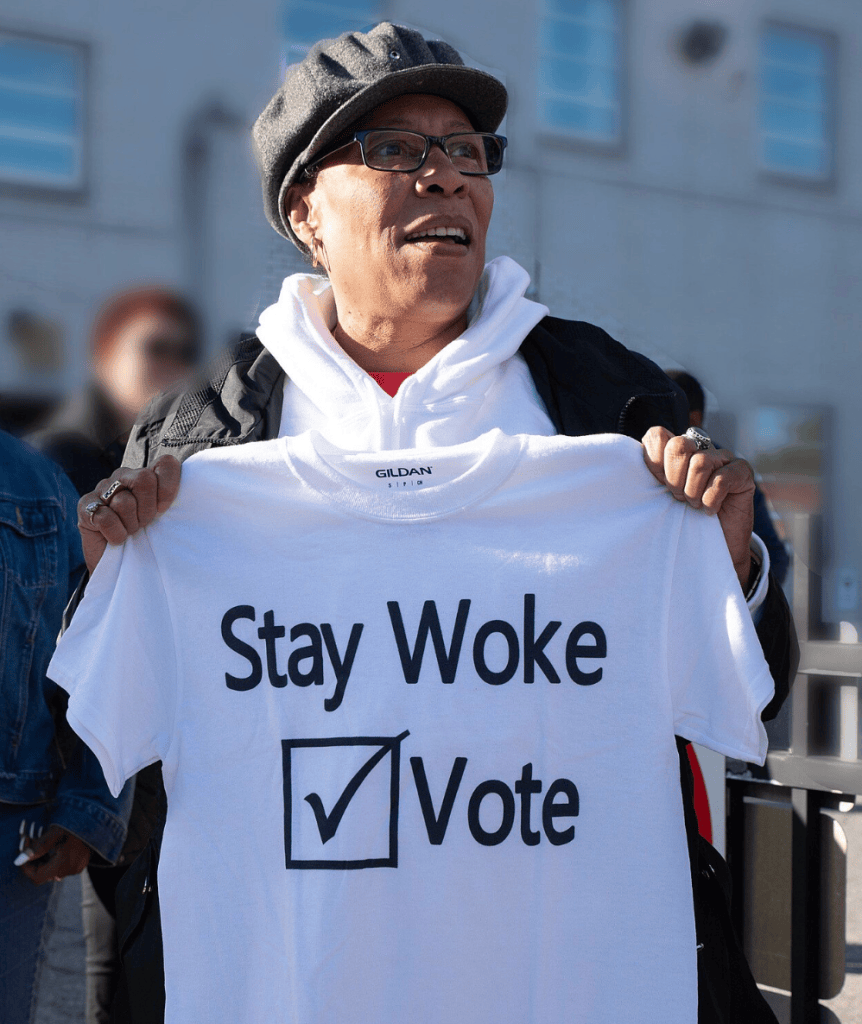
In fact, argues lInguist and social critic John McWhorter (as cited by Wikipedia), “the history of woke is similar to that of politically correct, another term once used self-descriptively by the left which was appropriated by the right as an insult.”
As the word has been used historically, there’s nothing insulting about it. Wikipedia’s article, which is unusually detailed and objective, finds antecedents in the abolitionist Wide Awake movement of the 1850s and Black philosopher Marcus Garvey, who wrote in 1923, “Wake up Ethiopia! Wake up Africa! Let us work towards the one glorious end of a free, redeemed and mighty nation.” The iconic blues singer Lead Belly (more formally known as Huddie Leadbetter, is credited with the first recorded use of the word “woke” in its vernacular sense. Says Wikipedia again (in its profile of Leadbetter):
In possibly the earliest audio recording of the phrase, Ledbetter urged Black listeners to “stay woke” in the spoken afterword to a 1938 recording of his song “Scottsboro Boys”. The song tells the story of nine Black teenagers and young men falsely accused of raping two white women in Alabama in 1931. Ledbetter warns his listeners, “So I advise everybody, be a little careful when they go along through there—best stay woke, keep their eyes open.” [Links in the original.]
Maybe it’s just because I’m a wordsmith and a retired English teacher who enjoys historical research as a hobby, but I think the word — and the concept — deserve better treatment than they get from the likes of Florida Gov. Ron DeSantis, who got a “Stop WOKE Act” (oh so cleverly titled the ”Stop Wrongs to Our Kids and Employees Act”) passed by his state legislature. Or from Donald Trump, who famously said in 2023, “I don’t like the term ‘woke’ because I hear, ‘Woke, woke, woke.’ It’s just a term they use, half the people can’t even define it, they don’t know what it is”; and made it his business to turn it into a nasty right-wing buzzword.
Turning liberals’ word choices into insults is a characteristic — and very effective — tactic of right-wing influencers. Even “liberal” has long been an insult in some quarters. So have academic or legal terms like critical race theory, which originated as a legal doctrine used to study housing discrimination, and DEI (diversity, equity and inclusion), a catchall term for policies intended to limit discrimination against protected minorities. Even the Black Lives Matter of 2020 has become a focal point of political derision.
There is a strong element of racial backlash in all of this, and Perry Bacon Jr. of The New Republic argues (as cited by Wikipedia) the “anti-woke posture […] promotes white and conservative fear in response to activism by African Americans as well as changing cultural norms.” Florida, a hotbed of right-wing backlash, even has on its books.
All of which led Andre Gee, a freelance writer and hip hop music critic of Brooklyn, to call out Ocasio-Cortez for saying in a national TV interview “Woke 1 was crazyyyyy” and backing away from BLM’s call to “defund the police.” In another column for the Guardian, he argued:
While everyone weighed in on “Woke 1”, though, I was more concerned with why the hell we were using branding co-opted by conservatives to discuss a movement against state-sanctioned killings of Black people. “Woke” has long shifted from Black America’s prideful adjective to a mocking noun that has been weaponized to ridicule Black liberation movements. Progressive liberals now adopting that dismissive language while placing confines on the movement for Black lives is damning.
Gee may have a point there. He noted that the term, which is attested in African American vernacular at least since Lead Belly recorded the Scottsboro Boys song in the 1930s, became popular with a younger generation in the 2010s. He said:
The term “woke” originated in Black American communities, and was popularized by a 2008 Erykah Badu lyric: “Even though you go through struggle and strife / To keep a healthy life, I stay woke.” The term became popular parlance in the 2010s; to “stay woke” meant you understood the components of white supremacy enough to identify them anywhere, whether in a work of art or a politician’s dog-whistling comments.
But, as with other terms that originated in Black culture (“Blexit”, “Black fatigue”), the phrase was co-opted by rightwingers who claimed that calls for progressive policy were divisive and reactionary. By 2020, as the police killings of George Floyd and Breonna Taylor sparked a worldwide uprising, the burning of Minnesota’s third precinct, and widespread calls for radical change, conservatives pushed back by vilifying the word “woke”. [Links in the original.]
So what’s a retired English teacher out in the hinterlands supposed to do with all of this? Rep. Ocasio-Cortez certainly doesn’t need my advice.
She’s a skilled politician, and she’s adapt in balancing the needs of her district, which takes in parts of the Bronx and gentrifying neighborhoods in Queens, with whatever national aspirations she might have. Nor do I have any words of wisdom for Andre Gee. My grandfather was a Norwegian immigrant pastor in Brooklyn, but the borough was hardly the hipster mecca it has become today. My world, out here in corn and soybean country, is far from his in the hipster mecca of Bedford-Stuyvestant.
And yet — yet sometimes I wonder. Is “woke” ready for reapproptiation even out here on the prairies? The term is used by linguists (as paraphrased by Wikipedia) to describe a “cultural process by which a group reclaims words or artifacts that were previously used in a way disparaging of that group.” Given its history, and the history of race relations in America, I think it’s time to reconsider “woke.”
It wouldn’t be without precedent. The prime example, at least in my lifetime, came in the 1960s when Black power advocates reclaimed the word “Black.” Certainly, the word “woke” also has a deep and honorable history. In a 2025 interview on WAAV-TV of Huntsville, Ala., ethnomusicologist Mark Puryear told anchor Nakell Williams that Lead Belly’s use of the term in a song about the false convictions of the Scottsboro Boys speaks to something deep within the history of American culture:
This song, the “Scottsboro Boys,” was the telling of the story, as well as a warning, really just a warning to African Americans and Black people traveling in Alabama and throughout the South to just keep your guard up, to not let your guard down and be aware that, you know, the environment was not necessarily a friendly environment. Researchers tell me they think the most notable instance of the use of the term ‘woke’ is by Lead Belly and in spoken words during activist Marcus Garvey’s 1920s call for Africa to wake up and unite.
Keep your guard up. Be awake. I can forgive Rep. Ocasio-Cortez and other progressives for backing away from slogans like “defund the police.” After all, as adept a politician as New York Mayor Zohran Mamdani can say, in a similar context: “Sometimes, what you believe can change and develop.” But when I hear Gov. DeSantis or someone like tech guru Elon Musk sound off about something he calls the “woke mind virus,” I’m convinced: (1) He’s being silly; and (2) Mark Puryear is right when he says the word points the way to something deep and admirable in our common history. He put it like this in his interview with WAAV:
I’m glad that people have found their way to both Marcus Garvey and Huddie Leadbetter because of this term, and that our public and people are […] not letting something just sit in the current day. They’re looking into our historic past because that’s so important. we have so much history we haven’t taught.
I can’t speak for anybody else, of course, but every time a DeSantis or an Elon Musk sounds off about “woke” this, “woke” that, I hear echoes of Amos ’n’ Andy and the white performers all painted up in blackface for the old minstrel shows. But most of all, I think of the contribution Black people like Lead Belly and Marcus Garvey have made to American culture. Garvey was speaking to a Black audience, of course, but I hear a summons to us all: Wake up, America. Let us work toward the goal of a free, redeemed and mighty nation.
Links and Citations
Andre Gee, “By disparaging 2020 protests as ‘Woke 1’, liberals are following the rightwing’s lead,” Guardian, Aug. 19, 2026 https://www.theguardian.com/commentisfree/2026/aug/19/woke-1-aoc-rightwing.
Arwa Mahdawi, “Sure, ‘Woke 1’ had its issues – but we have far bigger problems on our hands,” Guardian, Aug. 15, 2026 https://www.theguardian.com/commentisfree/2026/aug/15/woke-1-aoc-progressives.
Mark Puryear, interviewed by Nakell Williams, “The Woke Culture War,” Part 3, WAAV-TV, Huntsville, Ala., Feb. 5, 2025 https://www.youtube.com/watch?v=ClVGYh9Ruck&t=26s.
Julia Shapero, “Trump doesn’t like the term ‘woke’: ‘Half the people can’t even define it,” The Hill, June 2, 2023 https://thehill.com/homenews/campaign/4031584-trump-iowa-dislikes-term-woke//
[Uplinked, Aug. 24, 2026]


