A week after President Trump was re-elected, Psychology Today posted an article to its website noting that the outcome “reflects a moral injury for many — a psychological wound caused by betrayal of deeply held values.” Explained Mary Ann McDonald of Holy Cross College in Worcester, Mass., the article’s author:
Regardless of what side of the aisle you find yourself on, it has become undeniably true that what we thought was [an] aisle is not an aisle at all, it is a gaping abyss. The things that separate us are not about policies or economics. The things that separate us are about hatred, violence, and dehumanization.[…] And this deep sense of unease is not just about who won or lost; it’s about a growing recognition that the rules of the game, the structures of meaning and morality we thought we could rely on, might be crumbling and might have already crumbled.
Now, six months later, things have only gotten worse. As Trump has implemented his vision, the moral injury has only intensified. Republican majorities in Congress have cut food and medical assistance for low- and moderate-income familes by nearly $1 trillion, and mass deportation has terrified immigrant communities, especially Latinos in Democratic cities.
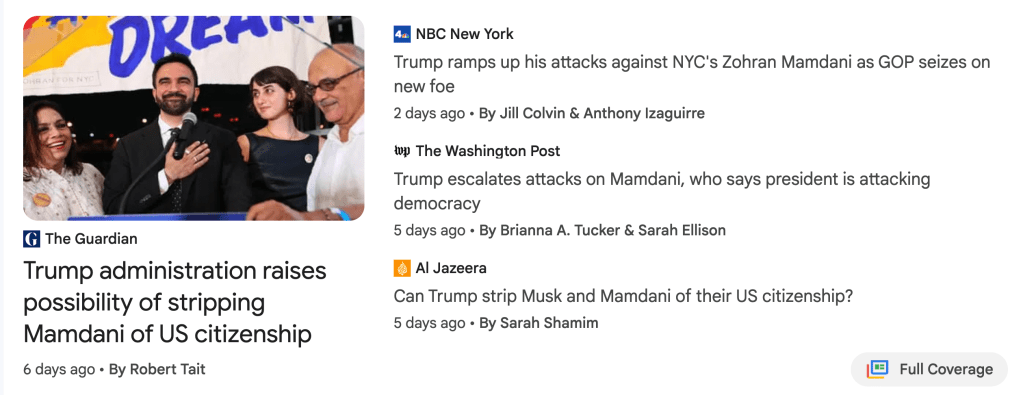
More and more, an animus against Black and brown people has been apparent to Trump’s opponents (although his supporters vociferously deny it). This came to a head June 24 when Zohran Mamdani, a naturalized citizen of Indian Muslim heritage, won the Democratic primary in New York City and Republicans called for him to be deported. But for several months, Trump’s Immigration and Customs Enforcement (ICE) agency has been accused of targeting Black and brown people (again, Trump denies it).
All of this has been profoundly upsetting to people who perceive that Trump’s agenda violates their moral, ethical and/or religious values. Some claim this sense of psychological damage amounts to moral injury.
Moral injury, in the general sense of a feeling of remorse and betrayal among people involved in warfare or other events that violate their deeply held beliefs, has been recorded throughout history, leaving evidence as varied and prominent as the tragedies of Aeschylus (who fought at the Battle of Marathon in 490 BCE) and the Bayeaux tapestry, which records a battle fought in 1066 CE. It is not yet recognized as a separate psychiatric disorder, but in a guide to clinical practice, the American Psychological Association cites a 2009 working definition by BT Litz et al.:
disruption in an individual’s confidence and expectations about one’s own or
others’ motivation to behave in a just and ethical manner. . . . brought about by
perpetrating, failing to prevent, bearing witness to, or learning about acts that
transgress deeply held moral beliefs and expectations. [Ellipsis in the original.]
Current scientific research on the subject began with American psychiatrist Jonathan Shay, who worked with Vietnam veterans in the 1980s and 90s. It has some characteristics in common with post-traumatic stress disorder, but it is not at this point given a separate heading in the American Psychiatric Assocciation’s Diagnostic Statistical Manual. Moral injury has shown up in studies of health care professionals, first responders, witnesses and others who were unable to avert a tragedy. Symptoms have also been observed, I believe appropriately, in individuals who feel complicit in perceived moral transgressions of their governments, societies and/or cultures.
Perhaps unsurprisingly, the concept has been analyzed in light of our toxic political discourse in America. McDonald, who wrote it up after the November election, teaches at a Jesuit college. And others have noted that Trump’s indifference to the poor and marginalized violates fundamentals of Catholic social teaching upholding human dignity and the common good. Writers of other traditions have explored it, including David Brooks of the New York Times, who combines his Jewish heritage with the teachings of Christianity (I’ve blogged about him HERE), and historian Diana Butler Bass, an Episcopalian with Methodist and evangelical roots (we’ll get back to her in a moment).
Only months into Trump’s first term in office in 2017, Dr. Grant Hilary Brenner, a psychiatrist at New York’s Mount Sinai Beth Israel Hospital, noticed the disorienting effect on ordinary people inherent in Trump’s “attention-grabbing style and disruptive, seemingly capricious approach,” on the one hand; and “protests rife with moral outrage, glaring injustice, racist and fascist fervor, general divisiveness, and the distortion of fact for fiction,” on the other. In an April 2017 article on the Psychology Today website, he said all of this amounts to collective moral injury:
In America, for years now, there has been partisan fighting and nepotistic agendas crippling our representative political system. Our system, meant to limit the damage done by incompetent or malicious leaders, is being tested from within, by questionable leadership by Trump and and his administration, satirical often comedic characterizations of same, and infighting within both parties in addition to their inability to collaborate.
Now, a good eight years later, Trump’s second term began with sudden, draconian cuts to medical and food assistance; hollowing out of institutions like the Education Department and the US Agency for International Development; and performative mass deportations of immigrants that remind critics as knowledgeable as historian Timothy Snyder, an expert on Soviet and Nazi tyranny, of “incipient state terror.” (Snyder recently left Yale for the University of Toronto, where he says he can more freely speak out against authoritarianism in the US.) All of this strikes critics, perhaps especially those in religous spaces, as deeply, fundamentally wrong.
Thus, when theology professor Kristin E. Heyer of Boston College says Trump’s second-term agenda violates the fundamentals of Catholic social teaching, she speaks for other faith traitions — perhaps most faith traditions — as well. In the Jesuit magazine America, she says:
From a Catholic perspective, these plans raise deep moral concerns about undermining human dignity and the right to seek asylum, harming family unity and the common good, and risking a police state. They invite (further) demonization of racial, ethnic and religious minorities, a structural sin that has harmed human dignity and solidarity as well as malformed our collective imagination on immigration and national identity alike. [Parentheses in the original.]
While Heyer’s focus was on immigration, she grounds her argument in something more basic. Among other things, she recalls the late Pope Francis’ 2015 address to Congress, citing the Golden Rule, as well as the principle in the Hebrew Bible that all human beings are created in the imago Dei, the image of God:
Catholic social teaching is grounded in a vision of the person as inherently sacred and made for community. All persons are created in the image of God and therefore worthy of inherent dignity and respect. Whereas this vision does not compromise autonomy, it understands humans as profoundly interdependent.
(What Trump and other critics of DEI [diversity, equity and inclusion] might think of the Latin imago Dei I have not been able to ascertain.)
It is precisely those fundamental moral standards of human dignity and love of neighbor, many of us believe, that the Trump regime deliberately, intentionally violates. Even before the November 2024 election, an interview suggesting as much was widely leaked to the media. In it right-wing pundit Russell Vought, now head of Trump’s federal Office of Budget and Managment, was quoted as follows (per the Gaardian‘s account in a profile of Vought):
“We want the bureaucrats to be traumatically affected,” Vought said in a video revealed by ProPublica and the research group Documented in October. “When they wake up in the morning, we want them to not want to go to work, because they are increasingly viewed as the villains. We want their funding to be shut down … We want to put them in trauma. [Ellipsis in the original.]
In her profile a month after Vought took office, perhaps with tongue in cheek, Alice Herman of the Guardian said Vought’s words might be coming true. It can safely be said the events of the past six months suggest that it has.
Nor has the psychological damage been limited to federal employees. Diana Butler Bass, who writes prolifically on spiritual topics and in 2024 joined other scholars in a “Faith and Democracy” iniative, noted already in February that the atmosphere around Washington “feels toxic.” Bass, who lives in the Maryland suburbs, explained:
Regular people are hurt, badly hurt, by threats to their families and livelihoods, and from having communal trust eroded. We’re the impact zone of the MAGA assault on democracy. Despite being surrounded by the monuments and museums of American heroes and history, it is like living in some other place — and it isn’t good.
Citing Vought’s remarks about traumatizing “bureaucrats,” Bass said the Trump regime’s mass firings, thinly veiled (or quite open) racism and cruelty were obviously part of a stragegy intended to harm others as well:
Indeed, last summer, one person (who now holds a major position in this government) specifically — and happily — stated that his goal was to purposefully put Americans into trauma. Traumatized people can’t respond. Traumatized people go along. Traumatized people isolate themselves. Traumatized people can’t think clearly.
Not just ginning up fear to win an election. Purposeful mass trauma has become a political strategy. A propaganda war creates anxiety. But psychological warfare causes trauma. We’ve grown used to the former; now the second has been introduced. And that is a kind of social sadism.
It started here, in my neighborhood. But trauma-as-policy won’t end here. [Links in the original.]
Bass returned to the subject late in June, when Republicans were calling for left-wing Democratic New York mayoral candidate Zohran Mamdani to be stripped of his citizenship and deported, and presidential immigration adviser Stephen Miller proclaimed his belief that Mamdani’s Democratic primary victory was the “clearest warning yet of what happens to a society when it fails to control migration.”
During a June 27 podcst with other “Faith and Democracy” speakesr, Bass said Miller’s remarks were part of a pattern designed to stir up racial hatred and further isolate and divide Americans. “The intent of all this moral injury is to damage us, through all these interlockimg events,” she said, “to hate our neighbor and to refuse to stand for an inclusive vision of what America should be.”
Bass said the underlying bigotry and racism were inescapable. “Once in a while they’ll confess […] where the moral injury is intended to be directed right now.” Mamdani is also a member of the Democratic Socialists of America (New York election law permits candidates to affiliate with more than one party), but his policies are those of a progressive Democrat. Bass said they also are inclusive, and a “gorgeous reminder of our humanity.” She elaborated:
You an have a good life. and you don’t have to sacrifice yourself to billionaires. or to racism or to any of these other things in order for you to get ahead. We can all move ahead togther. I know there are people in America who don’t like that. But, boy, I’m on that bus.
I’m on that bus. I think Jesus is on that bus.
I can’t think of anything I could possibly add to that.
Links and Citations
American Psychological Association, Addressing Moral Injury in Clinical Practice, available online at https://www.apa.org/pubs/books/addressing-moral-injury-clinical-practice-sample-chapter.pdf.
Diana Butler Bass, “Wellbeing and Witness,” The Cottage, Substack, Feb. 25, 2025 https://dianabutlerbass.substack.com/p/wellbeing-and-witness.
__________, Jemar Tisby, Kristin du Mez and Robert Jones, “Israel, Iran, and End Times Prophecy,” The Convocation Unscripted, June 27, 2025 https://www.youtube.com/watch?v=BS04r6y7fXU.
Grant Hilary Brenner, “Moral Injury: How Collective Injustice Harms Us All,” Psychology Today, April 3, 2017 https://www.psychologytoday.com/us/blog/experimentations/201704/moral-injury-how-collective-injustice-harms-us-all.
Zaria Gorvett, “How ancient civilisations dealt with trauma,” BBC, Dec. 8, 2023 https://www.bbc.com/future/article/20231208-the-rituals-that-helped-our-ancestors-recover-from-trauma.
Alice Herman, “Russell Vought: Trump appointee who wants federal workers to be ‘in trauma’,” Guardian, Feb. 10, 2025 https://www.theguardian.com/us-news/2025/feb/10/who-is-russell-vought-trump-office-of-management-and-budget.
Kristin E. Heyer, “A Catholic guide to migration ethics in the Trump era,” America, Dec. 12, 2024 https://www.americamagazine.org/faith/2024/12/12/heyer-migration-ethics-trump-era-249427
Tami Luhby, “House GOP lawmakers are proposing nearly $1 trillion in cuts to Medicaid and food stamps. Here’s who could be impacted..” CNN, May 21, 2025 https://www.cnn.com/2025/05/21/politics/medicaid-food-stamps-gop-proposed-cut.
Gustaf Kilander, “Republicans are calling on Trump to revoke Mamdani’s citizenship and deport him,” The Independent, June 26, 2025 https://www.the-independent.com/news/world/americas/us-politics/zohran-mamdani-trump-deportation-citizenship-b2777570.html.
MaryCatherine McDonald, “Moral Injury Meets Politics,” Psychology Today, Nov. 12, 2024 https://www.psychologytoday.com/us/blog/the-hope-circuit/202411/moral-injury-meets-politics.
Kristina Fullerton Rico, “Deportation fears create ripple effects for immigrants and their communities,” The Conversation, Feb. 19, 2025 https://theconversation.com/deportation-fears-create-ripple-effects-for-immigrants-and-their-communities-248817
.Timothy Snyder, “State Terror,” Thinking About…, Substack, April 15, 2025 https://snyder.substack.com/p/state-terror.
Robert Tait, “Trump administration raises possibility of stripping Mamdani of US citizenship,” Guardian, July 1, 2025 https://www.theguardian.com/us-news/2025/jul/01/trump-zohran-mamdani-citizenship.
[Uplinked July 28, 2025


