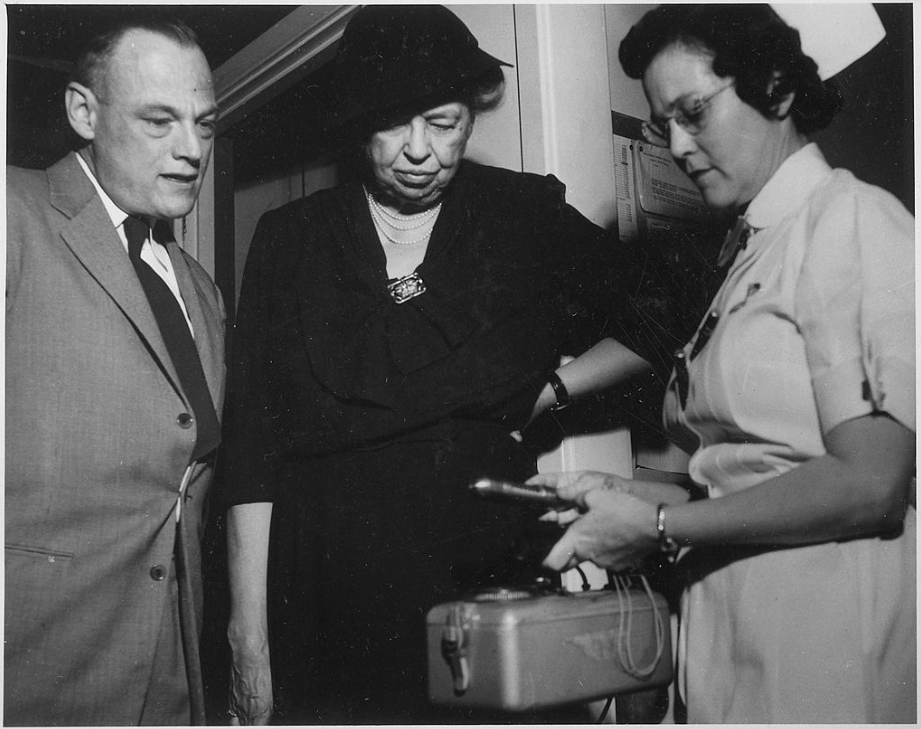
When I was growing up in East Tennessee, an Episcopal priest in a neighboring city was also the executive director of the Oak Ridge Institute of Nuclear Studies, a consortium of universities that worked with the old Atomic Energy Commission to promote nuclear medicine research and education and in the aftermath of World War II. He helped me sort out my feelings about science and religion as a teenager, and I still think of him 70 years later.
In fact, I think of the guy every three months, when I go to the Interventional Radiology department at HSHS St. John’s Hospital in Springfield to have a stent replaced.
Some of the scientific research leading to the technology I am a direct beneficiary of today was developed during the 1950s at labs like ORINS (now known as Oak Ridge Associated Universities). Its founding director was the Rev. William G. Pollard, and I feel a sense of gratitude — not only for the folks at St. John’s, whom I have gotten to know during two years of cancer treatment, but also for ORINS and the pioneers in what would evolve into today’s fields of nuclear medicine and radiology.
I owe an added debt of gratitude to Father Pollard for helping me sort out my attitudes toward science and religion as a teenager. Since I was disgnosed with cancer in 2022, the two are intertwined. Especially when I take the elevator down to IR in St. John’s every three months to have my stent changed, they’re both very much top of mind,
My first visit to IR was in the late spring of 2023, just after I’d had a radical cystectomy. There had been complications (you’ll be relieved to know I’m not going to go into them here), and I needed to have the stent installed. I’d been reading up on Jesuit prayer exercises during chemo, and I tried to remember them when I was being wheeled into the OR.
But all that came to mind was the old spiritual/gospel song, “I Want Jesus to Walk with Me.” Maybe not as sophisticated as what I’d been reading, but it’s long been one of my favorites, and the theology certainly fit the moment:
I want Jesus to walk with me.
All along my pilgrim journey,
Lord, I want Jesus to walk with me.
Enough said! I have a way of turning to music when words won’t suffice, and this was one of those times.
According to the United Methodist Church’s Discipleship Ministries website, “I Want Jesus to Walk with Me” comes down to us from oral tradition. It is considered an African American spiritual, but it may have mixed Black and southern Appalachian antecedents (Sparky Rucker, an old friend from Knoxville, and his wife Rhonda call these songs “Affricalachian,” reflecting a fusion of cultures — they’re a lot more common than you’d expect; they’re very much part of my spiritual formation, and I blogged about them HERE). “I Want Jesus” is well represented now in mainline Christian hymnals, as well as the Black gospel tradition. But I like the gospel versions best, and I’m sure I swung the melody a little as a sang it under my breath. It speaks to me in ways that theology and doctrine cannot.
Victoria Schwarz and Rev. Wilson Pruitt, who wrote the entry on “I Want Jesus” for the Methodist website, say it not only “affirms the peripatetic and pilgrim nature of this life.” When it’s sung by a congregation, its “theological power is found in the fact that not everyone will be facing a trial, but some will. And, as the body of Christ, we call on God together. The ‘I’ is not me, but us; we are one in Christ Jesus, and we all call God near.”
I wasn’t exactly waxing theological about the body of Christ, or koinonia to use a New Testament Greek term for the community of believers, that day when they were wheeling me on a gurney into the OR. But I’m sure I would have drawn comfort from the thought. But when Tiffany Shomsky of Calvin University’s authoritative Hymnary.org website, says: “As this song is sung, think about what it means to constantly have the presence of God, even when no human companionship is available,” I’m sure I would have agreed with her, too. But I wasn’t doing theology that morning.
When I got into the operating room, things got busy. Several techs and nurses bustled around prepping me and getting the room ready for the procedure, and I fell back on a type of humor I first developed as a police beat reporter getting to know the EMTs and sheriff’s deputies in my rural East Tennessee county (and revived when I got old enough to start showing up in hospital emergency rooms). Not exactly gallows humor. More like the cleaned-up-for-TV wisecracking we’d hear on the M*A*S*H show in the 1970s. Typically when medical staffers find a patient wanting to ease the tension with feeble humor, they’ll play along.
Anyway, the procedure went smoothly. I only required local anesthesia, I was more-or-less alert (more on the “less” side, though), and it was over before I knew it. I felt like there was a sense of common purpose in the OR that reminded me of I’ve seen reenacted in M*A*S*H reruns. It was more than reassuring.
Was Jesus walking with me, too? We certainly weren’t in church, but, in some way I couldn’t put my finger on, I’d like to think there was a working community, or koinonia to use the New Testament Greek term, in the OR that day. In any operating room, for that matter, on any day.
Which brings me back, in a roundabout way, to Oak Ridge and Father Pollard. I grew up during the 1950s just 20 miles from the AEC plants and laboratories that developed the atomic bomb during the war and branched out into nuclear power and medicine. As a kid, I didn’t know much about what went on in Oak Ridge (much of it was still classified), but I was aware of “Atoms for Peace,” an AEC public relations campaign of the day, and I knew they were doing interesting research with “hot” isotopes of iodine and cobalt-60 at the ORINS hospital. Eleanor Roosevelt, then a progressive icon, even visited the facility.
Pollard, who taught physics at the University of Tennessee before the war, was involved in the atomic bomb project and came to Oak Ridge in 1946. He had turned to the church during the war (finding comfort in an evening prayer service the day Nagasaki was bombed); got involved with a building fund drive that became St. Stephen’s; and ultimately became an Episcopal priest. With this combination of education and experience, he thought deeply and published widely about the perceived conflict between science and religion. He explained his evolution to Daniel Lang of the New Yorker:
I decided that science was a way of investigating the wonders of God’s creativeness, such as the marvelous unity of a living cell and the intricate combinations of particlesthat make up matter. That being so, it seemed to me irreligious to oppose the work of science. (Man in the Thick Lead Suit 198-99)
Very close to my understanding of the issue, then and now.
And it’s largely to Pollard that I owe that understanding. My home town of Norris was 20 miles from Oak Ridge, and my parish church began as a mission of St. Stephen’s.
My father, a TVA forester, researched tree crop genetics, and I grew up with the scientific method on one hand and a sense that government was openly hostile to science, of the other. Tennessee’s first “Monkey Law,” which forbade teaching evolution was still on the books. (It was repealed in 1867 and replaced with creationist legislation in 2016.)
The mental gymnastics involved in squaring my biology classes with state law left me contemptuous of church and state alike, an attitude I share with today’s “n-o-n-e-s,” young people (and more than a few fellow octgenarians) who claim no particular religious affiliation but may consider themselves spiritual, even religious notwithstanding. The term is spelled that way to distinguish us from nuns and other women religious.
At any rate, it was arranged for me to meet with Pollard in the late 50s, probably in my senior year of high school. As I recalled it years later (when I was teaching at a Catholic liberal arts college), it went something like this:
I don’t remember much of our conversation, except right at the end when I said I didn’t see how I could stay in the church. I’m sure Fr. Pollard fiddled with his pipe for a moment, and I know he paused for emphasis.
“Oh, well,” he said, at last. “You’ll be back.”
Do what? I asked.
“Give it time,” he said. “You’ll come back to the church.”
And so it was, nearly 50 years later, I came back Which means I made pretty much the same journey as Pollard had back in the 1940s and 50s, when he reevaluated his earlier dismissal of religion as “a fairy tale” preached by “Bible fundamentalists insisting that Adam was the first man and that the world was created in 4004 B.C.,” He never accepted the media narrative of a suddent conversion whth the bombing of Nagasaki; instead, he spoke of adopting the mindset of another community after rigorous study (Lang 195-96). “Throughout his studies, Pollard had to resolve in his mind a complicated marriage of science and religion,” says Pam Bonee, ORAU’s communications director, in a profile for the Tennessee Historical Society. “As he struggled with the issue, he came to believe, to put it simply, that science was a way of investigating the wonders of God’s creations.”
Very close to my own belief, then and now. In a 1959 lecture at General Theological Seminary, Pollard said:
The mid-twentieth century is an age which axiomatically grants truth and validity to scientific knowledge, but equally axiomatically discounts religion knowledge as mere opinion. This presents no problem to one conformed to the prevailing convictions of his age. But to me, […] the new range of reality I had come to know as a Christian was just as valid and substantial as the range of reality I knew as a physicist […] , (Physicist and Christian viii)
Today we have pretty much the same problem: How do people of faith live in a world of verifiable phenomena where trumpet blasts do not ordinarily topple stone walls, the sun does not stand still, pi equals 3.1416 and moral choices often lie hidden in a fog of ambiguity? If anything, it’s worse now because public trust in religious and scientific institutions has been undermined, albeit from different ends of the political spectrum, since the 1950s.
But Pollard’s answer still works, at least for me: Science and religion he regarded as complementary faith communities. When he spoke of faith, he had something in mind that was altogether more nuanced — and useful — than the beliefs we usually talk about:
Faith in physics, as we have just seen, does not consist in an adherence to any particular set of propositions about the nature of physical reality, but rather in an ingrained conviction concerning the ultimate intelligibility of any phenomenon in terms of universal natural laws. In exactly the same way, faith in Christianity does not consist in the adherence to any particular set of historic doctrines, but in an ingrained belief in Christ as the incarnate Son of God, and in the reality of God as revealed in him. In either case faith is quite distinct from doctrine. (Physicist and Christian 17-18)
I’ve got to admit I’m not 100% sure about that last part. Credal statements about the Holy Trinity sound like doctrine to me, and when I’m asked point-blank whether I believe in God I fall back on Einstein’s quip: “I believe in Spinoza’s God who reveals himself in the orderly harmony of what exists, not in a God who concerns himself with fates and actions of human beings..” (But I don’t claim to be an expert here, and I’m cribbing the quote from Wikipedia.) In any event, I think Pollard lets me off the hook when he says in passing:
On the other hand, few people outside the Church realize how much it is possible in principle to modify essentially all of the historic doctrines of the Catholic faith, nor how essential it is to the power and vitality of the Gospel that each age re-express the historic understandings of the Faith in the light of its own experience.
I’d say it’s not only possible but necessary. Perhaps especially in a hospital operating room. I may believe in Einstein’s God (and Spinoza’s) revealed to us in the orderly harmony of God;s creation, but I also want Jesus to walk with me. Our English word “faith” comes down to us from Indo-European word roots meaning trust or confidence. Faith, to me, means trusting enough to walk the talk.
From the same Indo-European root (*bheidh-, if you want to get wonky about it) comes the New Testament Greek word for faith, and early Christians understood it as a relationship with God “that created a community based on trust, instead of a set of mental beliefs or feelings of the heart” (I’m cribbing again from Wikipedia, which I tend to use as kind of a personal summa theologica). And when it comes to dealing with something like stage 4 cancer, I’m all about trust.
Trust in God, yes, but also trust in my medical team. Trust in my treatment plan. Trust in my family, friends (both on social media and F2F), church members, doctors, medical support staff and occasional random strangers who have helped me and supported me in the last 2½ year. (And I haven’t even gotten around to mentioning all who have shared prayers, best wishes, healing vibes and pictures of cats and baby goats on social media.) One thing you hear from cancer survivors is a new appreiation for the kindness of others. Cancer turns out, quite unexpectedly, to be a group activity.
So when I pray, whether it’s in the IR department at St. John’s or driving across town for a doctor’s appointment or an infusion, I don’t pray for a miracle. I’m even training myself not to pray for a. good outcome on a blood test or a CT scan. That would be like asking God to violate the orderly laws of God’s creation. Instead, I pray for the docs and nurses; I pray for my personal support team; and I pray for the strength to handle whatever is coming next. Faith, I’ve decided, isn’t what you say. It’s what you do. Walking the talk. And, yeah, walking it with Jesus.
Links and Citations
“Background on Tennessee’s 21st Century Monkey Law,” National Center for Science Education, Feb. 25, 2016https://ncse.ngo/background-tennessees-21st-century-monkey-law.
Pam Bonee, “William G. Pollard,” Tennessee Encyclopedia, Oct. 8, 2017 https://tennesseeencyclopedia.net/entries/william-g-pollard/.
“Amber Davis, 7 important gifts the ORAU Medical Division gave the world,” ORAU: Then & Now [blog], Oak Ridge Associated Universitieshttps://www.orau.org/blog/history/seven-important-gifts-the-orau-medical-division-gave-the-world.html.
Daniel Lang, The Man in the Thick Lead Suit (New York: Oxford University Press, 1954).
“Religious and philosophical views of Albert Einstein,” Wikipedia https://en.wikipedia.org/wiki/Religious_and_philosophical_views_of_Albert_Einstein#:~:text=%22%20(Spinoza).-,Agnosticism%20and%20atheism,god%20is%20a%20childlike%20one..
Victoria Schwarz and Rev. Wilson Pruitt, “History of Hymns: ‘I Want Jesus to Walk with Me’,” Discipleship Ministries, United Methodist Church, April 2019 https://www.umcdiscipleship.org/resources/history-of-hymns-i-want-jesus-to-walk-with-me.
Tiffany Shomsky, “Worship Notes, For Leaders, ‘I Want Jesus to Walk with Me’,” Hymnary.org.https://hymnary.org/text/i_want_jesus_to_walk_with_me#tune.
Also my lecture, “Faith, Hope and Poetry: Science and (Pre-)Postmodern Ways of Knowing in the Writing of Kathleen Norris,” Last Lecture’ Series, Springfield College in Illinois, March 9, 2000 https://ordinaryzenlutheran.com/faith-hope-poetry/; and my post “Blacks, whites and Southern old-time music,” Hogfiddle, Sept, 27, 2009 https://hogfiddle.blogspot.com/2009/09/blacks-whites-and-southern-old-time.html. Hogfiddle was a blog I kept on Appalachian dulcimers, roots music and cultural studies from 2006 to 2016.
[Uplinked April 15, 2025]

 Ordinary Time
Thanks so much, Pete! So very grateful to you for sharing your research and reflection on “cancer as a group activity.” Indeed, all is ever so interrelated! We need each other!
May you and Debi and all of us experience Easter healing blessings.
Loving supportive prayers,
Sr. Bernice
LikeLiked by 1 person
Why, thank you, Sister! (I’m just checking the comments now, belatedly.) When I write these reflective journals, I’m usually wrestling with a topic I find difficult. (It’s like Flannery O’Connor once said, how do I know what I think until I write it down?) So I never know how they’ll land with readers. Your prayers are very much appreciated.
LikeLike
This one is SO good.
LikeLike
Wow, thanks, Debi! It’s one I put a lot of though into.
LikeLiked by 1 person