Editor’s (admin’s) note. I began this post a couple of weeks ago when President Trump made it clear he was backing fascist Russia against Ukraine and our (former?) NATO allies. I was reminded of a whimsical line from the Broadway production of Sound of Music, which reminded me in turn of my extended family’s experience with the Norwegian resistance in World War II. I couldn’t quite get it to jell — I think we can all agree Nazis aren’t inherently whimsical — but I’m returning to it because I can’t get what an uncle in Oslo said out of my mind; if anything, it’s more relevant now as our descent into neofascism continues.. Click HERE 1 for an update (when I get it written).
***
You may be bent on doing deeds of derring-do, / But up against a shark what can a herring do? […] Be wise, compromise. — Rodgers & Hammerstein, Sound of Music, 1959.
***
Ever since President Trump turned my world upside-down by openly siding with Russia in its invasion of Ukraine, I’ve been reorienting myself — improbably — with help from a song in a frothy 1959 musical and — also improbably — from tales of the Norwegian resistance under Nazi occupation during World War II.
And — perhaps most improbably of all — it all fits together (up to a point).
The song is almost whimsical, It was in the 1959 stage version of The Sound of Music by Richard Rodgers and Oscar Hammerstein, and it manages to rhyme “deeds of derring do” with “up against a shark what can a herring do?” Just the right tone, I thought at first, to poke fun at a cartoonish wannabe dictator like Trump.
But there’s a dark, disturbing undertone there. Maybe it’s not fun after all. Sound of Music was about the Anchluss, the Nazi takeover in Austria in 1938. And I’m just old enough to remember the immediate aftermath of World War II in the 1950s.
Many, perhaps most, of the adults in my life had served, either in combat or an atomic bomb project near my hometown; one uncle, a medic from Brooklyn, went ashore at Normandy on D-Day. Like so many kids with an immigrant famly background, I grew up with stories of the European resistance to Nazi occupation. So I think of the Rodgers and Hammerstein song, and I wonder: Up against a shark, what can a herring do? What would I do?
I’m not the only one who wonders about things like that. Kristin du Mez, historian at Calvin University and author of Jesus and John Wayne, says knowing the stories of the Dutch resistance helped focus her research on the intersection of late 20th- and early 21st-century white Christian nationalism and far-right, authoritarian politics in America:
Growing up [in the Christian Reformed Church], it seemed as though every family with Dutch ancestry could claim a relative or two who fought in the resistance or risked their lives to hide Jews. […] Shaped by these stories of Dutch Christian heroism, I grew up believing that Christianity was a countercultural force for good, the source of strength in the face of tyranny.
That’s entirely relatable — I still have a copy of Alt for Norge (all for Norway), published in 1942 by the government-in-exile on King Haakon VII’s 70th birthday, and I grew up with the same things we wonder about today. How did we get to this place in 2025? In America? What do people of good will do about it? How do we resist?
“Reflecting on this history,” du Mez said in a year’s-end column in Du Mez CONNECTIONS, “I’m left pondering what sort of faith equips one to speak a prophetic voice, a voice that can cut through nationalism, particularly when nationalism is turned to unchristian ends?”
More and more as Trump attacks the courts, the media, doctors and scientists, and the civil institutions of our society, I wonder. And, like people of faith like Kristin du Mez, I’m feeling discouraged. A few days later, in a column about New Year’s resolutions, she wrote:
When I asked one of my kids about their hopes for 2025, they stared at me blankly. “Honestly, I’m just hoping we don’t end up with a dictator,” they offered.
Same, kid. Same.
What concerns me (one of many things) is the paralysis that seems to have gripped “the resistance.” I get it, I’m feeling it too. And that feeling of powerlessness only adds to the collective despair.
Now, two months after New Year’s, there’s even more reason to worry about fascist dictatorships. Not only does Trump more-of-less openly side now with Russia’s Vladimir Putin, he openly attacks the norms and institutions of “small-d” democratic government at home.
And this comes at a time when scholars like Timothy Snyder of Yale, author of On Tyranny and Bloodlands: Europe Between Hitler and Stalin, have warned for 10 years that with Trump, there has “always been a presence, not an absence: the presence of fascism.” In an interview with Canadian Broadcasting Corp. shortly before Trump’s inauguration, Snyder explained:
I think people can be fascist without having total power, right? I mean, Mussolini had to deal with the king for a while. He had to deal with parliament for a while. You know, Trump also had to deal with Congress for a while. So you can be a, you can be a fascist without there being a fascist system, right?
Chilling enough? Wait. There’s more. In a more recent interview, Snyder told Channel 4 News, a British TV network (at 20:19), we’re running out of time to protest effectively. Trump’s wrecking-ball destruction of federal agencies and the rule of law are exacerbated by a media landscape in which ownership is increasingly concentrated in hedge funds, oligarchs like Elon Musk, Mark Zuckerberg and the owners of The LosAngeles Times and The Washington Post:
If America’s going to have a chance here, it’s it’s going to be because thousands and thousands of people take little initiatives positively — not just to defend, but to advance the things that they care about. If Americans sit and wait for the next terrible thing to happen, then the terrible things will keep happening and mounting up and at a certain point it will seem pointless.
I’d love to be proven wrong on this, but I’m convinced now that Trump wants to effectively hand over Ukraine to Putin. Closer to home, he intends to set up a new world order in which strongmen in Moscow, Beijing and Washington (dare I say Mar-a-Lago?) rule the world through “spheres of influence,” including Greenland and a “51st state” in Canada in our sphere. (Very similar spheres of influence figured in George Orwell’s 1984.)
Far-fetched? I used to think so. Now I’m not so sure.
It’s a long way from the Bloodlands of Stalinist Russia to the 1959 Broadway version of Rodgers and Hammerstein’s The Sound of Music. Yes, it’s the ultimate feel-good musical, but it’s about the von Trapp family singers who fled Austria just after the Nazi German Anschluss, or takeover. And “No Way to Stop It,” the song with the clever lines that captured my imagination, is about resisting the Nazis. Or, more pointedly, about not resisting.
“You may be bent on doing deeds of derring-do, / But up against a shark what can a herring do?” two of Capt. Georg von Trapp’s old friends, urge him. “Be wise, compromise! […] Let them think you’re on their side, / Be noncommittal.”
Spoiler alert: He doesn’t. He flees the Nazis instead. So it fit the play’s storyline. Just barely — it didn’t make the Hollywood musical version. I guess Nazis just aren’t fun guys for a Broadway musical? But I can’t get the words out of my head. Up against a shark what can a herring do? Be wise? Compromise? What would I do? What can I do now when another batch of latter-day fascists is running wild in Washington?
The stories of the Norwegian resistance are a better fit, since Ukraine in 2025, like Norway in 1940s, is occupied by a nearby dictatorship with similar visions of empire.
Besides, as a Norwegian-American kid growing up in the lee of World War II, I gloried in those stories. They were part of my heritage. (Dare I add: full of bang-bang-shoot-’em-up too?) Later, when I went to summer school at the University of Oslo in my 20s, I met my Uncle Ingolf, who had played a small role in the resistance.
Technically, he was probably a second cousin, but in my generation, we considered any older male relative our uncle. Ingolf had been a reporter for the Minneapolis Daglig Tidende (daily times), and he was a reporter in the Associated Press’ Oslo bureau when the Germans invaded and shut it down. I asked him about the resistance, and I’ll never forget his answer.
“Oh,” he said, dismissively. “I thought they were Boy Scouts.”
It was not a compliment. Since Ingolf was fluent in English, he was contacted soon after the Nazi invasion and offered a public affairs slot with the Norwegian government-in-exile in London. The resistance was active throughout the war in smuggling people across the border into neutral Sweden, and Ingolf had useful skills. Could they get his wife out with him, he asked. No, was the answer, they couldn’t.
So he stayed in Oslo for the duration of the war. I knew Ingolf and Bara as a gracious older couple, charming but rather formal in a way that I took to be typical for Europeans of the older generation (although Ingolf could be blunt and outspoken when he wanted to); I fully understood why he couldn’t abandon her during the war.
Ingolf was an old newspaper guy, and he was full of stories. About my grandfather, who was a Norwegian Lutheran pastor in rural Minnesota; about life as an immigrant who returned to Norway after the Tidende folded during the Great Depression; and life in general. One stands out in my mind these days.
Once during the occupation, Ingolf was walking his dog on a downtown street in Oslo,when a German soldier stopped him and demanded to see his papers. He forced himself to remain calm and polite, as anyone would in the circumstances, but the dog picked up on his tension and growled at the German while Ingolf stood there smiling politely and wishing he could get the dog to shut up.
Bur toward the end of the war, he took to carrying a small camera and discreetly taking pictures of British planes flying overhead. It was still risky, but he got the pictures to the underground press. (I’ve seen underground pictures like his in Alt for Norge and other wartime histories. Blurry specks in a B&W gray sky, but they gave hope.) So I think Uncle Ingolf did what he could. Up against a shark, what can a herring do?
Is it like that with Timothy Snyder’s positive “little initiatives?” Not enough to change the course of history, no. But maybe you do what you can when you can. I’ve joined my share of protests and demonstrations over the years, and I’ve also held jobs where political activity would have been a violation of my ethics. The moral calculus can be subtle and complicated.
In occupied Norway, there were other factors at work. Norwegians were considered racially pure by the Nazis — how can I say this without going down a nasty, racist rabbit hole? — largely because they were stereotypically blond “Nordic” types. So the occupation was, relatively speaking, less harsh and punitive than in the death camps of Eastern Europe. And the pro-Nazi Quisling regime, named for a Norwegian turncoat named Vidkun Quisling, edged into full-scale dictatorship slowly (a bit like the proverbial boiling frog cited b opponents of the Trump regime in today’s America).
In 1942 schoolteachers throughout Norway were forced to join a union affiliated with the collaborationist Nazi party; 11,000 (of 14,000 teachers nationwide) refused; a thousand were jailed, and 500 were sent to a hard labor camp in the far north of Norway.
This action, which the puppet regime characterized as a strike and met with a lockout, ended soon enough; after several monhs, the Quislings reopened the schools and brought detainees back from the arctic camps. The demand that teachers join the Quisling union stayed on the books, and with it a Nazi curriculum, but both were typically ignored and only sporadically enforced.
In a 2023 podcast, 63 Degrees North at the Norwegian University of Science and Technology in Trondheim, moderator Nancy Bazilchuk, suggests “the refusal by Norwegian teachers to indoctrinate their students into the Nazi way of thinking” represents “one of the largest successful non-violent resistance movements” anywhere in recent history. But for the most part, resistance took smaller, safer, often symbolic steps.
Teachers and other adults wore paper clips in their lapels, for example, while students fashioned them into necklaces or bracelets. I’m reminded of the American teachers who wore safety pins during Trump’s first term, to show support for young LGBTQ people who were bullied so much in that period. It was hailed by some, and dismissed as feel-good tokenism by others. But Christine Saxman, a Chicago-area high school teacher, argued both sides of the issue and decided:
For me, the pin symbolizes standing against all the violence: racism, Islamophobia, anti semitism, ableism, sexism, homophobia, transphobia, and xenophobia. As a victim of sexual assault, I want to see the pin. I will ask for support and action from those wearing it. And I will have the conversation [about virtue signaling] if it is just an empty gesture. But, wow, will I enjoy the conversations that let me know I am not alone. Don’t underestimate that
Bottom line: This stuff can be complicated, and I don’t want to judge anybody’s motives.
Anyway, most schools in Norway stayed open for the duration of the war, and the paper clip became a symbol of national pride. Other teachers chose more concrete, less symbolic ways to resist. When local schools were sporadically closed during the war, often for specious reasons, teachers who had lost their jobs in the public schools turned to underground home-schooling or private classes.
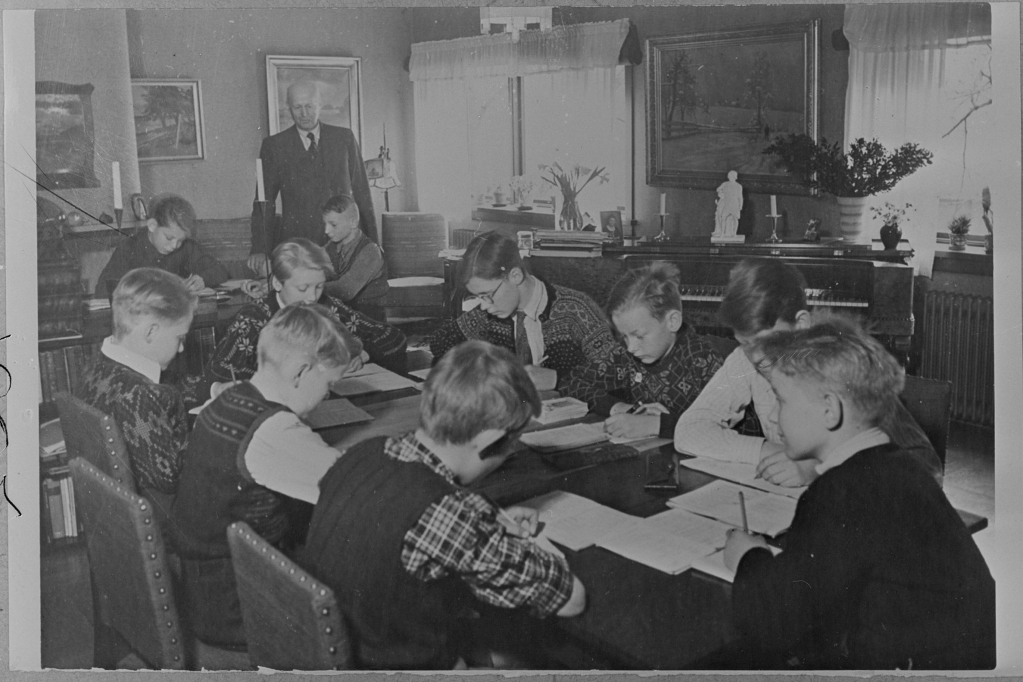
The picture at the head of this post shows a home school in Oslo, where the public schools were taken over in 1943 to quarter German occupation troops. It was smuggled out to the Norwegian government-in-exile and is now housed in the National Archives in Oslo. I’ve had a soft spot in my heart for these underground press photos, ever since I thumbed through Alt for Norge (all for Norway) as a kid. And I can’t help but think of Uncle Ingolf gritting his teeth and trying to act pleasant while his dog snarled at a German soldier in wartime Oslo. Or sneaking pictures of Royal Air Force planes flying overhead.
I guess maybe I need my heroes. At my age, I’m not exactly cut out for “deeds of derring-do.” But what about Timothy Snyder’s positive “little iniatives?” Maybe there are little things I can do. Maybe there’s even still a little room for whimsy. Trump, as we so often hear, isn’t Hitler. I’d say he’s more like Vidkun Quisling, or, better yet, Adenoid Hynkel, the “Great Dictator” in Charlie Chaplin’s 1940 movie. Or tinpot wannabe dictators everywhere.
(How about Donald Duck in the 1943 cartoon Der Fuerher’s Face? The possibilities are endless.)
Like my Uncle Ingolf, I’m an old newspaper guy, a compulsive wordsmith. And I do have a little platform. (You’re looking at it right now.) I guess that makes me a keyboard warrior, aptly defined by Urban Dictionary user “Chi z” (on Sept. 28, 2006) as a person who uses “the power imbued in his weapon (ie. text input ability) […] to manifest his true warrior nature in a safe and removed environment.” Ouch! Ironic enough for you?
But a little irony, I can live with. Especially if it’s mixed with enough humility to keep me on my toes. It’s the platform I’ve got, and, more and more lately, I feel obligated to raise my little voice for the rule of law and small-d democracy. I may not be able to get rid of the fascists in Moscow and the White House. (Spoiler alert: I won’t.) But, hey, we have township and school board elections coming up next month in Springfield. I can at least share early voting information to social media. And I think it’s better, like Timothy Snyder says, than to wait for the next terrible things to happen, and keep happening till “at a certain point, it will seem pointless.”
Notes
1 First of ___ posts on the theme of resistance, riffing on a rather whimsical line from Rodgers’ and Hammerstein’s Sound of Music — “up against a shark what can a herring do?” I haven’t been too thrilled by the whimsy in a song that’s ostensibly about compromising with Nazis, but after I had this post mostly drafted, Jeffrey Salkin argued — convincingly, I believe — in his Religion News Service column Martini Judaism that a light touch was absolutely necessary in getting lessons from the Holocaust across to a mass audience at the time. Next: I give Salkin his due, contrasting his take on the movie with film critics of the day, and coming around to thinking his headline, “60 years later, ‘The Sound of Music’ message about fleeing Nazis is just as powerful,” is accurate, even though I’m still amivalent about the song.
Links and Citations
Nancy Bazilchuk et al., “1100 Norwegian teachers fought Hitler — and won,” 63 Degrees North, podcast, Norwegian University of Science and Technology, Trondheim, Oct. 18, 2023 https://www.ntnu.edu/63-degrees-north; click HERE for transcript in PDF format.
Jim Beckerman, “One song in ‘The Sound of Music,’ 60 this year, sums up our moment. Why isn’t it in the film?” NorthJersey.com [Bergen Record], rpt. Providence Journal, March 1, 2025 https://www.providencejournal.com/story/entertainment/movies/2025/03/01/the-sound-of-music-at-60-what-song-about-accepting-nazis-was-cut/78220537007/.
David Corn, “Is Trump Extremism Getting More Extreme?” Our Land: A Newsletter from David Corn, Jan. 13, 2024 https://link.motherjones.com/public/33987677.
Kristin du Mez, “Christmas in a time of Christian nationalism,” Du Mez CONNECTIONS, Substack, Dec. 22, 2024 https://kristindumez.substack.com/p/christmas-in-a-time-of-christian.
__________. “Resolute,” Du Mez CONNECTIONS, Substack, Dec. 31, 2024 https://kristindumez.substack.com/p/resolute.
Kate Guadagnino, “So Long, Farewell,” Paris Review, Jan. 20, 2017 https://www.theparisreview.org/blog/2017/01/20/so-long-farewell/#:~:text=Rumor%20has%20it%20that%20Pauline,need%20not%20happen%20to%20peopl.
Historiske foto: Norge under okupasjonen, 1943, National Archive, Oslo https://foto.digitalarkivet.no/fotoweb/archives/5001-Historiske-foto/Indekserte%20bilder/L_1632Fo30141703310024_1.tif.info#c=%.
Christine Saxman, “Thoughts on the Safety Pin–To Wear or Not,” Women Change the World Blog, Wellesley Centers for Women, Nov. 15, 2016 https://www.wcwonline.org/WCW-Blog-Women-Change-Worlds/Thoughts-on-the-safety-pin-to-wear-or-not.
Jeffrey Salkin, “60 years later, ‘The Sound of Music’ message about fleeing Nazis is just as powerful,” Religion News Service, March 21, 2025 https://religionnews.com/2025/03/21/60-years-later-the-sound-of-music-message-about-fleeing-nazis-is-just-as-powerful/
Timothy Snyder, “Russia Ukraine: will Trump’s peace plan just lead to more war?” interview by Krishnan Guru-Murthy, Channel 4 News, London, March 5, 2025 https://www.youtube.com/watch?v=Vea2fTYYypM.
__________. “Trump, fascism and a warning from the past – Transcript,” interview by Jayme Poisson, Front Burner, CBC News, Dec. 20, 2024 https://www.cbc.ca/radio/frontburner/trump-fascism-and-a-warning-from-the-past-transcript-1.7416222.
Simon Tisdall, “Trump has utterly changed the rules of engagement,” Guardian, March 3, 2025 https://www.theguardian.com/commentisfree/2025/mar/03/donald-trump-world-leaders-democracy.
“Why Did Norwegian Teachers Wear Paper Clips During World War II?” Memory & Action, United States Holocaust Memorial Museum, Aug. 19, 2021 https://medium.com/memory-action/why-did-norwegian-teachers-wear-paper-clips-during-world-war-ii-5a9aa379e29.
[Uplinked March 24, 2025]


