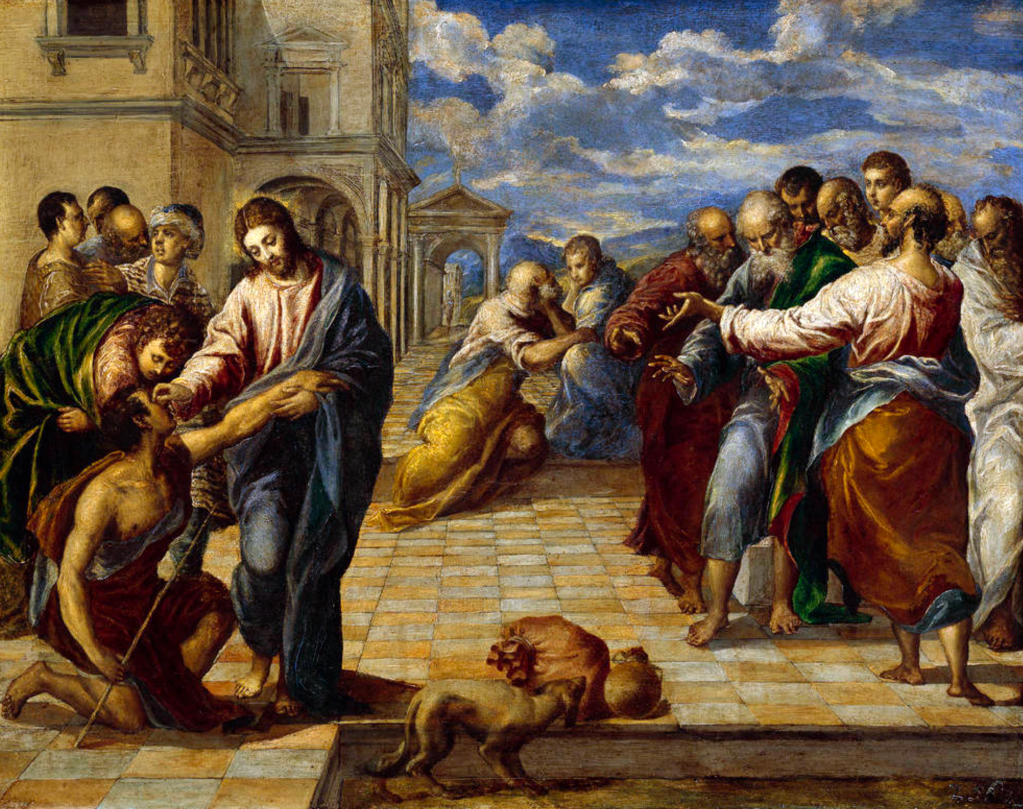
John 9 (NRSVue)): 28 Then they reviled [the man who had been born blind], saying, “You are his disciple, but we are disciples of Moses. 29 We know that God has spoken to Moses, but as for this man, we do not know where he comes from.” 30 The man answered, “Here is an astonishing thing! You do not know where he comes from, yet he opened my eyes. 31 We know that God does not listen to sinners, but he does listen to one who worships him and obeys his will. 32 Never since the world began has it been heard that anyone opened the eyes of a person born blind. 33 If this man were not from God, he could do nothing.” 34 They answered him, “You were born entirely in sins, and are you trying to teach us?” And they drove him out.
***
“For John,” states AJ, “proclaiming the Gospel can both unite and divide: the same point holds today.” How have you or your congregation experienced this truth for yourselves? — Leader Guide, Gospel of John, by Amy-Jill Levine (Nashville: Abingdon, 2024): 40.
Several years ago when Benedict XVI was pope, a Catholic friend asked me what I thought of his pronouncement Dominus Iesus. Issued in 2000, when he was still prefect of the the Congregation for the Doctrines of the Faith, and reaffirmed in 2007, it held tha that only the Catholic Church offered salvation, and other faith traditions were “gravely deficient.”
To be honest, I had to stop and think a minute. Since I’m not a Catholic, I felt at least mildly insulted by Benedict’s pronouncement, of course, but I didn’t want to sound snotty about it. Besides, she had a good question.
And I’d wrestled with the issue before, as a Protestant lay faculty member at a Catholic liberal arts college. So I gave it my best shot. “Well,” I said. “Doesn’t it come down to marketing?” As the leader of a religious denomination in a pluralistric, competitive religious marketplace, I figured, Benedict had every right to promote his brand.
Protestant denominations do the same thing whenever they insist on believer’s baptism or various doctrinal statemens in their creeds, covenants or articles of belief. The beliefs can function as what advertisers call a unique selling proposition, i.e. a “unique benefit exhibited by a company, service, product or brand.”
That’s pretty much the way I feel about the gospel according to St. John. A lot of it boils down to marketing.
I’ve been thinking a lot about John lately. In Sundays@6, our parish’s adult formation group, we’re reading an introduction to John by Amy-Jill “AJ” Levine, an emerita professor of New Testament at Vanderbilt Divinity School. It’s written for use in small-group discussions, and marketed by Abingdon Press, a publishing arm of the United Methodist Church.
Which means Levine, who describes herself as a “Yankee Jewish feminist who teaches in a predominantly Protestant divinity school in the buckle of the Bible Belt,” has an interestig way of teaching the New Testament to Christian readers. As we used to say down South, she knows how to get the fodder down to where the mules can reach it.
And, at least in my opinion, she has her work cut out for her with John’s story of the man who was born blind. Like other stories of John’s in which Jesus heals on the Sabbath, it brings him into conflict with “the Jews.” (Levine has a valuable, nuanced perspective on this, as we will see.)
Basically, I think John’s animus toward “the Jews” grew out of a local dispute in the first-century diaspora — perhaps in Ephesus — that evolved into family fight, then a marketing campaign and, ultimately, 20 centuries of Christian antisemitism. I’ve learned to deal with it by telling myself when the evangelist spoke of “the Jews,” he had in mind a very specific group of Jewish elders who expelled him from the synagogue down the street. When I substitute “good church-goin’ folks like me,” it helps me get my head straight in spite of the anachronism.
Anyway, there’s a lot going on in the story of the man who was blind from birth; like the rest of John’s gospel, it is complex and multilayered. So I’m coming more and more to believe that dwelling on what John may have thought about the synagogue down the street in Ephesus misses a fundamental point.
Besides, as Levine says, there’s a basic unintended irony when we conflate a controversy of the 90s and the story of Jesus’ ministry 60 years before, “given that Jesus and all hsinitial followers were, in fact, Jews” (Gospel 75) .
Good point!
Then there’s this: The guy can take care of himself. When he is interrogated, he comes back with a snappy answer. Several of them, in fact. It starts when the elders ask: “What did he do to you? How did he open your eyes?” A spirited exchange follows:
He answered them, “I have told you already, and you would not listen. Why do you want to hear it again? Do you also want to become his disciples?” Then they reviled him, saying, “You are his disciple, but we are disciples of Moses. We know that God has spoken to Moses, but as for this man, we do not know where he comes from.” The man answered, “Here is an astonishing thing! You do not know where he comes from, yet he opened my eyes. We know that God does not listen to sinners, but he does listen to one who worships him and obeys his will. Never since the world began has it been heard that anyone opened the eyes of a person born blind. If this man [Jesus] were not from God, he could do nothing.” They answered him, “You were born entirely in sins, and are you trying to teach us?” And they drove him out.
If there were any. rabbis among the religious authorities who interrogated the man — and it’s a pretty good bet there were — they must have realized he was beating them at their own game. (You can’t read much about the Talmud, the Jewish scripture dating from the 1st through the 6th centuries, without noticing a characteristic “give‑and‑take of argument” that boils down to something like this: Rabbi X said one thing, and Rabbi Y said another; the dialog has been going on for centuries and continues to this day.) I’d like to think he was winning the argument when the authorities played their trump card (pun not entirely unintended) and drove him out.
The man who was born blind isn’t the only character in John’s gospel who gets the better of the authorities. The woman at the well in Samaria even holds her own with Jesus, no less, in debate over “living water” at Jacob’s well. And there’s still even more going on in John’s account of the man who was born blind. Levine, or the Abingdon Press writer who put together the Leader Guide, brings it out with a question:
Read Genesis 1:1-2; Deuteronomy 5:22-23; and 1 Kings 8:12; all verses AJ uses to point out how darkness can also be revelatory. How does this biblical dimension of darkness shape your attitude toward the dark? What truths about yourself, other people, or God, if any, have you discovered in darkness? (Levine, Leader Guide 38)
The reading from Genesis is the very beginning of the creation story. “When God began to create the heavens and the earth, the earth was complete chaos, and darkness covered the face of the deep, while a wind from God swept over the face of the waters.” God said, “Let there be light,” there was light, and it was good. Darkness and light. The light comes out of the darkness, and the light is good. In Deuteronomy, not only light but the law and God’s covenant with Israel come “out of the fire, the cloud, and the thick darkness” at Mount Horeb (or Sinai). And the passage from 1 Kings tells of the ceremony when the Ark of the Covenant was placed in Solomon’s Temple:
And when the priests came out of the holy place, a cloud filled the house of the Lord, so that the priests could not stand to minister because of the cloud, for the glory of the Lord filled the house of the Lord.
Then Solomon said,
“The Lord has said that he would dwell in thick darkness.
I have built you an exalted house,
a place for you to dwell forever.”
There’s a lot here to unpack, way too much for a 1,500-word blog post on a parish book study. Much of it is directly related to the gospel of John, too. From the prolog — In the beginning was the Word […] What has come into being in him was life, and the life was the light of all people” — to Jesus’ final post-resurrection appearance just after daybreak in Galilee, images of light emerging out of the darkness.
When I first read John’s story of healing the man who was born blind for Sundays@6, my reaction was thoroughly ambivalent, and I decided I liked that!
For one thing, I’m enough of a recovering English major to enjoy teasing meaning out of a difficult text. For another, it speaks to something in my own faith journey. I don’t want to go down a rabbit hole here, but I’ve been drawn to something called the via negativa (aka apophatic theology, which argues we cannot define God but we can experience God’s presence in the world_ ever since I read TS Eliot in grad school.
In a poem called “East Coker,” one of his Four Quartets, Eliot wrote one of those lines that always stay with you: “O dark dark dark. They all go into the dark.” The Quartets are notoriously difficult, so I plodded through them line by line with a commentary by the Very Rev. John Booty, then dean of the Episcopal seminary in Sewanee, Tenn. Says Eliot:
I said to my soul, be still, and let the dark come upon you
Which shall be the darkness of God. As, in a theatre,
The lights are extinguished, for the scene to be changed
With a hollow rumble of wings, with a movement of darkness on darkness,
TS Eliot is out of style in literary circles now, and there’s a troubling undercurrent of antisemitism in his earlier poetry, but in an article for the Jesuit magazine America, poet Lisa Ampleman recommends the Four Quartets as an exercise for Lent.
She discovered Eliot in a parochial school library, as an eighth-grader “about to move away from the safety of a neighborhood school to a large high school nearly half an hour away,” and the lines that stood out for her promised: “[…] the end of all our exploring/ Will be to arrive where we started/ And know the place for the first time.” (The passage is from “Little Gidding.”) Ampleman recalled it like this
I was feeling anticipatory nostalgia for the ways that Sacred Heart School had shaped me, and T. S. Eliot helped me process that experience.I didn’t “understand” much of the poems, but I responded emotionally to them, which is a good approach to encountering poetry at any age.
The passage stayed with her — good poetry has a way of doing that — through the challenges of high school, college and a career as a poet and managing editor of The Cincinnati Review. And when came to write for America magazine, she harkened back to when her own faith journey was just beginning:
For those who count themselves spiritual explorers, a dive into the Four Quartets, with a clear eye on the background of its poet and a grain of salt, can help us too “to arrive where we started/ And know the place for the first time.”
Full disclosure: I’m finishing this post (rather belatedly) on the first Saturday in Lent. And I’m thinking Lisa Ampleman just might have a good idea there. Does God prefer to speak to us out the smoke, the clouds and the darkness?
Links and Citations
Lisa Ampleman, “A spiritual reading of T. S. Eliot’s ‘Four Quartets’,” America, Oct. 24, 2018 https://www.americamagazine.org/arts-culture/2018/10/24/spiritual-reading-t-s-eliots-four-quartets.
TS Eliot, Four Quartets, rpt. 2000 http://www.davidgorman.com/4quartets/
- Quartet No. 2, East Coker http://www.davidgorman.com/4quartets/2-coker.htm
- Quartet No. 4, “Little Gidding” http://www.davidgorman.com/4quartets/4-gidding.htm
Anthony Julius, “The poetry of prejudice,” Guardian, June 6, 2003 https://www.theguardian.com/books/2003/jun/07/poetry.thomasstearnseliot.
Amy-Jill Levine, The Gospel of John: A Beginner’s Guide to the Way, the Truth, and the Life (Nashville: Abingdon, 2024); Leader Guide (Nashville: Abingdon, 2024).
Jacob Neusner, “Talmudic Thinking,” My Jewish Learning, 70 Faces Media, New York, New York https://www.myjewishlearning.com/article/talmudic-thinking/.
[Revised and uplinked, March 8, 2025]

 Ordinary Time