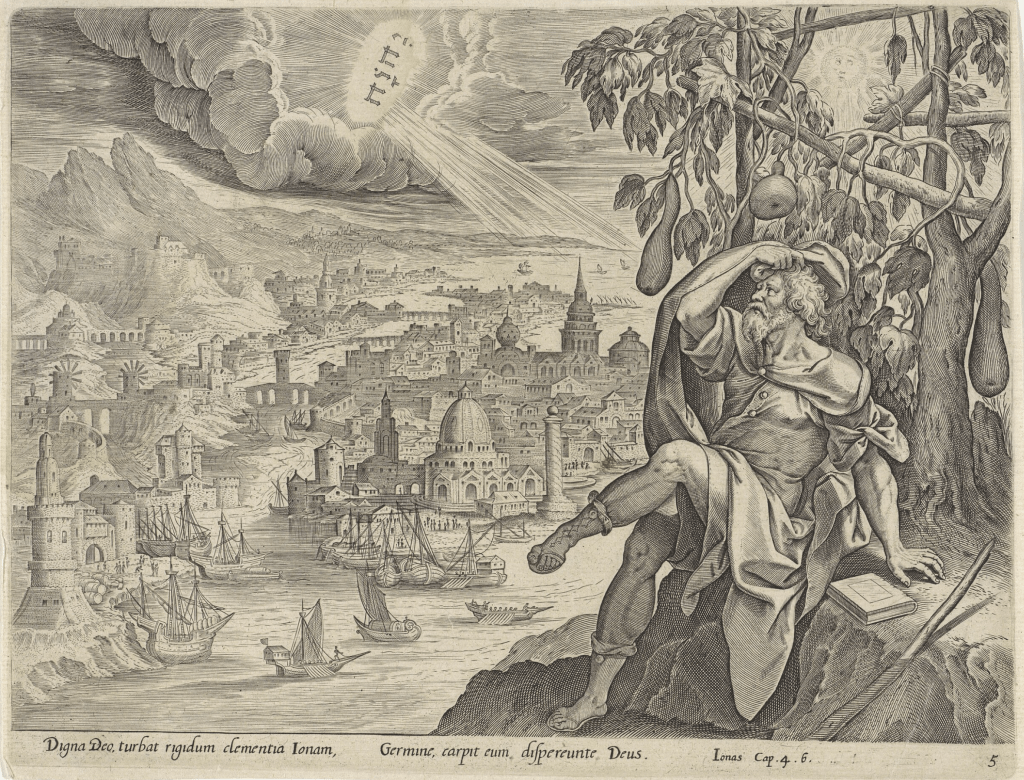
Welp, it looks like this is my lucky week. I’ve struggled at times with a book we’ve been reading for Sundays@6, the adult faith formation that that Debi and I facilitate for our Lutheran parish church. But this week we’re reading a chapter that invokes my favorite prophet in the Hebrew Bible (Old Testament), Jonah, who saved “Nineveh, that great city, in which there are more than a hundred and twenty thousand persons who do not know their right hand from their left and also many animals,” from the wrath of the Lord.1
The book, The After Party: Toward Better Christian Politics by Gordon Chang and Nancy French (Grand Rapids: Zondervan, 2024), offers guidance for evangelical congregations that have been wounded by today’s politicization — and polarization — of religion. It’s good stuff, but a little outside my frame of reference. The crisis it speaks to isn’t one I’ve directly experienced.
But Jonah? Now he’s my man!
For one thing, Jonah’s the only prophet in the Hebrew Bible (Old Testament) who succeeded in getting his message across; not only the king of Nineveh and all 120,000 people, but also the animals, repented and put on sackcloth and ashes. (There’s more than a whisper of satire in the story, which I love.) Jonah’s a bit of a curmudgeon, too, whom I identify with, and he’s not afraid to backtalk the Lord. When he does, of course, he gets put in his place right quickly. I identify with that, too! All in all, I think the book of Jonah is a little masterpiece.
Like so many kids, I first encountered it through the children’s bible story of Jonah and the whale (actually a big fish in the Hebrew). But that’s only part of Jonah’s story. The word of the Lord comes to Jonah and directs him to go to Nineveh, “that great city,” and tell the people there to repent. They’re hereditary enemies of the Israelites; they destroyed the Northern Kingdom of Israel and besieged Jerusalem. So Jonah, who has desire to save Nineveh, instead tries to flee to what is now Spain — the opposite end of the known earth. That’s where the fish story comes in.
In mid-voyage, the Lord sends up a storm; Jonah is cast overboard; and he winds up in the belly of a great fish. He repents and cries out to the Lord — “out of the belly of Sheol2 I cried, / and you heard my voice” (2:2 NRSVue). The Lord relents, and the fish spits Jonah out on dry land; and the Lord renews his call — go now to Nineveh and warn the people to repent. Jonah does what he’s told this time; the Ninevites repent; and Jonah is crushed. He wanted Nineveh destroyed, but, as he tells the Lord, ” I knew that you are a gracious and merciful God, slow to anger, abounding in steadfast love, and relenting from punishment. And now, O Lord, please take my life from me, for it is better for me to die than to live” (4:1 NRSVue).
Jonah sulks in the shade of a vine, “waiting to see what would become of the city.” (An early mistranslation has it as a gourd, and there are various guesses; the original Hebrew word describes a type of castor bean native to the region.3 I think it’s a castor bean, after spending way too much time researching the issue. But best of all I like the Wierix brothers’ description, in Dutch or Flemish: Jona onder de wonderboom. A miracle tree!) Instead, Jonah gets into an argument with the Lord, who sends an east wind to wither the bush. “Is it right for you to be angry about the bush?” asks the Lord.
Jonah has no answer. And, on that ambiguous note, the story of Jonah and the people of Nineveh ends.
Chang and French draw a more clear-cut moral from the story than I do. Focusing more on Jonah’s prayer of lament and thanksgiving in the belly of the fish (a magnificent bit of Hebrew poetry reminiscent of the psalms), they ask in a set of reflection questions:
Next ask God to bring to mind a life experience that resonates with Jonah’s experience in the belly of Sheol. It could be an experience related to politics, and if something comes up in that realm, go with it. But God may also prompt an experience from another realm of your life: health, relationships, career, or something else. […] As you reflect on that experience through the lens of Jonah 2, try to remember how God’s presence showed up within that painful or ugly experience. What forms did his presence take? What did it feel like to fall into God’s presence at that time?
And this:
What might change for you if you could come closer to experiencing God’s saving presence within the ugliness and pain of politics? (149-50)
Their questions remind me very much of the Jesuit and Benedictine spiritual exercises I’ve learned in spiritual direction. For me, however, the part of Jonah that speaks to me, the part that influences (I hope) my daily life, isn’t in Chapter 2, the belly of the fish, but in Chapter 4 when Jonah bickers — I have no other word for it — with God under the shade of the bush, tree or gourd outside Ninevah, that great city. So I’m gonna go with Chapter 4.
An Ignatian contemplation under the miracle-tree
When I’m engaging with scripture, I like to use a Jesuit spiritual practice called Ignatian contemplation (after St. Ignatius, founder of the order) — that is, imagining myself in a biblical story. (One more reason to go with Jonah 4: I’ve never been in the belly of a fish. Fish, to me, should be breaded in cornmeal and deep fat fried.) But I can imagine myself in a 17th-century illustration by Flemish printmakers Antonie and Hieronymus Wierix that shows Jonah under a vine heavy with gourds — the wonderboom — conversing with the Lord in the heavens above. The plant is probably a castor bean, and the cityscape in the background owes more to Renaissance iconography than to ancient Nineveh, but I can imagine myself sitting under the vine like Jonah.
Chang and French ask readers to recall a life experience that resonates with Jonah’s experience in the belly of Sheol, or, in my case, under the miracle tree outside Nineveh. I’m not sure I can do that. Nothing in my experience quite fits the white-hot, and historically justified, hatred Jonah held for Nineveh. I disagree with Republicans on many policy issues, but I don’t hate them. In fact, I find myself agreeing more and more with old-school, fiscally conservative Republicans like Bill Kristol and the Bulwark podcast crowd.
And as a newspaper reporter I covered enough legislative bodies, from county commissions down South to the Illinois legislature, to realize you need two strong parties to negotiate compromises and move public policy forward. However, I do have a cynical, snarky streak, and I can put myself in Jonah’s shoes, or sandals, under the Wierix brothers’ wonderboom on the outskirts of Nineveh:
I’m tired, and I’m footsore. Nineveh is a big, big city, and it’s not easy on the feet walking around for three days proclaiming, “Forty days more, and Nineveh shall be overthrown!” Since it’s me in this Ignatian exercise and not Jonah, I don’t have the prophet’s blind hatred for the people of Nineveh — let alone the animals! — but I’m thoroughly ambivalent when I learn the Lord has decided to spare them his wrath. Ambivalent and, I have to confess it, more than a little bit passive aggressive. Controlled anger might be a better word for it. So I pray, trying, but maybe not trying too hard, to keep the sarcastic edge out of my voice:
O Lord! Is not this what I said while I was still in my own country? That is why I fled to Tarshish at the beginning, for I knew that you are a gracious and merciful God, slow to anger, abounding in steadfast love, and relenting from punishment. And now, O Lord, please take my life from me, for it is better for me to die than to live.
But the Lord doesn’t take the bait. Instead, he replies: “Is it right for you to be angry?” Tired, patient tone of voice. Very, very patient. Like he’s trying to calm down a toddler.
I’m stung by the inference, so I don’t answer. I pout and stalk off without a word. Just east of the city, I find a vine and make myself a booth, or shelter, under the shade of the vine. But the Lord isn’t done with me yet. Almost as soon as I sit down, a huge castor bean shrub springs up. It’s so tall, it overshadows the vine I’ve wrapped around the bush, and it’s nice and cool in the shade.
OK, I think, this is the Lord’s doing — no bush is going to grow that fast. I’m puzzled. This isn’t what I was expecting. So maybe he really is gracious and merciful, slow to anger and abounding in steadfast love. I’m cooling off, and so is my anger. I sit there into the evening, and fall asleep. It’s the first good night’s sleep I’ve had since the Lord sent me off on this wild goose chase. Thank you, Lord.
But as soon as the sun comes up in the morning, another surprise. Wham, bam, thank you ma’am, an east wind blows up out of the desert and the castor bean tree withers and dies. The sun’s beating down on me, and I’m about ready to pass out.
“What’s going on here?” I say, directing my words up to the sky and repeating my refrain from yesterday. “It is better for me to die than to live.”
“Is it right for you to be angry about the bush?” replies the voice in the sky. Patient, still like he’s talking to a toddler. A hint in his voice that I’m trying his patience, but, I sense, gracious and abounding in steadfast love.
“You’re damn right it is,” I reply. Not as gracious as the occasion requires, I’ll admit, but it’s hot out here. “I’m angry enough to die.”
Another surprise. The Lord isn’t going to let me die. Instead, he comes back at me with what I can only describe as a little homily:
You are concerned about the bush, for which you did not labor and which you did not grow; it came into being in a night and perished in a night. And should I not be concerned about Nineveh, that great city, in which there are more than a hundred and twenty thousand persons who do not know their right hand from their left and also many animals?
There the conversation ends, and with it my Ignatian prayer exercise.
Chang and French see in the wonder tree — whether it’s a gourd, a castor bean or some other plant that gives shade — an echo of the Garden of Eden in Genesis:
God patiently invites Jonah back into his story of redemptive hope, which encompasses all of humanity. The plant evokes the Eden story. ad the fundamental truth: all humans — of every political tribe — are created in the image of God and meant to dwell together in the garden, tending to and benefitting from creation.
Yet, the story of Jonah ends on that ambiguous note I like so much. Chang and French like it too:
The book [of Jonah] ends by leaving Jonah standing outside the city contemplating this invitation. The Bible doesn’t tell us how he finally responds, which is a sure sign that God wants the question to be hanging around for future readers like us.
The book of Jonah is only four chapters long, about the length of a modern short story. But there’s so much going on in it, and the satire is so delightful, I keep coming back to it. This time, picking up on Chang’s and French’s message of redemptive hope, I’ve decided I can sum up the Lord’s final homily in two sentences: We’re made in the image of God. So let’s act like it!
Notes
1 All quotations are from the book of Jonah, New Revised Standard Version Updated Edition https://www.biblegateway.com/passage/?search=Jonah%201&version=NRSVUE ff.
2 The Hebrew name for the place of the dead, Wikipedia https://en.wikipedia.org/wiki/Sheol.
2 Many translations, including the King James bible, identify the plant as a gourd, but Jules Janick of the ag school at Purdue and Harry S. Paris of Newe Ya’ar Research Center in Israel have done a thorough study of the translations; they trace it back to the mistranslation of the Hebrew word for a kind of castor bean as “gourd” in the Septuagint, a Greek version of the Hebrew Bible dating to the 2nd and 3rd centuries BCE. Even St. Augustine and St. Jerome quarreled about it in the 5th century CE, and recent translations tend to duck the issue. The New Revised Standard Version (updated edition), for example, has “plant.” Best of all I like the Wierix brothers’ description, in Dutch or Flemish: Jona onder de wonderboom. The miracle tree!
Links and Citations
Curtis Chang and Nancy French, The After Party: Toward Better Christian Politics (Grand Rapids: Zondervan, 2024); 149-50, 160-61. See website at https://redeemingbabel.org/the-after-party/.
“Father James Martin: An introduction to Ignatian contemplation,” interview with Sean Salai, America, Sept. 21, 2016 https://www.americamagazine.org/content/all-things/easing-contemplation.
Jules Janick and Harry S. Paris, “Jonah and the ‘Gourd’ at Nineveh: Consequences of a Classic Mistranslation,” Cucurbitaceae 2006, North Carolina State University, Asheville, Sept. 17-21, 2006 https://www.cabidigitallibrary.org/doi/pdf/10.5555/20113341082.
Jona onder de wonderboom Geschiedenis van Jona (serietitel) Theatrum biblicum, Wikimedia Commons https://commons.wikimedia.org/wiki/File:Jona_onder_de_wonderboom_Geschiedenis_van_Jona_(serietitel)_Theatrum_biblicum_(..)_(serietitel),_RP-P-OB-9375.jpg.
[Uplinked Oct. 25, 2024]


_Theatrum_biblicum_(..)_(serietitel),_RP-P-OB-9375.jpg)
Pete, this is Shrikant Awasthi, your old friend from UTK.
I enjoyed this piece about Jonah and Ninevah so much that I read every paragraph twice to make sure I understood it correctly.
Being an Engineer, I have been as far away from Literature as one can imagine. Yet, perhaps due to genes from my late father, a professor of English Literature, and my association with you decades ago, I am tremendously attracted to your writings. Your topics (as I understand them) often have relevance to current affairs as much as to our soul.
I have long wanted to read the Bible – both testaments – in sequence. Someday I will. Reading your articles brings that day closer and closer.
Best wishes. Keep writing.
LikeLiked by 1 person
Hi Sri, great to hear from you! Regards to Aditi. Hope y’all are doing well.
And I appreciate your kind words about the stuff I write for the blog. There was a short story writer named Flannery O’Connor who said something like, “I write because I don’t know what I think until I get it down on paper.” I don’t recall the exact words, but something like that. Anyway, that’s why I write the stuff I do. I hadn’t thought much about religion — didn’t even go to church till I was in my 60s and my mother moved to Springfield — but after I retired, I started reading more. (I’ve heard it compared to studying at the last minute for final exams as we get older. 🙂 ) So it’s all kind of new to me, and I do a lot of reading.
So I take it as a great compliment that you’re interested in what I write!
If you’re interested in reading the bible, I think it’s a great idea. Debi read it all the way through several years ago; I started to, but I got bogged down in the books of Leviticus and Deuteronomy, which are full of ancient Hebrew law codes and pretty tedious, and I never finished it. What I’ve done instead is to read books I’m interested in — Genesis, the gospels of Mark, Matthew, Luke and John, Acts. Jonah is definitely one of them. It’s short, too! Might be a good starting point.
Can I recommend a book to you? It’s by a guy named Adam Hamilton, pastor of a big United Methodist church in the Kansas City area, who does a lot of study guides for small group discussions and knows how to explain things for ordinary lay readers. It’s titled “Making Sense of the Bible Today,” and it’s relatively cheap. Debi and I are considering it for the small group discussions we co-facilitate, and I’m really enjoying it.
This is getting way too long, so I’ll sign off now. Again, thx so much for your comment. It’s good to hear from you.
— Pete
LikeLike