d r a f t
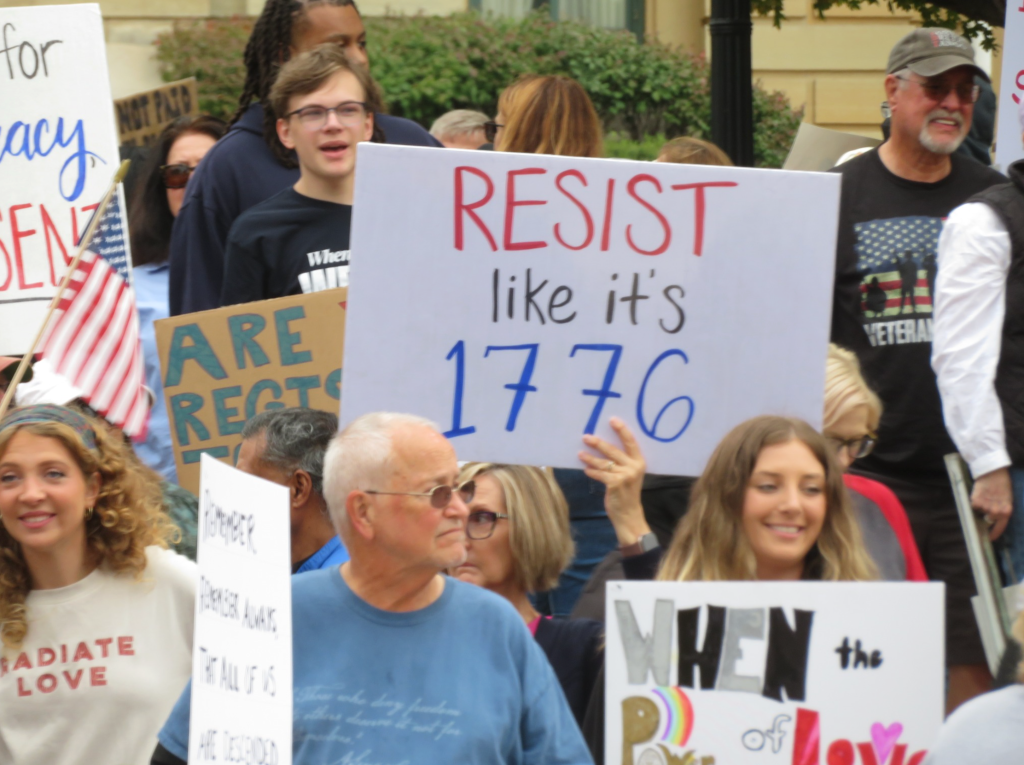
When the Trump regime first announced it would send “military troops” (whatever they meant by that) to Chicago, the reaction from Capitol Fax readers in Illinois was immediate and withering. Subscribers to the state government newsletter include lawmakers, state agency officials and seasoned political operatives; and commenters to the companion blog are allowed to use internet handles to protect their identity — and with it, their agencies and employers. The upshot: CapFax comments are unusually knowledgeable and well moderated, and, as a longtime reader, I think they may be taken as broadly representative of opinion around the Illinois Statehouse and City Hall in Chicago,
So it’s worthy of notice that when CapFax first reported the US Homeland Security Department’s request for troops, announced by Gov. JB Pritzker, the first three comments out of the box were:
- Candy Dogood – Monday, Sep 29, 25 @ 3:26 pm: I believe we call this “pulling a King George.”
- ArchPundit – Monday, Sep 29, 25 @ 3:30 pm: While a horrible idea (posse comitatus and all) the soldiers are likely more disciplined than the gang of ne’er do wells in the worst policing agency in the federal government [the US Border Patrol]. It could decrease the level of conflict.
- DuPage Saint – Monday, Sep 29, 25 @ 3:31 pm: Maybe Trump will quarter all the troops in private residences. He might as well [violate] every clause of the Bill of Rights.
Points well taken, especially the bits about DHS and quartering troops. But I don’t think it’s entirely fair to compare King George III to Trump. He didn’t go crazy until later, and the colonists’ beef was with with the King in Parliament. Neither king nor parliament was a model of good governance at the time, but, unlike Trump, George III was a constitutional monarch.
The distinction is important. There are kings, and there are tyrants. They’re not always the same breed of cat. Not all kings are tyrants, and not all tyrants are kings. We’ll get back to that point in a minute. For now, it’s enough to remind ourselves a constitutional monarch is bound by the rule of law.
I can’t pretend to be an expert on comparative government, but I have met an actual living, breathing — and shmoozing — king. He was King Olav V of Norway, and I thought he was a nice guy. It happened like this. One summer during grad school, I studied at an international institute affiliated with the University of Oslo. And we had an audience, or reception, at the royal summer residence.
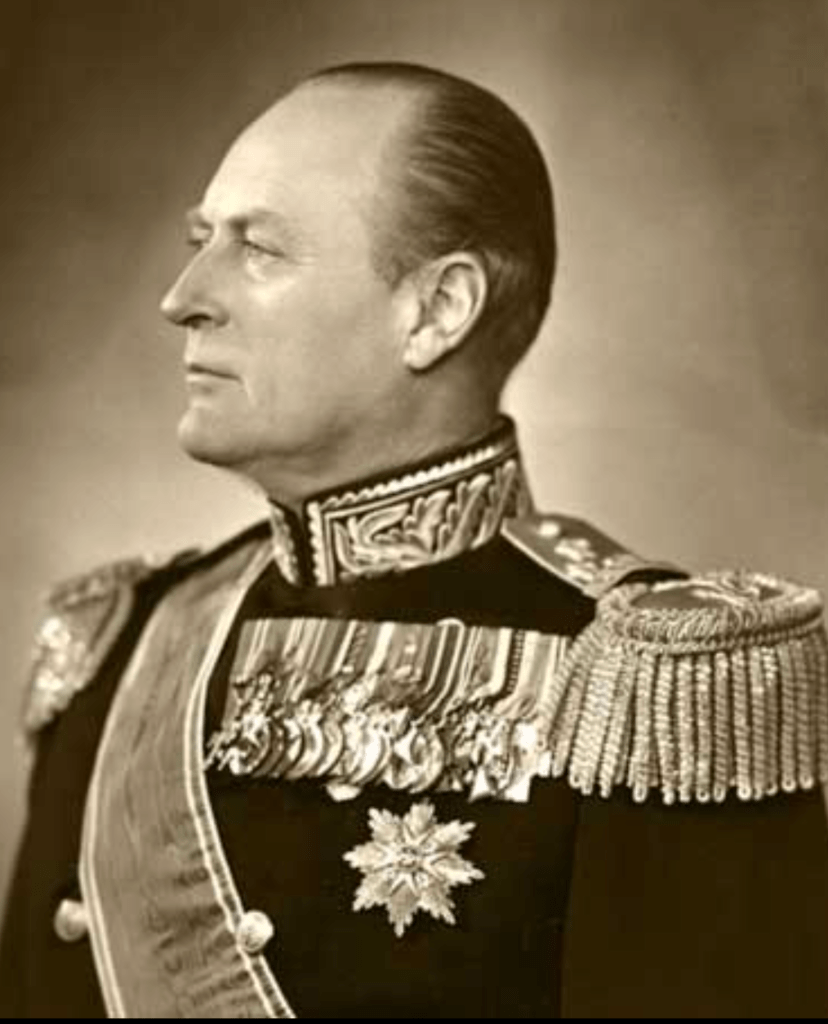
It was like a reception line. When our turn came, each of us shook hands with King Olav and spoke briefly before moving on. He asked me where I was from; Tennessee, I replied; and we chatted amiably about his visit to a TVA hydroelectric power station.
After my turn was up, I stepped aside a few feet and observed the king in action, fascinated. We drew students at the International Summer School, literally, from all around the world. I was close enough to eavesdrop (I don’t remember any security whatsoever), and he was jovial, able to find something in common to share with each of the students.
I don’t remember what any of them said, but I do recall thinking this guy was a natural politician and it was too bad he couldn’t put his skills to use running for an elected office.
Of course, I realize now King Olav of Norway needed each and every one of his political skills to rule as a constitutional monarch. You wouldn’t see a guy like him tearing down one-third of the royal palace on a whim. Nor, I imagine, would he have lost the rebellious American colonies if history had placed him on the English throne instead of King George III in the 1770s.
George III certainly had his failings. But, contrary to what we learned in school, he was a constitutional monarch. Military historian Rick Atkinson, writing in The Atlantic, offers this critique:
A few guiding precepts shaped his reign. The monarch must shun Roman Catholicism and preserve the British constitution, enshrined in documents such as the Magna Carta and the Bill of Rights of 1689. His powers were far broader than those wielded by a British monarch today. But he could not rule by royal caprice; rather, he needed cooperation from his ministers and majorities in both houses of Parliament, restrictions that he embraced as a proper restraint on despotism. Not once would he exercise his right to veto a parliamentary bill, even those he opposed. He believed that maritime power and colonial policy should promote commerce, the bedrock of national prosperity. “I am born for the happiness or misery of a great nation,” he declared, “and consequently must often act contrary to my passions.”
That means by today’s standards, George III was bound by the rule of law. In Anglo-American jurisprudence, it dates back to Magna Carta in 1215, and the last Stuart king to flirt with divine right monarchy was deposed in the 1680s. But George was stubborn, and some historians think he may have suffered from bipolar disorder later in life. At any rate, he refused to compromise with American colonials who argued they were denied the Rights of Englishmen or bill of rights issued in 1689. A tyrant, they called him.
But I still don’t think the poor guy deserves to be compared to Donald Trump. In a word, I think King George gets a bum rap.
Granted, our Declaration of Independence, in addition to its soaring language about the truths we hold self-evident, contains a list of grievances: “The history of the present King of Great Britain is a history of repeated injuries and usurpations, all having in direct object the establishment of an absolute Tyranny over these States.” Prominent among them:
- He has erected a multitude of New Offices, and sent hither swarms of Officers to harrass our people, and eat out their substance.
- He has kept among us, in times of peace, Standing Armies without the Consent of our legislatures.
- He has affected to render the Military independent of and superior to the Civil power.
Nearly 250 years later in 2025, several of these have a decidedly contemporary ring. ICE and the US Border Patrol may not be “New Offices” or “Standing Armies,” but Trump has sent “swarms of Officers,” without the consent of state governments, “to harrass our people” in Los Angeles and Chicago. And the US Marine Corps was deployed, however briefly, to LA.
[LATER, Nov. 14. That’s as far as I got in my journaling before events caught up with me. Now that I have time to get back to it, some things have changed. National Guard deployment is blocked — for now, at least — by federal court order. In the meantime, ICE and the Border Patrol seem to be reinvented as a paramilitary organization, with an increase in the kind of undisciplined, sometimes brutal Border Patrol tactics alluded to by a CapFax commenter back in September.]
More troubling, there are whiffs of something in the Trump regime that goes way beyond King George’s brand of 18th-century tyranny. Especially during “Operation Midway Blitz” in Chicago, there have been distinct echoes of 20th-century blood-and-soil Central European ethnonationalism in the Department of Homeland Security’s crackdown on immigration.
We saw one when Trump tried to call out the troops in September. In a social media post, he referenced the movie Apocalypse Now and said: “I love the smell of deportations in the morning […] Chicago [is] about to find out why it’s called the Department of WAR.” He may have been telling the truth when he later claimed he didn’t mean it. There was a definite comic opera vibe to his social media post, as there is to his entire rebranding of the Defense Department. But he got his intended message across.
As Illinois Gov. JB Pritzker said, “This is not a joke. This is not normal.” Since then, the federal courts have balked at setting the Guard loose on city streets — at least till the Supreme Court rules on the issue — but DHS is acting more and more like a paramilitary force. And its operation in Chicago is still named after the blitz.
If I were choosing a name for a legitimate law enforcement operation, I have to wonder: Wouldn’t it be more appropriate to name it after Eliot Ness, for example, instead of a Nazi military tactic? “Midway Blitz” could refer to the Blitzkrieg, the “lightning war” of 1939 and 1940 that saw Poland, Belgium and France overrun by German armored divisions, or to “the Blitz,” the terror bombing of London, Coventry and other British cities in 1940.
Either way, it’s not a good look.
Anyway, you’d think an outfit as concerned with public relations and optics as Trump’s DHS would find a less evocative name. Unless, of course, they intended to intimidate people. At the beginning of November, Chicago’s public radio station WBEZ said of the agency’s visual media:
Military imagery projects government strength in the face of Chicago’s dangers. Hyperbolic language describes unremarkable protests. Strong leaders like Gregory Bovino, commander-at-large of the U.S. Border Patrol, are propped up as the face of the campaign. Memes and references to pop culture tap into a younger audience. And social media influencers are deputized to spread the message.
This all coincides with a campaign to recruit more immigration agents that appeals to American nostalgia and patriotism while vilifying immigrants. One U.S. Department of Homeland Security ad with shadowy figures holding swords in a cloud of fog calls on Americans to “defend your hearth and home” because “the enemies are at the gates.” Another features a Coca-Cola bottle on a classic red Ford Bronco and says “America is worth fighting for.” [Links in the original.]
Something about all the hype and frippery makes me think of Gilbert and Sullivan, the same way that SecDef Pete Hegseth (I refuse to call him the secretary of war) reminds me of “I Am the Very Model of a Modern Major-General,” seen here in live performance by the English National Opera of London and Manchester. But for all the comic opera overtones, I’m afraid something more sinister may be at work here.
Back in April, historian Timothy Snyder warned that the regime was flirting with “incipient state terror” by demonizing undocumented immigrants as violent criminals, implying that “whatever the government does is good, because by definition the its victims are the ‘criminals’ and the terrorists’.” Snyder, who has written extensively of fascist and Stalinist terror during the 1930s and 40s, sees some of the same tendencies emerging now in the US.
He was particularly alarmed by the denial of due process to Kilmar Abrego Garcia, who was unlawfully deported in March, returned to the US under court order and whose case is still being litigated. “We can react by seeing all of this for what it is, and naming it by name: incipient state terror. We can react by associating ourselves with others are repressed before we are. Only in solidarity do we affirm law.” In terms that seem especially prophetic now, Snyder added:
If citizens endorse the idea that people named by authorities as “criminals” or “terrorists” have no right to due process, then they are accepting that they themselves have no right to due process. It is due process, and due process alone, that allows you to demonstrate that you are a citizen. Without it, the masked men in the black vans can simply claim that you are a foreign terrorist and disappear you.
When Snyder wrote of “incipient state terror” in mid-April, ICE and Border Patrol agents had only recently begun to wear masks, according to Nick Miroff of The Atlantic; by now, the practice is nearly ubiquitous. The feds say it’s a safety measure, to prevent doxxing, but it comes at a cost. “It’s a look that has long been associated with authoritarian regimes and secret police,” says Miroff, “and the basic visual signifiers of American law enforcement—criminals wear masks; cops show their faces—were suddenly inverted.”
Which leads me back to King George III. He sent British regular army troops to Boston in 1774, and fighting broke out the next year. But the “Regulars,” as they were known (by Paul Revere and others) wore red coats and marched in regular order. Their presence in Boston led directly to the Revolutionary War, when they marched out to nearby Lexington and Concord in April 1775 and tried to seize a colonial militia arsenal.
Whatever else you can say about them, and the colonists said plenty, the redcoats were not secret police. And King George III was nothing like Donald Trump.
Sometimes I can’t help but wonder how George III would react if somehow he were able to meet Trump, or to learn he’s been compared to Trump. Judging from what I know about the British royal family today, I suspect he’d suck it up and lay on all the gilt-edged pomp, circumstance and flattery that so delighted our Donald when he visited Windsor Castle in September.
After all, George III wasn’t a wannabe but a real king, and monarchs — like he said — are “born for the happiness or misery of a great nation, and consequently must often act contrary to [their] passions.” Our wannabe King Donald could learn a thing or two from him.
Works Cited
Rick Atkinson, “The Myth of Mad King George,” The Atlantic, Nov. 2025 https://www.theatlantic.com/magazine/archive/2025/11/king-george-iii-british-monarchy-american-revolution/684309/.
Sean Coughlan, “Trump’s coming to Britain. He’ll get a spectacular royal welcome but no cheering crowds,” BBC, Sept. 14, 2025 https://www.bbc.com/news/articles/cq5jgdvnll4o.
Declaration of Independence: A Transcription, America’s Founding Documents, National Archive https://www.archives.gov/founding-docs/declaration-transcript.
Nader Issa, “Watch how government propaganda techniques portray Chicago as a city at war with the feds,” WBEZ, Nov. 6, 2025 https://www.wbez.org/immigration/2025/11/06/watch-how-government-propaganda-techniques-portray-chicago-as-a-city-at-war-with-the-feds.
Juliana Kim, Alana Wise and Kat Lonsdorf , “Trump threatens ‘Apocalypse Now’-style action against Chicago to boost deportations,” National Public Radio, Sept. 6, 2025
https://www.npr.org/2025/09/06/nx-s1-5532148/national-guard-chicago-baltimore-new-orleans.
William Kristol, “No Kings,” The Bulwark, Oct. 6, 2025 https://www.thebulwark.com/p/the-rule-of-law-v-the-rule-of-trump-portland-national-guard-california-texas-shutdown-no-kings.
Kat Lonsdorf and A Martínez, “Trump dials back threats to Chicago, but says he still plans to send National Guard,” National Public Radio, Sept. 8, 2025 https://www.npr.org/2025/09/08/nx-s1-5533123/trump-dials-back-threats-to-chicago-but-says-he-still-plans-to-send-national-guard.
Nick Miroff, “Why They Mask,” The Atlantic, Nov. 10, 2025 https://www.theatlantic.com/politics/2025/11/ice-immigration-masks/684868/.
“Pritzker: DHS wants 100 “military troops” sent to Illinois,” by Rich Miller. Capitol Fax, Sept. 29, 2025 https://capitolfax.com/2025/09/29/pritzker-dhs-wants-100-military-troops-sent-to-illinois/#comment-13803969.
Timothy Snyder, “How ‘War’ Becomes War,” Thinking About …, Substack, Nov. 4, 2025 https://snyder.substack.com/p/how-war-becomes-war.
__________, “State Terror,” Thinking About …, Substack, April 15, 2025 https://snyder.substack.com/p/state-terror.
[Uplinked Nov. 16, 2025]

 Ordinary Time
