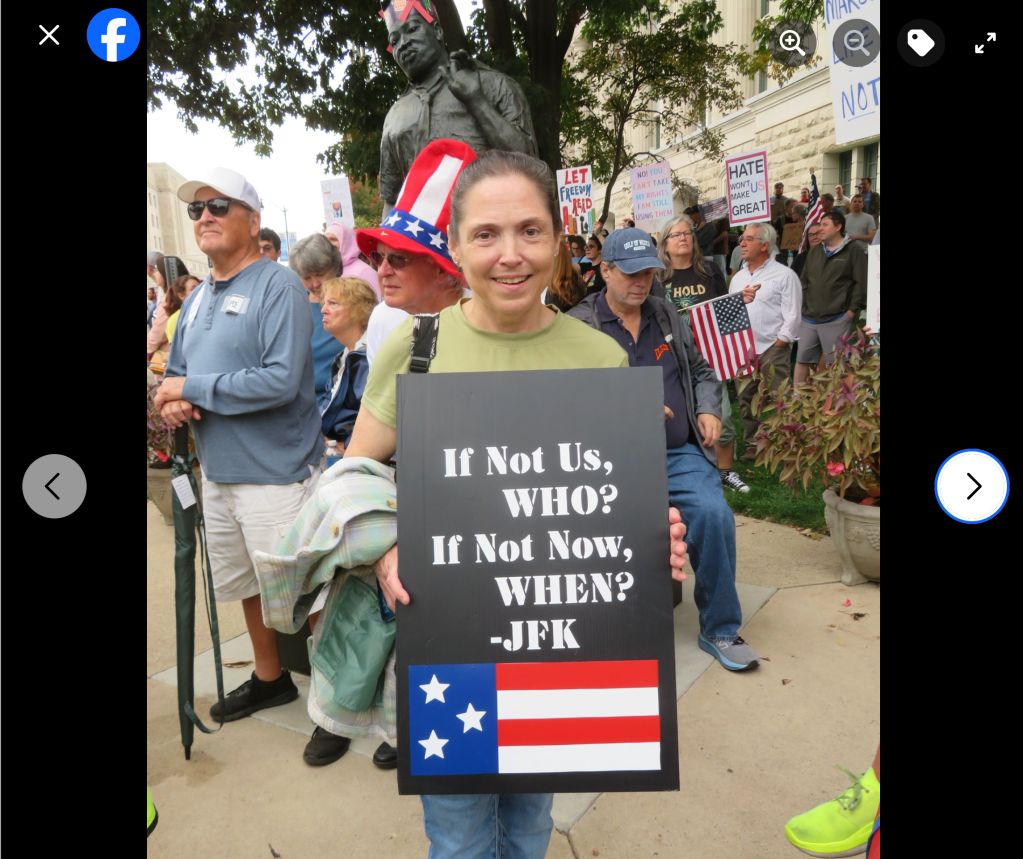
In the past 65 years, I have probably joined, watched and/or covered literally hundreds of rallies, lobby days, demonstrations, political speeches, festivals, street fairs and other outdoor events. Saturday’s No Kings rally in front of the Illinois State Capitol was one by far of the most remarkable. Billed as a rally, it combined the serious yet laid-back, even humorous, vibes of a demonstration and a street fair.
I think — I hope — Springfield’s rally, and others like it nationwide will be the beginning of a mass movement that restores American small-d democracy.
Estimates of the crowd ranged from 1,000 to 4,200. My rule of thumb as a longtime newspaper reporter is to split the difference between police and organizers’ crowd counts, and I would estimate a crowd of 2,000 to 3,000 around 1 p.m. when I was there. It was certainly bigger than other rallies I’ve seen at the Statehouse.
Karen Ackerman Witter wrote in Illinois Times, our weekly “alternative” paper:
People of all ages were present. The crowd filled the area around the Lincoln statue on the Capitol grounds, extended across Second Street by the Illinois State Library and State Supreme Court building and all along both sides of Second Street. Some who had attended the June [No Kings] rally noted that the current crowd was twice as large. Others were attending a protest for the first time.
Attached to Witter’s article were pictures featuring hand-lettered signs including: “No Kings Since 1776”; “When the power of love overcomes the love of power”; “Say, Don. I hear you like ’em young. Release the Files”; “Impeach / Convict / Remove”; “ICE = Gestapo,”; “Dump Trump”; “[commit an unnatural sexual act with] ICE / Chinga la Migra”; “Trump is a fascist pig”; “Zip ties are not for children”; “Authority is brittle / Oppression is the mask of fear”; “In America we should not have to proect democracy from the President”; and “I help my neighbors & I think my GOV’T should too.”
Some others we noticed: “Silence never WON RIGHTS,” printed by ACLU Illinois; hand-lettered signs including, “I need to be able to tell my grandchildren I did not stay silent”; and “I want the America my grandparents had — not Trump’s.” And my favorite: “Too Many Issues for One Sign!” Occasionally a counter-protester would drive by in a big shiny pickup truck flying a great big “Trump 2024” flag, but the whole atmosphere was peaceful.
One sign that caught my eye quoted a maxim attributed to President Kennedy (based on an often-quoted passage in Jewish sacred writing). Standing by a statue of the Rev. Dr. Martin Luther King on the State Library grounds across the street from the Statehouse, was a woman bearing a placard:
If not us, WHO? / If not now, WHEN? / JFK.
The sentiment is much older than JFK. According to Google AI, it originates with the first-century Talmudic scholar Rabbi Hillel the Elder. It has been used by US Rep. John Lewis, R-Ga., President Barack Obama and the American Jewish organization IfNotNow, “which advocates for an end to the Israeli occupation of the West Bank.” Adds Google AI:
Although often attributed to John F. Kennedy, the phrase “If not us, who? If not now, when?” traces back to Rabbi Hillel the Elder, a Jewish leader and scholar who lived in the first century BCE. A central text of Judaism, it is translated as “If I am not for myself, who will be for me? And if I am only for myself, what am I? And if not now, when?”.
As Hillel framed it, the quote is one of my favorite scripture passages in anyone’s faith tradition. There’s a lot to unpack in just a few words, and there’s a twist to it — a paradox — that keeps me thinking. I’m not usually a big fan of AI, which tends to be a compliation of conventional thinking, but I like Google AI’s explanation, which goes like this:
The saying is a teaching on responsibility, a hierarchy of actions that balances self-care and community commitment, and the importance of taking immediate action.
- “If I am not for myself, who will be for me?”: This first question addresses the necessity of self-respect and self-care, suggesting that you must first be invested in your own well-being to have anything to offer others.
- “If I am only for myself, what am I?”: The second part introduces a paradox, warning against excessive selfishness and highlighting that true identity is found in a connection to others and the community.
- “And if not now, when?”: This concluding phrase is a call to action, urging immediate action rather than procrastination on important tasks or goals.
This teaching is found in the Pirkei Avot (Ethics of the Fathers) and is meant to encourage a balance between looking after oneself and fulfilling one’s responsibility to the community. [Link and parentheses in the original.]
The combination of moral clarity, precision and paradox here reminds me of what the Historical Jesus scholar John Dominic Crossan says about another first-century rabbi — “if an audience filed past him afterward saying, ‘Lovely parable, this morning, Rabbi,’ Jesus would have failed utterly.” Being a rabbi, or a preacher, must be like teaching in that regard. You want to leave ’em with something to think about
According to Stephen Spearie, who wrote up the rally Saturday night for Springfield’s State Journal-Register, the Secretary of State’s police estimated the crowd at 1,000; the organizers, a local group calling itself Undivided & Focused – 50501 Refined, said “drone software put the crowd at 4,200.” Steve added:
In central Illinois, protests were scheduled in Carlinville, Bloomington, Effingham, Decatur, Gibson City, Galesburg, Urbana and Charleston, among other places. A Quincy rally was scheduled at the office of U.S. Rep. Mary Miller, R-Oakland, a supporter of President Donald Trump.
Springfield’s rally was one of 2,700 nationwide. Bill Kristol, a longtime Republican operative and neoconservative who left the party after it was taken over by Trump, attended a similar event in McLean, Va., an upscale suburb where many residents work for the nearby Central Intelligence Agency or federal agencies across the river in Washington. His reaction was similar to mine in Springfield. Said Kristol:
You might think that I’m too old and too experienced—dare one say, too jaundiced—to have been moved by the “No Kings” protests. To be honest, I rather doubted I’d really be moved by them.
But moved I was. And as we milled around in the party atmosphere in “downtown” McLean—with inflatable characters prancing and witty signs waving and drivers’ horns honking—I thought of these lines from Lewis Carroll’s nonsense poem, “Jabberwocky,” in Through the Looking Glass:
“O frabjous day! Callooh! Callay!”
He chortled in his joy.
But there was a serious, almost solemn note to it all. Very much like the mixture I noticed outside the Illinois Statehouse of enthusiasm, snark, patriotism and sober recognition that American values are under attack. Kristol put it like this:
On Saturday, the American people assembled lawfully on behalf of the rule of law. On Saturday, the American people demonstrated their commitment to keeping this a free country. [US House Speaker] Mike Johnson and all his fellow pro-Kings propagandists hoped for violence, extremism, and evidence of hate for America. But instead they saw peace, patriotism, and loyalty to America.
It was a frabjous day.
It was also an appropriately sober one. Those with whom I spoke on Saturday know there’s a long struggle ahead against the sustained attack on our freedom by those in charge. They understand that defeating this assault won’t be easy. So Saturday featured an unusual and impressive combination of joy and sobriety.
However, Kristol sounded a darker note when he suggested the possibility that Trump will call out regular troops by invoking the Insurrection Act of 1807 is even more likely in the wake of Saturday’s rallies:
It all seems to have made Donald Trump very unhappy. I won’t dwell on the bizarre AI-generated video with a crown-wearing Trump flying over and dumping excrement on Americans. Nor will I speculate, as a friend suggested to me, whether this was a “textbook example of disinhibition—a key symptom of dementia” on Trump’s part.
But I will note that Trump does seem bothered by the obvious success of No Kings Day. His response was to lash out and double down on authoritarianism. In a Sunday morning interview with Fox News’s Maria Bartiromo, Trump asserted, “Don’t forget I can use the Insurrection Act. And that’s unquestioned power.” And late that afternoon, in a press gaggle on Air Force One, after claiming the No Kings protests were “very small, very ineffective,” he returned to his favorite thought: “I’m allowed as you know as president [to use] the Insurrection Act. Everybody agrees you’re allowed to use that and there are no more court cases, there is no more anything. We’re trying to do it in a nicer manner, but we can always use the Insurrection Act.”
There was almost a wistful tone in Kristol’s account of the rally in McLean. A veteran of the Reagan and George HW Bush administrations, he was the founding editor of the Weekly Standard, a leading neoconservative magazine, and played an influential role in GOP politics for 20 years.
But the Weekly Standard strenuously opposed Trump; the magazine lost readers; and, in 2018, it ceased publication. Kristol helped finance and soon affiliated with The Bulwark, a website founded by key Standard staffers who continued his neocon, Never Trumper editorial policy. Most of them left the GOP and now consider themselves political independents.
Maybe I’m projecting a little, but at times I sense an elegiac tone in Bulwark podcasts, a nostalgia for the days before the presenters were forced out of their party. I feel something like it, too. I’m a fairly reliable Democrat, but I spent too many years covering legislative bodies — city councils, county commissions or boards, local delegations to the legislatures in Tennessee and Illinois — to have much respect for partisan ideologues.
I learned quickly the real work of legislation is done by people who could give a rousing political speech, then cross the aisle to do the hard work of negotiating a bill that would pass both houses. I also learned there were more than two sides to an issue — in Illinois, there were 117 in the House and 59 in the Senate, because the members voted the best interest of their districts.
But those days are gone now. (Although, to be fair, the Illinois legislature has functioned well enough in the last six years or so. For several years, it was as dysfunctional as Congress; it’s coming back now, but the Republicans tend to elect extremists.) Even if the national Democrats rise to the occasion in the 2016 and 2029 election cycles, it will take literally a nonviolent movement of millions of people in the streets petitioning their — our — government to overcome the armed might of Trump, ICE, the Border Patrol and the institutional racism underlying their drift toward autocracy.
So, even as a Democrat, I feel the same sense of urgency as the Bulwark’s ex-Republican writers, executives and podcasters. In my day, I admired the legislative process and I share their sense of loss and sadness.
One who fits the mold is Andrew Egger, the Bulwark’s White House correspondent. A graduate of conservative Hillsdale College in Michigan who wrote for the Weekly Standard and The Dispatch, another center-right online publication launched after the Standard went belly-up, he also wrote a Bulwark column on No Kings day:
So “No Kings” 2 has come and gone. It was a joyous—er, frabjous—day, as Bill notes. It was a peaceful day, with millions of people in the streets and no significant outbreaks of violence. It was a patriotic day, giving the lie to ridiculous MAGA rhetoric about crowds chock-full of America-hating terrorists.
Egger sounded even more of an elegiac note than Kristol did:
Even amid the joy of the marches, the grim sense of how much we’ve already lost was hard to miss on Saturday. Popping in on smaller protests across northern Virginia, I talked to multiple federal workers who were nervous about appearing on camera, fearing they’d be fired if it got out that they’d come. Ten months—that’s how long it’s taken Donald Trump to rewrite the rulebook to make American citizens fear state retribution for First Amendment–protected political expression.
And yet, there they were, protesting anyway.
Egger and Bill Kristol alike spoke of the “difficulty of the road ahead” and predicted that “Donald Trump remains a president hell-bent on maximizing his own personal power.” And that’s with or without the Insurrection Act. But 7 million people in the streets, even on a crisp autumn Saturday, is a lot ot people. “MAGA is an organized mass movement, but it is far from a majoritarian movement,” said Egger. “An organized resistance, if it can get organized, could dwarf Trump’s cult in sheer size.” Egger concluded:
[Trump’s] troops are in the streets. His immigration dragnets are scooping up citizens and migrants alike. He seems perfectly unconcerned about carrying on without congressional funding for anything in government—he’s just keeping the money spigots he cares most about turned on anyway. Every day he krazy-glues more bric-à-brac to the wall of the Oval Office and sticks another rhinestone in his crown.
We’re in this for the long haul, so buckle up. “No Kings” showed you aren’t resisting alone.
In other words — JFK’s and Hillel’s, especially — we’re all in this together. If not us, WHO? The Democrats in Congress aren’t going to come riding over the hill, like John Wayne and the cavalry in an old-fashioned western movie, to save us. No one is going to come riding up on a white horse to lead us, and, frankly, if someone did I wouldn’t trust them.
We’re all in this mess together; we’ve got to make common cause. If I am only for myself, what am I? Let me repeat: We’re in it together. Ex-Republican Never Trumpers. Disappointed left-of-center, work-both-sides-of-the-aisle Democrats like me. If we can put aside our policy differences long enough to restore a functioning legislative process, we can elect legislators who are willing to work across the aisle again. That’s how we got Illinois out of our governmental impasse in 2018. I’m betting we can do it again.
But we’ve got to do it now. If not now, WHEN? There’s a paradox here, too. Trump’s ICE and Border Patrol agents are in the streets now. He’s cowed the GOP majorities in the US House and Senate into submission and rendered the Democratic leadership impotent. He’s bent the communications media, including but not limited to Mark Zuckerberg’s and Elon Musk’s, to his will. The same with some, but not all, powerful white-shoe law firms and legacy universities. But that lends urgency to action. It demands action. It raises what the Rev. Dr. Martin Luther King Jr. called “the fierce urgency of now.”
Ordinary people are also voters, customers, clients, investors and audiences. In their numbers — our numbers — ordinary people have demonstrated how to use their political and economic clout — our clout — to get a comedian back on the air, and that’s just one example. Here’s another. An estimated 7 million of them — of us — turned out for No Kings rallies Saturday. Like Andrew Egger said, we’re in it for the long haul. We’d better buckle up.
Works Cited
Andrew Egger, “A Shot in the Arm,” The Bulwark, Oct. 20, 2025 https://www.thebulwark.com/p/long-live-no-kings-mass-protests-lewis-carroll-jabberwocky-frabjous-resistance
Bill Kristol, “O Frabjous Day!” The Bulwark, Oct. 2025 https://www.thebulwark.com/p/long-live-no-kings-mass-protests-lewis-carroll-jabberwocky-frabjous-resistance
__________, “Trump Hates America,” with Tim Miller, The Bulwark Podcast , Oct. 20, 2025 https://www.thebulwark.com/p/bill-kristol-trump-hates-america
Steven Spearie, “In gathering at ‘No Kings’ rally in Springfield, ‘we have to make a stand’,” State Journal-Register, Oct. 18, 2025 https://www.sj-r.com/story/news/local/2025/10/18/we-need-unity-1000-protesters-take-part-in-springfield-no-kings-rally/86773833007/.
Karen Ackerman Witter, “This is what democracy looks like,” Illinois Times, Oct. 19, 2025 https://www.illinoistimes.com/news/this-is-what-democracy-looks-like/
[Uplinked Oct. 23, 2025]

 Ordinary Time