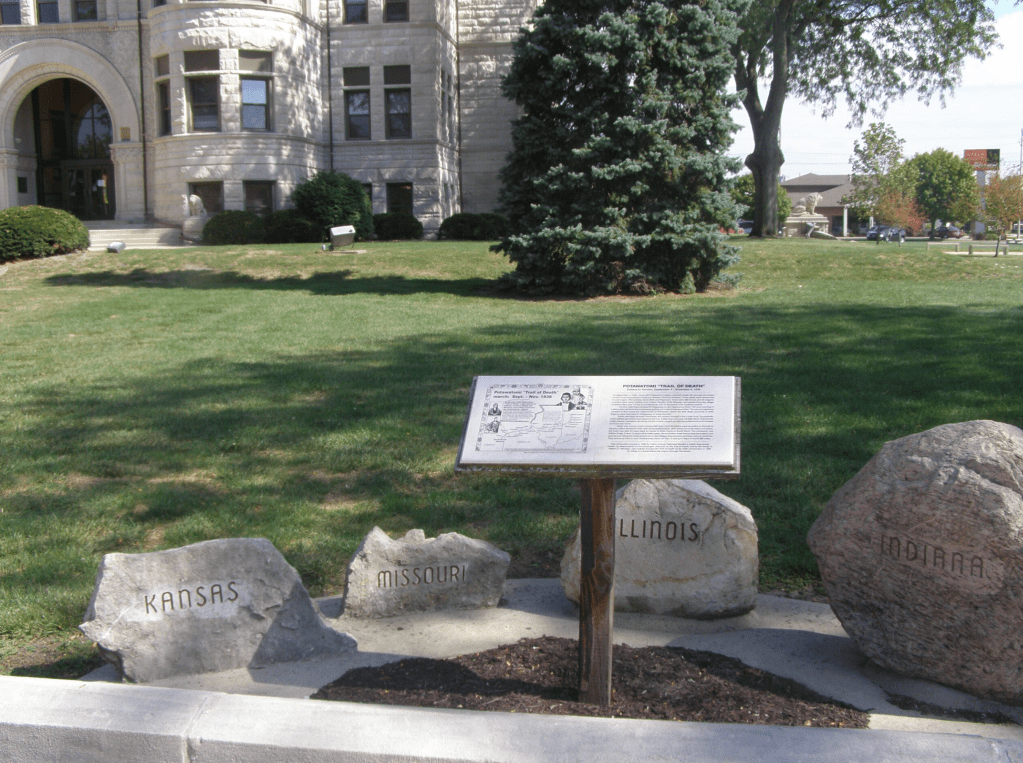
In September and October 1838, a band of Potawatomi Indians from northern Indiana crossed central Illinois under an armed guard of Indiana state militia. Their forced removal was known as the Potawatomi Trail of Death, and it was part of the Indian removal policy under Presidents Andrew Jackson and Martin Van Buren. I’ve been looking into it in the last few days, and I am amazed by the amount of primary source material I’m finding online — I think I’ve found enough to work up a proposal for next year’s Illinois History Conference at the Abraham Lincoln Presidential Library and Museum. Hence this post.
Some of those primary sources are linked below, along with extended quotation from passages specifically relating to the Potawatomi people’s passage through Springfield and Jacksonville at the end of September and beginning of October. While I still had the windows open, I decided to gather the information in an online format where I can find it again with a simple keyword search.
(For notes on how I use my blogs as a kind of electronic filing cabinet to save research notes and the “scraps of paper, half-completed outlines, photocopied articles, printouts of old stories downloaded from newspaper websites and other ephemera” that clutter my office space, see the explanation on a blog called Hogfiddle I used to maintain. I also used this blog for a class in Native American cultural studies I taught from 2006 to 2010.)
Wikipedia has this at https://en.wikipedia.org/wiki/Potawatomi_Trail_of_Death:
Although the Potawatomi had ceded most of their lands in Indiana to the federal government under a series of treaties made between 1818 and 1832, Chief Menominee refused to sign the Treaty of Yellow River (1836) that would have relinquished the reserve granted to him in the Treaty of Tippecanoe (1832). When the US demanded that Menominee and his band at Twin Lakes leave their reserve, they refused. Indiana governor David Wallace authorized General John Tipton to mobilize a local militia of one hundred volunteers to forcibly remove the Potawatomi from the state. On August 30, 1838, Tipton’s militia tricked the Potawatomi into meeting at their chapel at Twin Lakes, where they surrounded them. Shots were fired, then the militia gathered the remaining Potawatomi from other villages as far away as Shipshewana, Indiana for forced removal to Kansas. Father Benjamin Marie Petit, a Catholic missionary at Twin Lakes, joined his parishioners on their difficult journey from Indiana, across Illinois and Missouri, into Kansas. There the Potawatomi were placed under the supervision of the local Indian agent (Jesuit) father Christian Hoecken at Saint Mary’s Sugar Creek Mission, the true endpoint of the march. [Links to other Wikipedia pages in original.]
My main takeaways from the primary source material I found:
- There’s much more usable source material than I’d expected (kudos to the Indiana historical society and IU-Bloomington for putting so much on line). Although it focuses on Indiana Potawatomi, I think there’s enough to put together a readable narrative of the band’s passage from Danville through Decatur, Springfield and Jacksonville to Quincy (roughly the route of I-72); I’m planning to work up a proposal for next year’s Illinois History Conference at the Lincoln Museum and Archives.
- Conditions along the march were brutal. Of the 859 people who began the march, an estimated 40, most of them children, died enroute. Quite a few died of malaria or typhoid fever apparently brought on by drinking muddy water. The march took place in late summer during a drought year. In many ways it was similar to the Trail of Tears or ethnic cleansing of the Cherokee, Creek (Muskogee), Choctaw, Chickasaw and Seminole people in the 1830s, and grew out of the same US government policy.
- Many of the Potawatami people on the march were parishioners of Fr. Benjamin Marie Petit, a French missionary who wrote lengthy, and illuminating, letters to his family and/or superiors in eastern Illinois and Quincy, where the Potawatami party attended Mass and rested for several days. He’s especially good on land negotiations with the authorities in Indiana, details of the march when he arrived at Danville and the religious life of his parishioners. By his telling, which seems entirely sincere, they were devout Catholics. I’m very much reminded of the Cherokee stories of the Trail of Tears; many of the Cherokee were good Baptists, and in both cases, the people who were ethnically cleansed included a significant number of Christians.
- Racial, nativist and religious attitudes reflected a complex relality in the early 19th century that I need more time — and secondary historical analysis — to unpack. Many of the Potawatami people in Indiana and southern Michigan had been converted to Catholicism during the previous century. Ironically enough, when their descendants were marched through the lower Midwest in the 1830s, nativist and negative attitudes against Catholics and Natives tended to reinforce each other at times, and contradict each other at others. I don’t think there’s enough evidence in the material on the Trail of Death to parse these attitudes with any precision, but they’re reflected in what we do have.
So I’ll leave it till later to see if I can sort this stuff out; in the meantime, here are a couple of preliminary observations:
Anti-Catholicism was very much a thing in the 1830s, although it peaked later in the century as Irish immigration increased. In 1834 an Ursuline convent in Boston was burned to the ground by a Protestant mob, and both anti-Catholic feeling and nativist, or anti-immigrant, prejudice ran high during the period; it was amply reciprocated by the French-speaking Catholics in Fr Petit’s congregation. Putting its own spin on things, as far as the Catholics among the Potawatomi diaspora were concerned, was the general attitude toward American Indians.
Even so, the sources suggest a complicated mixture of sometimes conflicting attitudes. Many whites, especially in Indiana and more cosmopolitan towns like Quincy and Jacksonville (influenced by abolitionists from New England) were sympathetic. Fr. Petit’s letters are especially revealing, showing a depth of love for his Native parishioners along with what he perceived as a lack of civilization. (I think he perceived a lack of civilization among his American Protestant interlocuitors, too, and there’s a fun passage about two French travelers who stayed overnight with the party north of St. Louis!)
Some of the 19th- and early 20th-century sources from Indiana, which include testimony from old settlers who remembered the removal, show a mixture of attitudes ranging from contempt to open sympathy. A very sympathetic account in the Terre Haute Courier, copied below in the excerpt from Jacob Piatt Dunn, True Indian Stories (1909), is especially sympathetic. (Dunn, BTW, is credited with coining the term “Trail of Death”):

Also, a very strange, very evocative item linked to the diary of Jesse C. Douglas (edited by Shirley Willard) in the Sangamo Journal dated Sept. 29, 1838, that quotes John Ridge (Yellow Bird), a leader of the Cherokee people who authorized the land cession in Georgia that led to removal and was later killed in Oklahoma. Says Wikipedia:
“In 1839, after removal to Indian Territory, opponents assassinated the Ridges, Boudinot, and other Treaty Party members for their roles in the land cession. This eliminated them as political rivals in the new territory. Stand Watie survived such an attack and later fought on the side of the Confederacy in the U.S. Civil War.” [Links in original.]
Ridge was prophetic in more than one sense of the word. The Sangamo Journal article is copied at right above:
***
Journal of an Emigrating Party of Pottawattomie Indians, 1838,” Indiana Magazine of History. 21 (1925): 315ff [https://scholarworks.iu.edu/journals/index.php/imh/article/view/6368/6454].
Recommended cite from Indiana University libraries: Polke, W. (1925). Journal of an Emigrating Party of Pottawattomie Indians, 1838. Indiana Magazine of History. Retrieved from https://scholarworks.iu.edu/journals/index.php/imh/article/view/6368.
“This journal of the emigration seems to have been written by Polke himself, but no certain proof has been found. It is printed here through the courtesy of the Ft. Wayne Public Library, which possesses the original, and the State Library, at Indianapolis, which has a photostatic copy.” (Polke, “Journal,” 315)
Excerpts from Polke, “Journal,” 324ff
Friday, 28th Sept.
Left Long Point at a little before 8 and crossed the prairies in- tervening. At 2 o’clk. P. 31. we reached the Sangamon (on the banks of which we have encamped for the last five days) after crossing which we pitched our tents. We are now within a few miles of Springfield, which place we shall pass through to-morrow. Judge Polke, the Conductor, on the occasion of passing through a village of the character of Springfield, requested I-o-weh, one of the principal chiefs, so to arrange and accoutre the Indians as to insure a good appearance. The chief wa; delighted with the proposition and no doubt the emigration to-morrow will present quite a gaudy appearance. As an inducement they were promised some tobacco, which they have been much in want of for several days. The day has been very warm, which added to the length of our march, fatigued much the emigrants. The illness of the camp is disappear- ing gradually, and we may safely calculate upon a great diminution in the number of sick at the next report of the physician. Forage and provisions becoming plenty, as we nearer approach the settled portions of the state. Distance travelled to-day Eighteen miles. Two children died during the night.
Saturday, 29th Sept.
In order to pass Springfield at as early an hour as possible, we rose before light, and at 8 o’clock were on our way. The Indians amongst whom a degree of pride was excited, arranged themselves into line, and with an unusual display of finery and gaudy trumpery marched through the streets of Springfield. The wayfares were covered with anxious spectators, so much so indeed as to threaten [325] for a time to impede the progress of the Emigration. We passed clearly through however, and that too without the detention of a single Indian. At 3 we reached our present Encampment, McCoy’s Mills, distant from last night’s camp seventeen miles. This morn- ing, Dr. Jerolaman on account of his continued indisposition, re- quested leave to remain in Springfield a few days to recruit. Per- mission was granted. Our march today was through a very dry region of Country. We are now encamped on a stream affording little water.
Sunday, 30th Sept.
We left McCoy’s Mills at about 9 o’clk. and at 12 reached Island Grove, the place of our Encampment 6 miles distant from the Camp of last night. Our march was made necessarily short on account of the scarcity of water-this being the only watering place nearer than ten or fifteen miles. The death of a child occurred a few hours after our encampment. Health of the sick still improv- ing. Provisions and subsistence good and healthy. The Indians still bring in large quantities of game-sufficient for their subsist- ence-and they greatly prefer such provisions as they acquire by the chase. One of the Dragoons was dismissed last night for in- toxication-Nothing of the kind is permitted.
Monday, 1st October.
Early in the morning we left Island Grove-travelled over a dry prairie Country, seventeen miles, we reached our encampment, near Jacksonville, at 3 o’clock in the afternoon. Nothing occurred during our march save that a child fell from a wagon, and was very much crushed by the wheels running over it. It is thought the child will die. To-night some of the chiefs reported two runaways, who left this morning. During the Evening we were much per- plexed by the curiosity of visitors, to many of whom the sight of an emigration or body of Indians is as great a rarity as a travelling Caravan of wild animals. Late at night the camp was compli- mented by a serenade from the Jacksonville Band. We struck our tents at 8 this morning, and prepared for a march. Owing to the very great curiosity manifested by the citi- zens generally, Judge Polke, after being solicited, marched the emi- gration into the square, where we remained for fifteen or twenty minutes. Presents of tobacco and pipes in abundance were made by the citizens to the Indians, who appeared quite as much delighted with the favor shown them as with the excellent music of the Band which escorted us around the square. We continued our journey, and at 3 o’clock reached our present encampment about sixteen miles from Jacksonville. The day was excessively warm and the dust very afflicting, added to which water was scarcely to be found on the route. Provisions and forage we find in considerable quantities, without difficulty.
***
“The Trail of Death, Letters of Benjamin Marie Petit” by Irving McKee, the Indiana Historical Society, v. 14 (1941), pp. 97–101 https://archive.org/details/trailofdeathlett141peti/page/n13/mode/2up
(Petit 98ff) It was Sunday, September 16. I had only just arrived when a colonel,41 seeking a favorable place to encamp, appeared. Soon afterward I saw my poor Christians, under a burning noonday sun, amidst clouds of dust, marching in a line, surrounded by soldiers who were hurrying their steps. Next came the baggage wagons, in which numerous invalids, children, and women, too weak to walk, were crammed. They encamped half a mile from the town, and in a short while I went among them.
I found the camp just as you saw it, Monseigneur, at Logansport — a scene of desolation, with sick and dying people [99] on all sides. Nearly all the children, weakened by the heat, had fallen into a state of complete languor and depression. I baptized several who were newly born — happy Christians, who with their first step passed from earthly exile to the heavenly sojourn.
The General, to whom I introduced myself, expressed his satisfaction at seeing me, and, with a condescension I did not expect, he arose from his chair, which was the only one there, and offered it to me. That night was the first I passed in a tent.
Early the next morning they heaped the Indians into the baggage wagons, and everybody mounted. At our departure Judge Polke, chief conductor, came to present me with a horse which the government had procured from an Indian for my use along the way. At the same time the Indian approached me and said: “My father, I give it to you, saddled and bridled.”
We departed for the next encampment, where several days’ rest was granted us. On my word the six chiefs42 who had till now been treated as prisoners of war were released and given the same kind of freedom which the rest of the tribe enjoyed.
The order of march43 was as follows: the United States flag, carried by a dragoon; then one of the principal officers, next the staff baggage carts, then the carriage, which during the whole trip was kept for the use of the Indian chiefs ; then one or two chiefs on horseback led a line of 250 or 300 horses ridden by men, women, children in single file, after the manner of savages. On the flanks of the line at equal distance from each other were the dragoons and volunteers, hastening the stragglers, often with severe gestures and bitter words. After this cavalry came a file of forty baggage wagons filled with luggage and Indians. The sick were lying in them, rudely jolted, under a canvas which, far from protecting them from the dust and heat, only deprived them of air, for they were as if buried under this burning canopy — several died thus.[100] We camped only six miles from Danville. There I had for two successive days44 the happiness of celebrating Holy Mass among my good savage children. I administered to several who were dying and baptized a few more infants, and, when we quitted this camp two days later, we left behind six graves in the shadow of the cross. The General dismissed his little army there and himself departed from us45 — he had announced his intention of doing so shortly after my coming.
We soon found ourselves on the grand prairies of Illinois, under a burning sun and without shade from one camp to another. They are as vast as the ocean, and the eye seeks in vain for a tree. Not a drop of water can be found there — it was a veritable torture for our poor sick, some of whom died each day from weakness and fatigue.
Soon we began evening prayers together again, and the Americans, attracted by curiosity, were astonished to find so much piety in the midst of so many trials. Our evening exercises consisted of a chapter of the catechism, prayer, and the hymn,
“In thy protection do we trust, / O Virgin, meek and mild,”
which I intoned in Indian and which was repeated by the whole audience with a vigor which these new Christians bring to all their religious acts.
Often throughout the entire night, around a blazing fire, before a tent in which a solitary candle burned, fifteen or twenty Indians would sing hymns and tell their beads. One of their friends who had died was laid out in the tent; they performed the last religious rites for him in this way. The next morning the grave would be dug; the family, sad but tearless, stayed after the general departure; the priest, attired in his stole, recited prayers, blessed the grave, and cast the first shovelful of earth on the rude coffin; the pit was filled and a [101] ittle cross placed there. The curious inhabitants, for whom everything in the depths of these deserts is a spectacle, moved, despite their prejudices, by these poor yet imposing solemnities of the dead, would end by raising their hats, and the smile of scorn would turn to a sort of grave and religious astonishment.
Sunday mornings, when the lack of good water (more than once our horses refused to drink water which we had left) or some other motive forced us to continue the march, I was granted a two hours’ delay.46 The Indians would attend Holy Sacrifice, during which they astonished the ears of the spectators by singing hymns, some of which — for me at least — had a sweet harmony indeed. I preached briefly on the Gospel of the day, recommended that they tell their beads along the way — then I folded up my chapel, the tents were dismantled, and everybody mounted. Ordinarily we did not travel on Sunday— the Mass was then preceded by the morning prayer and the catechism, followed by the rosary. In the afternoon they would again assemble for the catechism. Vespers were sung in Indian, the rosary followed, then the evening prayer and a short sermon, which once or twice I allowed myself to pronounce without an interpreter — to the great delight of my listeners.
I could not help feeling elated on the way at the attentions of the Catholics. When we camped near a town where some lived, they would come to see me at our encampment, invite me to breakfast before our departure the next day, and indeed do all in their power to show their joy at seeing a priest. A few days’ journey from the Illinois River I was stricken with fever. An old Frenchman came to the camp and made me promise, by the force of his pleading, to take a few days’ rest at his home. The next morning he introduced his wife. He had brought his carriage to take me away, but the fear of again [102] finding myself behind the emigration and the difficulties of rejoining it made me reply with a definite refusal.47 We had hardly arrived at Naples, where we crossed the Illinois, than a Protestant, married to a French Catholic woman from Vincennes, learning that a sick priest was among the emigrants stationed there for two days, came to offer me his house.48 I accepted, and, thanks to the care lavished on me, my fever was cut short.
I took the public stage at Naples and started in advance for Quincy in order to complete my cure by a few days’ rest in that town. There I met a German priest, M. Brickwedde, and a German congregation, who received me with a welcome hard to imagine.49 I was also well greeted by some American Catholics and by several of the town’s richest Protestants, who offered me their hospitality.50
When the Indians arrived at Quincy, the inhabitants, who compared this emigration with previous ones, could not help expressing their surprise at the modesty of our Christians, their calmness, and their general demeanor. A Catholic lady, accompanied by a Protestant friend, made the sign of the cross, symbolizing religious fraternity. Immediately the Indian women came up to shake their hands cordially; the savages never fail to do this when they encounter Catholics. The Protestant lady wanted to do as much and tried the sign of the cross, but, betrayed by her lack of practice, she could not succeed. At once an Indian, who knew some English, went up to her and said, “You nothing.” It was true.
One day Judge Polke, our principal officer, introduced one of his friends, a Baptist minister. I was in my tent, surrounded as usual by Indians. He wanted to shake hands with [103] the Indians, and I told them to approach — that he called himself their friend. Then, as if he must make a sensation, this minister, with that commanding enthusiasm in which his kind are never lacking, cried : “Ah, they are bone of my bone, flesh of my flesh! I truly feel here [putting his hand on his heart] that I love humankind. Young man, may God bless your labors among them — make them better than they are.” When he had gone, I told my Indians that he was a Protestant minister. At this all who had shaken hands with him replied with a grimace.
One evening I was waiting in my tent for evening-prayer time when two young men introduced themselves to me — they were compatriots recently arrived from France, and by the steamboat captain’s inadvertence they had been carried to Independence instead of New Orleans. They were now proceeding to their destination. These gentlemen spoke and understood very little English; this made their position difficult in this distant land. While passing along the road, they had seen our tents and fires. “Perhaps it is a fair,” they had said to each other, and, curious as all Frenchmen, they had come to see. Then, very much surprised to hear some half breeds conversing in French, they had spoken to them, and, learning there was a French priest here, they had themselves brought to me. I greeted them as well as possible. We spoke of our country; I invited them to supper, following which they attended public prayer with much edification. They went a little way off to retire. They were somewhat frightened by the state of the countryside, which was all in arms. The majority of the Protestants in the country had resolved to exterminate or at least expel certain sectarians called Mormons, who refused to submit to the tax and the public charges.51
Shirley Willard (ed.). “Entries from the diary of Jesse C. Douglas, Enrolling Agent under General Tipton, the United States’ conductor of the forced removal”. Archived from the original on March 3, 2016. Retrieved February 23, 2015. https://web.archive.org/web/20160303182119/http://www.usd116.org/mfoley/trail/douglas.html
[Judging from the web address, this appears to be from a project of Urbana School District 116 — I may have info on a dead link in my old class notes linked below. — pe]
Saturday 22nd Sept. 16 mi., Sidoris’ Grove, Heavy rain, exceedingly cold. A wagoneer discharged for drunkeness. 2 intoxicated Indians locked up.
click here to see a picture of Sadoris’ monument to the Trail of Death
Sunday 23rd Sept. 15 mi., Pyatt’s Point on Sangamon river. Father Petit performed service before journey started. A child died this morning. 29 sick persons left in camp.
Monday 24th – Tuesday 25th Sept. 15 mi. Sangamon Crossing in Illinois. 2 children and 1 adult died. Indian men permitted to go hunting. Sick left in camp yesterday caught up.
Wednesday 26th Sept. 14 mi., Decatur, Ill. The physician is sick. A child died after dark.
Thursday 27th Sept. 14 mi., Long Point, Ill. Indian men procuring so much game that rations not needed, camp is full of venison.
Friday 28th Sept. 18 mi. Crossed Sangamon River. Polke promised Indians tobacco after going thru Springfield tomorrow if the present a good appearance. Chief I-o-weh in charge of celan up. Forage is plentiful. 2 children died during the night.
click here to see newspaper article from Springfield, IL
(Sept. 29, 1838) about the Potatwatomi march.
Saturday 29th Sept. 17 mi., McCoy’s Mills. Indians dressed up to pass thru Springfield, Ill. Camped at stream with little water.
Sunday 30th Sept. 6 mi., Island Grove. A child died. A dragoon (note: soldier) dismissed for intoxication.
Monday 1st Oct. 17 mi., Jacksonville, Ill. A child fell from wagon and was crushed by wheels, will probably die. Late at night the camp was complimented by serenade from Jacksonville Band.
Tuesday 2nd Oct. 16 mi. Marched into Jacksonville town square where presents of tobacco and pipes given to Indians by citizens. Band played & escorted Indians. Camped at Exeter.
Wednesday 3d – Thursday 4th Oct. 9 mi., Naples, Ill. Spent 9 hours fording Illinois River. Able to wash clothese & make mocasins. 2 children died.
Friday 5th Oct. 12 mi., McKee’s Creek. Subsistence: beef & flour. Had to hunt for water, found only in stagnant ponds.
Saturday 6th Oct. 18 mi., barren encampment we named Hobson’s Choice. Beef and potatoes issued to Indians tonight. A child died this evening. Rain, cooler.
Sunday 7th Oct. 12 mi., Mill Creek in Illinois. A child died.
Monday 8th – Wednesday 10th Oct. 7 mi., Quincy, Illinois. Steam ferry across river, entered Missouri. 3 childrendied. Permission granted to remain in camp each succeeding Sabbath for devotional services (note: attended Mass at St. Boniface Catholic Church in Quincy).
click here to read newspaper article from Quincy, IL
(October 13, 1838) about the Potawatomi March
***
McDonald, Daniel, Removal of the Pottawattomie Indians from northern Indiana; embracing also a brief statement of the Indian policy of the government, and other historical matter relating to the Indian question. Indianapolis: D. McDonald and Co., 1899. Internet Archive https://archive.org/details/removalofpottawa02mcdo/page/n9/mode/2up.
Bio of McDonald https://scholarworks.iu.edu/journals/index.php/imh/article/view/5991/5703, editor of Plymouth Democrat and active Mason. Summary notes:
Tipton’s report, Sept, 18, 1838, 21-24 — gets into land speculation, not unsympathetic to Indians but supportive of removal, worried about violent resistance; Tipton’s journal 24ff
xxx’s description of conditions on march under Judge Polke –malaria — very sympathetic, bio of Tipton (from Sevier Co., old Indian fighter)
Settlers’ recollections in Marshall County, Ind., where Twin Lakes chapel and community were located:
- William Sluyter, was present at Twin Lakes during removal, Sept. 3-4 – “sad sight” – village, chapel destroyed, 43-44
- Statement of David How, 10yo at time — Indians shamefully treated. 44
- Thomas Houghton, was told of a Miami Indian who told militia officer he was not Pot., not affected by treaty, officer hid him until caravan passed by.
- John Lowery, 45-46 — very defensive of Tipton Indians were always kindly treated by him, gathering at chapel
- I.N. Clary, wagoner, 46 _ Indians well treated — along entire route
***
Jacob Piatt Dunn, True Indian Stories; with Glossary of Indiana Indian Names. (Indianapolis: Sentinel Printing Co., 1909) 234-52. https://archive.org/details/trueindianstori01dunngoog/page/n8/mode/2up
Dunn is credited with coining the phrase “Trail of Death.” Very readable account based on primary sources, with informative footnotes.
Wikipedia https://en.wikipedia.org/wiki/Jacob_Piatt_Dunn
(Dunn 247ff) A letter to the Terre Haute Courier, dated September 17, 1838, which was widely copied in the [248] State papers, tells of their arrival at Danville, 111., and is notable for its tone of seeming apology for sympathy with the sufferers. The writer says : “Their movements are impeded much by sickness, and those various accidents to which an emigrating party of 800, old and young, may be supposed liable. Although there .are fifty or sixty sick in the camp, this proportion is said to be less than that which exists in the county around Danville, and other portions of the Wabash, in proportion to population. * * * Some affecting scenes have taken place in the camp since and before the Indians were got under way. One chieftain had a mother upward of a hundred years old, over which a consultation was held whether or riot it would be better to put her to death before she started, as no hopes of her long surviving (particularly under the fatigues of emigration) could reasonably be entertained. Fortunately, humane counsels prevailed, and the poor creature died and was buried after a journey of four days. * * * Others have been compelled to leave a wife after them in one place, and a child in another, in consequence of sickness; and some have had to [249] bury, far remote from their native hunting grounds, or from the promised land of their adoption in the West, their nearest and dearest kindred. These things, of course, must excite one’s sympathies, but how can they be avoided, considering all things? They are treated with all possible kindness by the amiable conductor and those under him ; but yet, to see 800 poor, half-clothed, hatless, breechless creatures in a single file, choked with dust, and suffocated with heat, mounted on poor, half-starved Indian ponies, is a sight that no man of sensibility can look upon unmoved or with composure. The difficulty of finding water, horse feed, etc., in crossing the Grand Prairie, it is feared, may impede very much their march, as well. as increase among them the progress of disease.”
At this point General Tipton and his men turned back, except fifteen men retained as an escort, and the Indians proceeded under the care of Judge William Polke, the Government agent, and Father Petit. At this point General Tipton and his men turned back, except fifteen men retained as an escort, and the Indians proceeded under the care of Judge William Polke, the Government agent, and Father Petit. They rested for two days before starting on, and Father Petit records : “Here we left six graves under the shadow of the cross.” Then [250] they marched on into the parched prairies of Illinois, crossed the Mississippi, and on to the Osage River, where they arrived after a journey of two months over the trail of death, 150 fewer, by death and desertion, than when they started.
In his report of the removal. General Tipton says of Father Petit: *’It is but justice to him to say that he has, both by example and precept, produced a very favorable change in the morals and industry of the Indians ; that his untiring zeal in the cause of civilization has been and will continue to be eventually beneficial to these unfortunate Potawatomis, when they reach their new abode/’ But Father Petit was not to remain with them. He found Father Hoeken waiting to take charge of them, but he was so weakened by the journey that six weeks passed before he could turn back as directed by Bishop Brute’, One hundred and fifty miles on horseback brought him to St. Louis, but he could go no farther. He found kindly shelter with the Jesuits there — ^his last shelter. A month later Bishop Brute’ received a letter from the rector of the Jesuits in which he said: “What a great loss has your diocese [251] ustained in Father Petit! He arrived here .on the 15th of January, reduced to a most pitiable state by the fever; eleven running sores on different parts of his body, his person covered with the tint of the jaundice, and in the last stage of debility. God certainly gave him strength which his body did not possess, in order to reach St. Louis. * * * On the night of the 10th of February they came to tell me that he was near his end. As I entered he raised his head, and inclined it, saluting me with a smile upon his dying lips. I asked him if he suffered much. He answered by casting an expressive glance at the crucifix, ‘You wish to say’,’ I replied, ‘that He suffered much more for you ?’ ‘Oh, yes,’ he answered. ‘ I placed the crucifix to his lips, and he kissed it twice, with great tenderness. During his agony we recited the prayers for the dying, which he followed, his eyes constantly fixed upon us. He sweetly expired about midnight, age twenty-seven years and ten months.”
Father Petit’s memory is cherished. In 1856 the clergy of Notre Dame brought his remains from St. Louis and reinterred them by those of Father De Seille. One of them [252] writes: “We consider these two precious mortal remains a double source of blessing for the ground they sanctify. It does us good to kneel between those two revered tombs, so eloquent in their silence. We feel very little inclined at any time to pray for them, but we love to recommend ourselves to their intercession.” And the Indians are not forgotten. In 1905 Daniel McDonald, of Plymouth, who is thoroughly conversant with the story of their wrongs, and has called public attention to it, introduced in the Indiana Legislature a bill for an appropriation to erect a monument to the Potawatomis at Menominee village, and rebuild the Indian chapel. He made an eloquent plea for this memorial to the Indians we had mistreated, but his bill did not pass at that session. Undaunted, he continued his effort, and in 1907 his bill became a law. The commission provided for by this act is now preparing for its work, for which it is authorized to receive outside donations in addition to the $2,500 appropriated by the State, and in due time a fitting memorial will be made to these people, who, it must be confessed, suffered hard treatment at the hands of our forefathers.
***
Two posts from a blog I maintained when I taught an undergrad Native American cultural studies course at Benedictine University Springfield (now closed), have links to contemporary accounts available on the internet; also a link to the course syllabus:
- HUM 221: Potawatomi Trail of Death – questions for in-class discussion, Feb. 10, 2010 https://hogfiddle.blogspot.com/2010/02/hum-221-potawatomi-trail-of-death.html
- HUM 221: A glimpse of Potawatomi people today, Feb. 16, 2010 https://hogfiddle.blogspot.com/2010/02/hum-221-potawatomi-today.html
- hum 221 syllabus – spring 2010, Jan. 19, 2010 https://hogfiddle.blogspot.com/2010/01/hum-221-syllabus-spring-2010.html
Lots of dead links there, but some links to Potawatomi tribal websites and other current sources.
[Initially uplinked Oct. 15, 2025]

 Ordinary Time