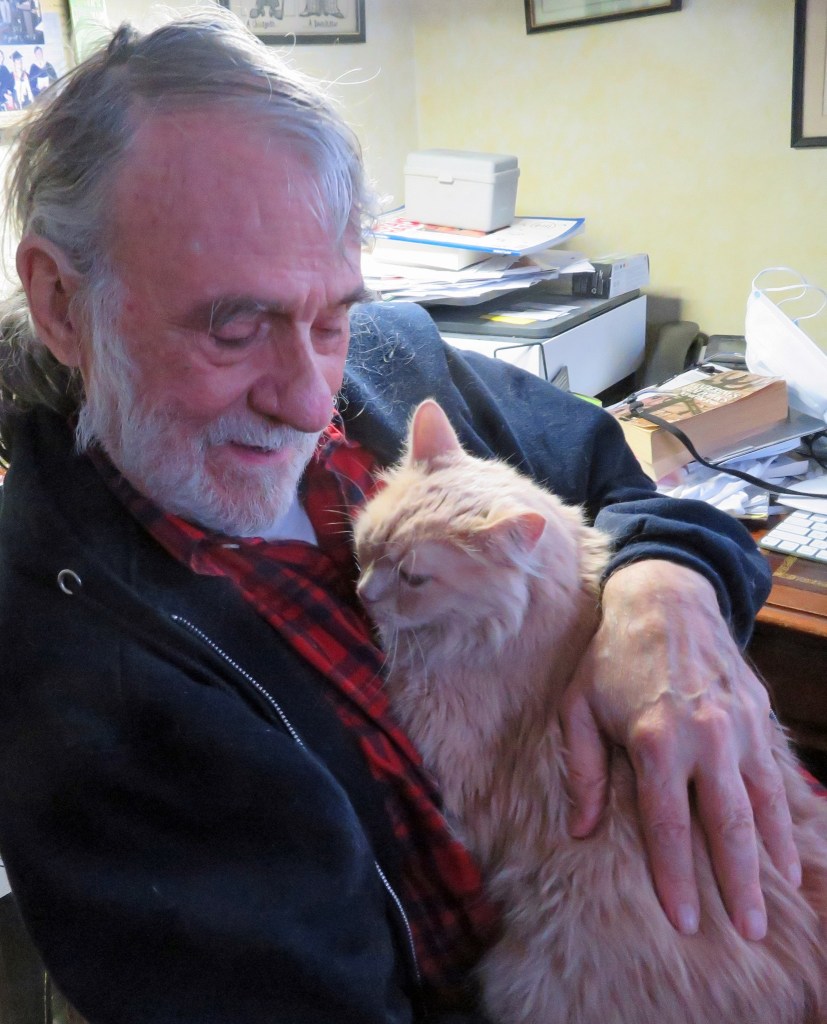
Our parish church held a blessing of the pets on St. Francis’ feast day. Debi and I thought about taking Bryce to be blessed, but decided against it. That would have meant loading him into a cat carrier, a process he protests vociferously. Plus we weren’t sure the other animals — or human beings — would react well to his incessant yowling during the ceremony.
So we stayed home, laying on some extra kitty treats in honor of the occasion. And I decided to write this blog post. (Besides, it’s a welcome break from writing about politics.)
Bryce has been at home with us for 10 months now. His “gotcha day,” when we picked him up from the Animal Protective League of Springfield, is Dec. 21. He’s about three years old and, like other pets we’ve adopted from APL, he’s a rescue kitty. He was picked up by Sangamon County Animal Control from a “hoarding situation” a year or two ago. We don’t know much about the conditions before animal control was called in — something tells me I don’t want to know — but apparently he was bullied, and he developed a distrust of people. So technically he’s not a feral, but you wouldn’t have known the difference at first.
Certainly he acted like a feral. The day we went to pick him up from APL, he escaped from his cage and it took staffers a good 15 minutes to trap him and get him into the cat carrier. When we got him home, he bolted again and spent the next two weeks hiding in a cardboard box in my home office.
But Bryce has another side. Slowly, slowly, s-l-o-w-l-y he’d come out of his cardboard hidey-hole, usually at night, to eat and to use the litter box. He warmed up to Debi first — she’s the one who usually feeds him — but after a while he’d let me play with him from across the room. He liked those cat toys that dangle from the end of a wand that looks like a little fishing pole.
More often, I’d be sitting at my home computer and, when I turned around, I’d discover him sitting across the room watching me. I’d seen that look before!
Debi and I first met Bryce at the Cats’ Pyjamas Cat Café downtown. It’s a lovely place, three or four blocks from the Illinois State Capitol, where you can socialize with shelter kitties from APL and, very often, arrange to adopt them. It’s win-win-win, a win for APL and the café management, a win for the customers and a win for the cats. We started going there a few weeks after the death of our 18-year-old domestic longhair, also a rescue from APL, and that’s where I first laid eyes on Bryce.
There’s a fair amount of traffic in the main room where you can meet cats on a couple of overstuffed sofas, a steady back-and-forth of people and cats coming and going. And several feet from the door, crouched sphinx-like in the relative safety of a cat tree, I noticed Bryce surveying the scene with evident interest.
Curiosity kills the cat, according to the old saying, but this time, curiosity won my heart.
Bryce is a yellow cat, what the British call a pale ginger, the same color as Champie, the kitty we’d just lost. (The Brits, by the way, think gingers are descended from the cats on Viking longboats.) Champie was a little scaredy-cat too; or maybe he just shared my formidable Norwegian reserve. Anyway, I’d like to think our eyes met there in the cat café, and the rest of the story was foreordained.
So last December, Bryce came home with us. I like to watch animal rescue videos on YouTube (they’re usually cheery little stories with happy endings, quite unlike the usual fare on the news sites I follow), so I already knew that getting a feral cat to trust you can be quite a process.
Bryce’s transformation into a cuddly house cat, but one with a mischievous streak, was complicated because we’d adopted another rescue kitty at the same time. Elizabeth was a regal, gorgeous older calico, but she’d been out on the street before animal control picked her up. We don’t know the details, of course, but clearly she’d had a hard life and she was territorial in a way that street cats sometimes have to learn.
As Bryce mellowed, he started to get downright kittenish, and he wanted to be friends with Elizabeth. She’d hiss and swat him away. I guess if you’re finally being treated like royalty, you don’t have much time for a rowdy court jester. I could imagine Elizabeth sniffing and saying, in whatever language cats use among themselves, “We are not amused.”
Sadly, after six months Elizabeth died of a sudden congenital cardiac event. She had started to warm up to him a little, and we could tell Bryce was grieving. The signs are obvious if you know cats. But soon enough, his inner kitten came out again and he picked up a nickname. He’ll always be Bryce, but we call him Scamperpuss too. Suffice to say he’s earned the name.
So he has lots of cuddly moments now. On his terms, of course. (After all, he’s a cat.) I’m just happy we’ve given him a home where he feels like it’s safe to act like a kitten.
And it all started when I noticed the little guy watching us in the cat café.
BG Kelley, a freelance writer and teacher at an evangelical Christian school in Philadelphia, says in the National Catholic Reporter that animals and humans can communicate deeply without the gift of language. He cites a legend of St. Francis:
St. Francis provided valid reasons to see a self and a soul behind the eyes of animals. Historians provided the documentation, relating the story of the man-eating wolf of Gubbio.
The wolf for many years terrorized the citizens of the Italian city of Gubbio with predatory attacks on humans and other animals. Recognizing that the wolf’s ways had sprung from hunger, St. Francis communicated to the wolf that the townspeople would provide food for him as long as he lived if, in turn, he would agree not to harm another human or animal. Historians are in agreement that the wolf bowed his head in acceptance of the saint’s offer, and for the rest of his life the wolf respected the covenant, going from house to house every day to be fed by the townspeople until he died.
It’s a lovely story. Here’s a painting by Luc-Oliver Merson, a 19th- and early 20th-century French artist:

I think there may be more of a historical basis to the Wolf of Gubbio than other legends of the saints. For example St. Jerome, who translated the bible into Latin, is often pictured with a lion at his feet, from whose paw he is said to have removed a thorn. Jerome was real enough; the grotto where he translated the bible is still there, part of the Church of the Nativity complex in Bethlehem. The tale about the lion, however, is considered legendary.
The story of St. Francis and the wolf has its legendary elements, too. Wikipedia records, relying on the Little Flowers of St. Francis, that the wolf and the people of Gubbio honored the pact: “At the wolf’s death the city was saddened, for though he had slain so many, he was a symbol of the sanctity of Francis and the power of God.” Wikipedia also records that in 1872, the skeleton of a large wolf was discovered during excavation of the city’s Chiesa della Vittorina (church of the small victory), dedicated to St. Francis.
Merson’s painting, “Le Loup d’Aggubio,” shows a butcher feeding the wolf, who is wearing what appears to be a halo. (If you look carefully, you’ll also notice a cat at the butcher’s feet.) I wonder if, apart from the hagiography, we have an early counterpart here to the animal rescue videos I like to watch on YouTube. Feed a wild animal, and it’ll come around.
I can’t imagine our Bryce, aka Scamperpuss, ever qualifying for a halo. But I think it’s altogether likely that St, Francis, given his love for animals, could have fed a wolf and prompted the people of Gubbio to do the same. Who knows? Maybe the wolf somehow caught St. Francis’ eye, and felt some kind of kinship. Maybe kinda like I did when Bryce caught my eye at the Cats’ Pyjamas in Springfield?
Certainly Francis saw some kind of kinship with animals — just read his Canticle of the Creatures. He doesn’t mention animals by name, but he sees a relationship in all of God’s creation, from Brother Sun, Sister Moon and all the stars to “our Sister Mother Earth, / who sustains and governs us.” BG Kelley, who wrote for the National Catholic Reporter about St. Francis and the stray cat he adopted in Philly, says we can learn a lot about relationships from the animals:
Animals are teachers, messengers and reflections in a physical form of divine principles. To neglect the importance of our relationships with animals is to neglect the exigent needs of humans: Can the underprivileged be educated, the hungry fed, the poor clothed, the homeless given shelter, the lonely befriended, neighbors welcomed, or different cultures understood if we look at our relationships with animals as machines, as Descartes did?
Even in a post about Brother Cat and Brother Wolf, I don’t want to go too far down a rabbit hole here, but I take issue with René Descartes, the 17th-century French philosopher who “denied that animals had reason or intelligence.” Well, Descartes may be, as Wikipedia adds, “widely considered a seminal figure in the emergence of modern philosophy and science.” But I’m not buying it when he says (to quote Wikipedia again):
Whereas humans had a soul, or mind, and were able to feel pain and anxiety, animals by virtue of not having a soul could not feel pain or anxiety. If animals showed signs of distress then this was to protect the body from damage, but the innate state needed for them to suffer was absent.
Nope. I’ve known too many cats, as well as a couple of dogs, to go along with that one. Anyone who adopts strays or ferals can testify they demonstrably feel pain and anxiety. Possibly a touch of PTSD, too.
I’m with St. Francis and BG Kelley, who thought of St. Francis one winter’s day when he adopted a stray cat he named Hobette. In NCR he writes:
Hobette first came to the door one brutal winter day 16 years ago, a stray shivering, skinny and hungry for food and love. “We need to take him in,” my wife said.
“Absolutely,” I said.
The justification in our compassion for Hobette lies, I suppose, in the belief that the cat, like us, experienced pain and suffering. We did not look at him as a bicycle or a shovel left outside.
It was the right — and only — decision.
Years ago, St. Francis of Assisi helped me to understand the souls of animals, as his soul was strengthened by his love of animals.
Yeah — me too. So, take that, Descartes! That’s what I think, and that’s who I am.
Works Cited
Helen Burchell, “What makes ginger tom cats so adventurous?” BBC News, May 6, 2024 https://www.bbc.com/news/uk-england-68847274.
St. Francis of Assisi, “Canticle of the Creatures,” rpt. Xavier University, Cincinnati https://www.xavier.edu/jesuitresource/online-resources/documents/canticleofthecreatures-whitebackground.pdf
BG Kelley, “St. Francis, as well as a cat, helped me understand the souls of animals,” National Catholic Reporter, Oct. 1, 2019 https://www.ncronline.org/news/soul-seeing/st-francis-well-cat-helped-me-understand-souls-animals.
[Uplinked Oct. 27, 2025]

 Ordinary Time
Love this! ❤ Just one nitpick, though. Of course our Brycie Scamperpuss has a halo.
LikeLike