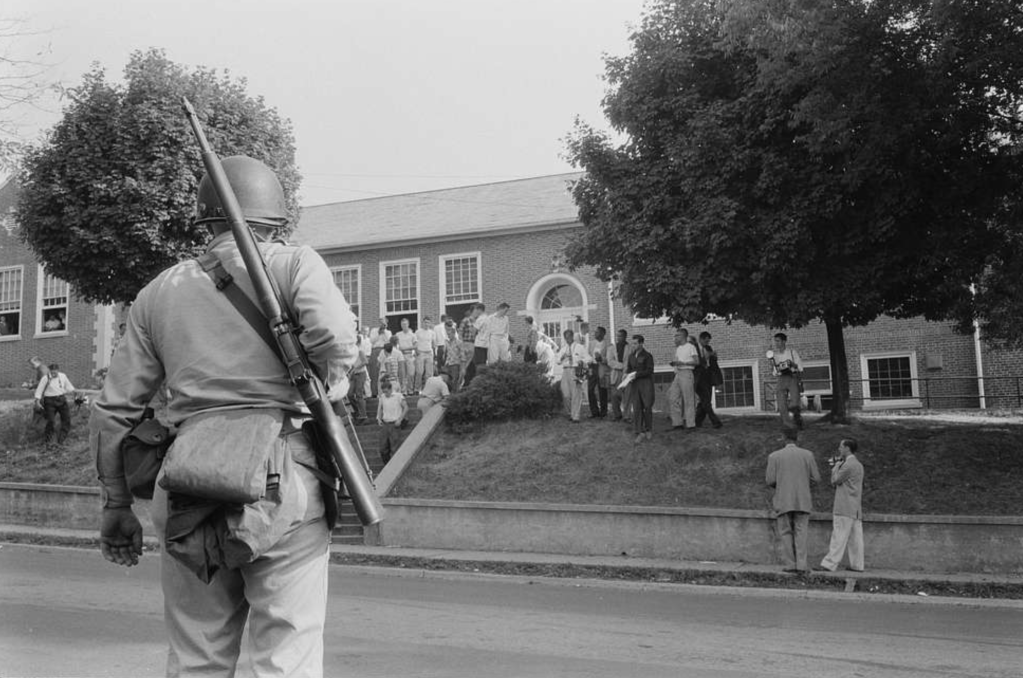
An offhand remark on a recent podcast about National Guard members patrolling the streets in Washington, DC, sent me down memory lane. The memories aren’t particularly happy, but, in an odd way, they give me hope for our future at a very dark time in Amereican history.
The remark came from Thomas Zimmer, a historian who left Georgetown University for Germany in June to avoid being censored by the Trump regime. A German citizen who sees parallels with 20th-century German history, Zimmer was interviewed on Lincoln Square. He had a visceral response (beginning at 7:00) to seeing pictures of Trump’s deployment of troops to Washington:
It’s crazy. Amored vehicles in the streets, and people with automatic rifles patrolling the streets, even if they’re not doing anything, that just changes the feel of where you are. That’s just not what a peaceful democratic society is supposed to look like. We all kind of feel this at a fundamental level: That’s just not right.
Zimmer’s immediate context was the reaction of some in the Trume regime to the murder of right-wing activist Charlie Kirk; he appeared on Lincoln Square to discuss a Substack he wrote speculating the murder might be used like Germany’s 1933 Reichstag fire to clamp down on the regime’s political opposition. My memories, the ones he triggered, are of a 1956 race riot in my county that was put down by the Tennessee National Guard.
That riot was a flash point (one of several) in the prolonged civil unrest that accompanied desegregation of the high school in Clinton, Tenn. Clinton was only 10 miles away, and I was keenly aware of what it feels like to see tanks in familiar streets. So I share Thomas Zimmer’s gut reaction to seeing the National Guard in Washington.
I don’t want to portray myself as some kind of hero of the civil rights movement, but I watched the violence on TV and read about it in the Knoxville News-Sentinel — my father warned me if he found out I’d been anywhere near Clinton, I wasn’t too old, even at 13-going-on-14, to get spanked (he was usually a mild-mannered guy, and I sensed he wasn’t bluffing). That said, it’s a formative experience to see tanks on the street in your home town. Or county.
But remembering those days also gives me a glimmering of hope. It’s difficult to unpack, because my feelings were profoundly mixed and they have changed over the years, but I think I need to try. Especially now, with tanks in the streets again.
Clinton High was the first school to desegregate under federal court order under Brown v. Board of Education. (Detailed accounts are available in a Barry Law Review article titled “A Lit Stick of Dynamite” and a chapter in the Equal Justice Initiative’s 2018 report Segregation in America. headed “Violent Resistance in Clinton, Tennessee“; Brief summaries are also available online in the Tennessee Encyclopedia and an account centering on the “Clinton 12,” the first Black students, in Wikipedia.) The struggle came to a head over the Labor Day weekend in 1956.
After protracted litigation in the federal courts, US District Court Judge Robert Taylor in 1956 reversed an earlier decision, citing Brown v. School Board, and ordered the Anderson County schools to desegregate with all deliberate speed, as the Supreme Court had directed.
Accordingly, the 12 Black students started school Aug. 27. While classes were relatively peaceful, crowds began to gather outside the school and the Anderson County courthouse nearby. Egged on by White Citizens Council activists (the preferred term around Clinton was “outside agitators”), the crowds grew more hostile. A violent demonstration took place Friday, Aug. 31.
Over the weekend an estimated 1,500 people rioted outside the courthouse. Local police and sheriff’s deputies were unable to contain the violence, and the Tennessee Highway Patrol and National Guard were called in Saturday night.
Clinton had only 12 policemen, and the outgoing county sheriff (who had been defeated for reelection) took no action. By a quirk of Tennessee law, a new sheriff couldn’t be sworn in until midnight Sept. 1. By that time, the situation was out of hand, although the new sheriff was able to deputize several civilian “home guards,” mostly World War II vets whom he stationed around the courthouse to protect the legal records inside.
The crowd, augmented by teenagers after a nearly Friday night foodball game let out, rocked cars on Main Street, which doubles as US Highway 25W. Finally, on Saturday night after prolonged dithering on the part of local and state officials, Gov. Frank Clement sent in the Tennessee Highway Patrol and called out the National Guard.
Again, I wasn’t there, but in later years as a newspaper reporter I knew county officials who had been part of the “home guard” that night. (I also interviewed people who admitted they had been in the mob, and said with hindsight they were ashamed; I had no reason to disbelieve them.) By all accounts, the sight of massed THP squad cars crossing a bridge over the Clinch River that overlooks the courthouse square, their emergency lights flashing, was an unforgettable moment. The state troopers were soon followed by the National Guard, and order was soon restored.
I remember seeing TV news shots of a tank set up at the intersection of Main and Market streets, to divert traffic on US 25W away from the courthouse square where the rioting was concentrated. There’s something about seeing tanks in the streets, as Thomas Zimmer said, that’s a hard punch in the gut. A Life magazine photo spread, curated in 2019 under the headline “Before Little Rock: Mob Violence Over Desegregation in Clinton, Tennessee, 1956,” brings back further memories, none of them pleasant.
What most stands out in my mind now is the overt racism.
In a remarkable piece of reporting that ran in the Knoxville News-Sentinel that Saturday afternoon (also available online), staff writer Homer Clonts noted an elderly policeman talking a teenage rioter out of assaulting a Black passer-by. By today’s standards, the violence was restrained. (I think, oddly, there may be some hopeful parallels embedded there.) But the mob at Clinton was largely unrestrained by law enforcement, and it was animated by wholly unrestrained racial animus.
Clonts, who seems to have been on the scene for several hours, wrote:
The frenzied mob was hurled to emotional peaks by white supremacy advocate Asa (Ace) Carter, a professional agitator who is executive secretary of the North Alabama White Citizens Councils and who has been likened to Adolf Hitler’s Fascists by members of his own movement.
Then, while Carter slipped away, the mob went about tearing up the town.
It literally wrecked almost every car bearing Negro passengers which passed down a U.S. highway that is the main street of Clinton, before finally deciding to let out-of-state Negro tourists pass unmolested.
In later years Carter would write a schmaltzy, and deeply problematic, book The Education of Little Tree purporting to be about values he learned from the Cherokee people. At Clinton in 1956, however, he was openly racist. Clonts recorded bits and pieces of his speech:
“I came here because I have four children, a little girl and three little boys,” Carter said. “I’d like to help you start a White Citizens’ Campaign in your town.
“We’re Anglo-Saxon. We make up just 30 percent of the population. For every three white men, there are seven colored men on this earth. But you’ll find that the Anglo-Saxon races are the only ones that have ever maintained a free government for free men.”
We don’t talk much about “white Anglo-Saxon Protestants” anymore. But Carter’s 1956 speech at Clinton lays bare the openly racist assumptions behind so muc f today’s ethno-nationalist rhetoric. Clonts’ account continues:
Carter was interrupted in his shouting speech several times, prayer-meeting fashion, by shouts from the crowd of “He’s right,” “That’s it,” “Tell ‘em, Ace.”
Law enforcement did not seek to interfere.
Carter declared:
“We have allowed to take over our land such organizations as the NAACP (National Association for the Advancement of Colored People). There are 356 organizations, altogether, working for the mongrelization of our children.”
He said the courts are trying “to take a white child and a Negro child and mongrelize our children.”
Then as now, the crowd turned against reporters on the scene. Special ire was reserved for the Clinton Courier-News, which won national awards for supporting desegregation but was less highly regarded that night, and Clonts said he had to prove he didn’t work for the Courier. He also notes:
Bill Middlebrooks, United Press bureau chief at Knoxville, can be credited with possibly saving one Negro man, who the mob was trying to pull from his car, from bodily harm.
Middlebrooks rushed into the mob and succeeded in pushing the crowd away and slamming the car door so that the driver could speed away.
The mob then began to yell, “There’s a n****r lover in the crowd. Let’s get him.”
Reprinting Clonts’ article in 2019, the News-Sentinel chose to partly redact the term, but to include it in the interest of accuracy. It’s language I remember well, partly because my parents were from Michigan and New York City, respectively, and I sounded like a Yankee every time I opened my mouth. It’s considered offensive now. It was offensive then. But, like the Sentinel’s editors said, it’s the way people talked.
Mostly I was well insulated from the world of Jim Crow, however. Norris, where I grew up, was only 10 miles from Clinton but it was a “TVA town,” a planned community built by the Tennessee Valley Authority. It was primarily a bedroom community for TVA and Atomic Energy Commssion employees in nearby Knoxville and Oak Ridge. It was also considered a “sundown town,” segregated by TVA policy during the 1930s (something I never knew until I consulted Wikipedia writing this post). Basically it was an upper middle-class enclave.
And East Tennessee wasn’t the Deep South. As a budding political junkie, even as a 14-year-old, I identified with “Southern moderate” politicians like US Sens. Estes Kefauver and Albert Gore Sr., both D-Tenn, and it was a point of pride to me that we lived in the “upper South,” less openly racist than Ace Carter’s Alabama.
So I can’t pretend my recollections are in any way typical.
I know I sympathized with the Black kids over at Clinton. I didn’t know any of them, but I did know they’d been forced to ride a bus 25 miles down to the “colored” high school in Knoxville if they wanted to go to school past eighth grade. In fact, they walked past the white school to get to the bus stop in Clinton. I also had a sense — and this, I think, was generally shared — if the adults would just shut up, the kids over at Clinton High could work this thing out.
One of the youth leaders in my church liked to say he used the restroom for “colored ladies” at the Pure Oil station in the town center, because it was cleaner than the others. I took that to mean segregation was, at best, silly. But it was also a reminder we are all equal in the eyes of God.
(We could use some of that attitude 70 years later, when as a society we are again obsessed with bathrooms.)
One other memory of civil rights days stands out. It was a few years later, probably in the summer of 1960 during the lunch-counter sit-ins. One day when I was shopping with my mother at a Rich’s department store in Knoxville, we noticed perhaps a dozen college-age kids picketing the store. Rich’s had one of those upscale tearooms with linen tablecloths and dainty little tea sandwiches. I wouldn’t want to eat there (I much preferred the Krystal hamburger joints), and I thought it was ironic the Black kids did.
But I admired their courage.
They attracted maybe 15 or 20 white onlookers. No one said anything, and there was no violence. Bt the atmosphere was tense, surly, and the Black kids were outnumbered. I didn’t join their picket line — the idea wouldn’t have occurred to me till several years later — but I felt like it was a turning point in my maturing attitudes about race. I still do.
Nearly 70 yars have passed now since those nights of political violence in Clinton, but Zimmer’s comment o executive editor Susan Demas of Lincoln Square brought back that queasy feeling of seeing tans on familiar streets. Now as in 1956, it’s proof something has gone terribly wrong. Even more, paps, I’m struck by how little the underlying racial animus has changed.
We call it by different names now, speaking of mass deportation and “vermin” who want to replace white Americans with Black and brown “aliens.” We use ethnonationalist dog whistles now, but Jim Crow is Jim Crow, no matter what you call it. The similarities with Asa Carter’s diatribe are subtle — so, to be fair, are the differences — but you can hear them hovering in the background when Zimmer says to Demas:
We’re not the target group of any of this. We’re white people, and we qualify as to what theTrump people think a rwal American should look like. If even we don’t feel like this is right, imagine what people who don’t look like us must feel when any minute they could be stopped, could be arrested. It’s terrible, but that is the intended consequence
The intended consequence is to send that message to anyone who is not a quote-quote “real American” in that weird ethnonationalist understanding of the Trumpists. You are not an American any more, and we do not want you. We do not want you in the public square, and we will come after you.
There’s one big difference, though, at least to my mind. When the governor of Tennessee sent the Highway Patrol and the National Guard into Clinton in 1956, he did so to keep the peace. When Trump sends troops into American cities, Zimmer suggests — and I concur — he has something quite different in mind.
For one thing, Trump’s deployments are glorified photo ops. State and local authorities in Los Angeles, Washington and Chicago insist crime rates are in fact dropping and they have no need of federal troops. For another, the Trump regime has been credibly accused of racial animus in sending troops to majority Black and brown cities. If anything, he’s been accused of trying to stir up trouble. In Tennessee in 1956, Governor Clement called out the Guard to protect Black students. The difference couldn’t be starker.
In his Substack piece, Zimmer discusses Trump’s motivation like this:
The Right is at war. War on Chicago. Department of War. A Civil War against the Left. As is always the case in the Trump era, there is something silly about these proclamations, about the constant need to perform “rah-rah-we-are-going-to-war!” MAGA manliness. But unfortunately, the Trumpists are seeking to bring reality closer in line with rhetoric. Over the summer, they have militarized the political conflict. What was just a horror scenario in the background in January is already reality: Trump is deploying troops domestically, against blue cities and political opponents. [Links in the original.]
We’ve come a long way since 1956, largely thanks to the civil rights movement, and that gives me hope. But Jim Crow is still Jim Crow, no matter how much you try to pretty it up in the White House.
Links and References
“Before Little Rock: Mob Violence Over Desegregation in Clinton, Tennessee, 1956,” ed. Lily Rothman and Liz Ronk, Life, History https://www.life.com/history/school-integration-clinton-history/.
Homer Clonts, “Racist Mobs Overrun Clinton: Police and Patrol Sit by Passively,” Knoxville News-Sentinel, Sept. 1, 1956, rpt. in Andrew Capps, “Read the News Sentinel’s front-page story about racists rioting over the Clinton 12 ruling,” News-Sentinel, March 23, 2019 https://www.knoxnews.com/story/news/local/2019/03/23/read-news-sentinels-1956-front-page-story-riots-over-clinton-12/3252180002/.
Johnny Cerisano, A Lit Stick of Dynamite: The Story of Desegregation in Clinton, Tennessee, 26 Barry Law Review 67 (2021) https://lawpublications.barry.edu/cgi/viewcontent.cgi?article=1174&context=barrylrev.
Equal Justice Initiative, “Massive Resistance,” Segregation in America (Montgomery, Ala.: EJI, 2018) https://eji.org/reports/segregation-in-america/.
Edwaed R. Murrow, “Clinton and the Law,” 1956, Tennessee Time Traveler (CC0 1.0 Universal) https://www.youtube.com/watch?v=SC0T5yh6nXs&t=1711s.
Carroll Van West, “Clinton Desegregation Crisis,” Tennessee Encyclopedia (Nashville: Tennessee Historical Society, 2017) https://tennesseeencyclopedia.net/entries/clinton-desegregation-crisis/,
Thomas Zimmer, “Is the Right Looking for a Reichstag Fire?: Historian Thomas Zimmer joins Susan Demas,” Lincoln Square, Sept. 17, 2025 https://www.youtube.com/watch?v=fw1ODsxJHe8.
__________, “The Right Wants a Reichstag Fire,” Democracy Americana, Sept. 12, 2025 https://substack.com/home/post/p-173430382
[Uplinked Sept. 28, 2025]

 Ordinary Time