Debi and I belong to a group affiliated with the Dominican sisters known as the Associates’ Anti-Racism Committee (AARC for short). It’s an offshoot of SDART (pronounced “ess-dart,” an acronym for the Springfield Dominican Anti-Racism Team), an initiative that’s succeeded in changing hiring and other policies in the motherhouse and the Springfield congregation’s schools and clinics scattered over the Midwest and Deep South.
On the agenda for our regularly scheduled Zoom meeting for December the other night, we were asked, “How are you feeling about the future of our country?” A timely question! I don’t think my evangelical and Republican friends (often the same people) quite understand how people of faith feel about the incoming reign of Trump 2.0. But the sense of loss and sadness as we went around the room (around the Zoom?) was almost palpable.
Something else was at work, too.
SDART has been around since 2004, and some of the sisters, associates and lay people have been working to dismantle policies and procedures grounded in deeply held, often unconscious attitudes of white superiority and paternalism, beginning with their own, for more than 20 years. The Springfield Dominicans’ mission statement includes:
- As an anti-racist institution we are accountable to people of color in mutual relationships based on respect, equality and Justice.
- Together we examine and redefine all aspects of our life, mission and ministry to incorporate and witness anti-racism. [Boldface type in the original.]
SDART was written up in America, the Jesuit magazine, in 2020 as a “model for religious communities nationwide,” but its work is never complete. AARC was formed a couple of years ago to work with Dominican associates, lay men and women who “embrace the Dominican traditions of prayer, study, community, and ministry” and “respond to God’s call to share the Gospel by preaching it through the witness of their lives.”
Meeting with the AARC folks for two years now has been an eye-opening experience. I thought I knew a fair amount about racism, as a police beat reporter and later from teaching college courses on Black and Native American cultural studies. But I realized quickly I could learn more, and ultimately contribute more, when I sat back and listened to their lived experience.
Anyway, there was a lot of wisdom shared in AARC’s Zoom session. A lot of self-reflection, a lot of hope and waiting to see what happens — after all, Advent is a time of waiting, self-examination and, above all, hope. Quite a bit of hard-won experience, too. One member spoke of visiting a group of older Black women soon after the election, who told her (and all of us):
“We’ve been here before’.”
Indeed we have. I don’t pretend to be any kind of hero of the Civil Rights movement, although, as what used to be called a white “Southern moderate,” I was one of its beneficiaries. Mostly I watched it from a safe distance. But I remember in the early 1960s admiring the courage of the Black kids — about my age at the time — who sat in at Woolworth’s and picketed Rich’s department store in Knoxville.
Yes, we’ve come a long way. Not far enough, but still a long way. We still have a long way to go, though.
After AARC’s Zoom session, I was inspired to call up “I’ll Be Rested,” Mavis Staples’ anthem to the Civil Rights movement, on YouTube. A rewrite — with help from producer Ry Cooder — of a “I’ll Be Rested (When the Roll is Called),” a 78rpm recording in 1936 by Black street musician Roosevelt Graves, it’s a testimony to the people who fought and died for freedom:
Until justice rolls down and righteousness
Like a mighty stream, keep alive the names
Of those who put their lives out on the front lines
And died just trying to live and breathe.
And to a “heavenly choir” of Black musicians, gone now but who will be there when the roll is called: Sister Mahalia Jackson, Sister Clara Ward, Dr. Thomas A. Dorsey. “And look over there, there goes Dr. Watts.” The list goes on. She sings of her father, Roebuck “Pops” Staples, patriarch of the Staple Singers, “Oh my, my, my / There he is, Poppa Staples /And you got your guitar with you.”
And every time I hear it, I’m carried away and I’m singing along with Mavis Staples, Ry Cooder and the heavenly choir. “And we’re going to sing, sing hallelujah / And never get tired.” I’m not Black and I’m not much of a musician, but I want to live my life so I can be there when the roll is called:
Oh what a time, oh what a time
He’ll say “Servant, servant well done
Come on home and rest your weary, your weary bones”
I’m gonna join the heavenly choir.
I bought the CD We’ll Never Turn Back 10 or 15 years ago. (Remember CDs?) And ever since. I’ii get it out and play “I’ll Be Rested” when I’m feeling down and needing inspiration. It never fails to lift me up. It also remind me: We’ve been here before, and we still have a long way to go.
What Have White Christians Wrought?
In an opinion piece on the Time magaine website immediately after the election, Robert Jones of the PRRI survey research firm had a blunt answer to the question:
Over the last decade, many white Christians have not just selfishly supported a dangerous, narcissistic man who promised to restore their waning influence; they have now willingly blessed the advent of a new American fascism that threatens our democratic future. They are principally responsible for Trump’s rise and return to power—and for everything that is coming for all of us in its wake.
When PRRI’s post-election survey came out a month later, the results were pretty much the same. Even a little starker. More than two-thirds of white Christians voted for Trump (including 85 percent of evangelicals, 59 percent of Catholics and 57 percent of non-evangelical Protestants). Jones’ initial estimate was correct — they were largely responsible for Trump’s election.
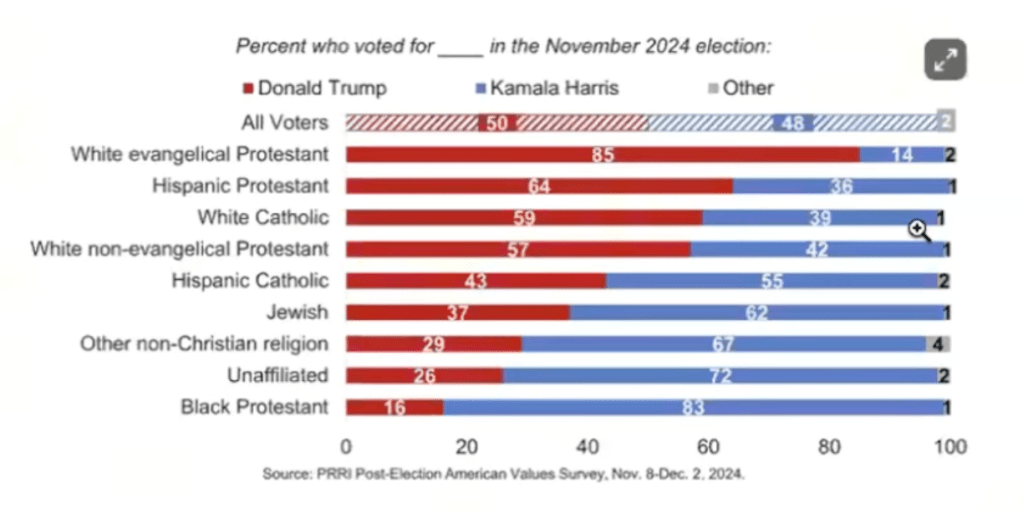
But they don’t speak for all Christians, as the cross tabs in the PRRI survey indicate. Hispanic Protestants, who tend to belong to charismatic, Pentecostal churches, went for Trump 64 percent to 36 percent; Hispanic Catholics, only 43 percent to 55 percent who voted for Democrat Kamala Harris (2 percent voted for other candidates). Most tellingly, 85 percent of white evangelical Protestants backed Trump while only 16 percent of Black Protestants did. Clearly multiple factors, including race, influenced the vote.
One of those factors is Christian belief. I won’t claim they’re broadly representative of anything other than my taste in reading material, but the magazines I read made it clear their values don’t reflect the policies of an incoming Trump 2.0 administration.
Thus the editorial board of Sojourners magazine, published by an evangelical Protestant not-for-profit with a strong commitment to social justice, pledged unyielding opposition. “This anti-democratic movement has hijacked part of our Christian faith,” reads an editorial in the January-February print issue. “We say it here plainly. The principles, methods, and policies of white supremacy and/or authoritarianism are incompatible with the message of Christ” (6). Similarly, a staff editorial in Christian Century, a journal of religion, culture and the arts for mainline Protestant readers, said:
This will be a hard time, and then it will end. We can easily be consumed by trying to game out exactly how hard or for exactly how long. But our hope lies in being present and faithful to our calling to pursue justice, promote compassion, build solidarity, and stand up for things that matter. (9)
Neither Sojourner’s editorial nor Christian Century’s are available online. But an article on the Century’s website by Julian DeShazier, senior minister of University Church in Chicago (who has a side gig as J. Kwest, a hip-hop artist), conveys a nuanced, almost ambivalent attitude I find appealing.
DeShazier’s article also has an ecumenical flavor that speaks to me: “U Church” belongs to two denominations, the Christian Church (Disciples of Christ) and the United Church of Christ, and DeShazier finds inspiration in the novelist Leo Tolstoy, who was excommunicated from the Russian Orthodox church for his views on church-state relations. Like Tolstoy, DeShazier has little use for the state. But, he adds:
This doesn’t mean we shouldn’t vote—we absolutely should—but when it comes to what’s at stake, or whether you “won,” I think we’re giving the state too much credit. It is a broken institution, this empire, and as a Black man I have come to trust its brokenness almost like clockwork. So for me, placing even a sliver of my spirit into this realm is a fool’s game—or worse, idolatry.
No doubt as a consequence, DeShazier warns against linking the church too closely to any political philosophy, no matter whether it’s formed by attitudes of white superiority or progressive ideology. That, however, does not rule out political action. Says DeShazier:
[…] what I don’t hear enough—and what gets me so many looks when I say it myself—is that this dark moment in our nation’s history is not going to determine whether we as a people are well or not. Our spirits will not be tied to this mess or the xenophobia that has caused it, because whoever wins an election, we the believers in love and justice still have work to do, people to hold to account, relationships to build. The difference is whose office we will call and how loud we will have to yell.
Election or no election, yes, we still have work to do; in the words of a half-remembered line of poetry, we have promises to keep and a long way to go.
Finally, an article by freelance writer and local newspaper columnist Valerie Schultz in the Jesuit magazine America especially spoke to me. Titled “Dear Catholic Boomers: Don’t get too comfortable during Trump’s next four years,” it speaks directly to me, even though I’m not Catholic, I’m not a grandmother and I’m a little too old to qualify as a Baby Boomer. It’s worth quoting at length: Feel free to fill in your own age group, gender and faith tradition (or no organized tradition at all) as you read it:
In light of this year’s presidential election, I have been confronting the comfort of my own life. I am a straight white American citizen, a privileged Boomer. In light of the threatened policies of the incoming administration, I am about as comfy as I can get without adding “male” to my description. I would like to keep my Medicare, but I suspect the collective fury of a lot of old people who vote (like me, a card-carrying A.A.R.P. member) will keep that program off the chopping block for a while. I will not be deported, unlike many other grandmas and dreamers. I am not a prominent enough writer for my columns to be investigated by the Department of Justice under some corrupt flunky. I can probably bury my head in the sands of my comfortable circumstances and turn to gardening as I mourn the demise of decency in government.
Indeed, that was my inclination on that sleepless election night, when I realized that white women, among other supposedly sane voting groups, were not going to save democracy, that a lot of American voters were not even going to bother to vote. I have long been a political junkie, but I considered never watching the news again. I considered unsubscribing from all pertinent podcasts and social media. I considered staying in my lovely safe home in a small town and abandoning all concern for anyone else. Then I remembered that I do not have that luxury.
I am a Catholic.
I am called—commanded, really—to feed the hungry, give drink to the thirsty, clothe the naked, care for the sick, visit the prisoner and welcome the stranger. This call comes directly from Jesus Christ. See Matthew 25. It is non-negotiable.
Like I said, it’s kind of a fill-in=the-blanks thing. Instead of “Catholic,” I might fill in the blank with “spiritual mutt” or “ecumenically minded Lutheran who’s read a little too much Zen.” The editors of Sojourners and Christian Century would fill it in differently, as would Julian DeShazier, the hip hop artist who pastors a church that answers to two mainline Protestant denominations.
Most faith traditions I’m aware of, in fact, have commandments like those in Matthew 25, which is soundly grounded, after all, in the Jewish law and the prophets. So other filled-in blanks could just as well read “I am Jewish,” “I am Muslim,” “I am Buddhist,” or any other religion. (Or none at all.) The commandments are non-negotiable.
Links and Citations
William Critchley-Menor, SJ, “The Catholic sisters who confronted their own legacy of racism.” America, March 5, 2020 https://www.americamagazine.org/politics-society/2020/03/05/catholic-sisters-who-confronted-their-own-legacy-racism.
Julian DeShazier, “After every election, I turn to Tolstoy,” Christian Century, Dec. 10, 2024 https://www.christiancentury.org/voices/after-every-election-i-turn-tolstoy.
Robert Frost, “Stopping by Woods on a Snowy Evening,” rpt. Poetry Foundation https://www.poetryfoundation.org/poems/42891/stopping-by-woods-on-a-snowy-evening.
Robert P. Jones, “What White Christians Have Wrought,” Time, Nov. 11, 2024 https://time.com/7174260/white-christianity-trump-election-essay/.
__________, Diana Butler Bass, Kristin DuMez and Jemar Tisby, “First PRRI Post-election Poll, Normalizing Telling the Truth, & Politics Comes Home for the Holidays,” The Convocation Unscripted, Dec. 20, 2024 https://www.youtube.com/watch?v=xUE2QH8RVSI.
Regina Munch, “We Can’t Disengage,” Commonweal, Nov. 7, 2024 https://www.commonwealmagazine.org/we-cant-disengage.
Valerie Schultz, “Dear Catholic Boomers: Don’t get too comfortable during Trump’s next four years,” America, Dec. 19, 2024 https://www.americamagazine.org/politics-society/2024/12/19/catholics-voted-trump-afflict-comfortable-249473.
“Spotlight: From the Editors,” Sojourners, Jan./Feb. 2025 [print edition].
“SDART: Springfield Dominican Antiracism Team,” Dominican Sisters of Springfield, Illinois https://springfieldop.org/mission-outreach/what-we-do/dismantling-racism/.
“What Now?” [editorial], Christian Century, Jan. 2025 [print edition].
[Uplinked Dec. 23, 2024]

 Ordinary Time