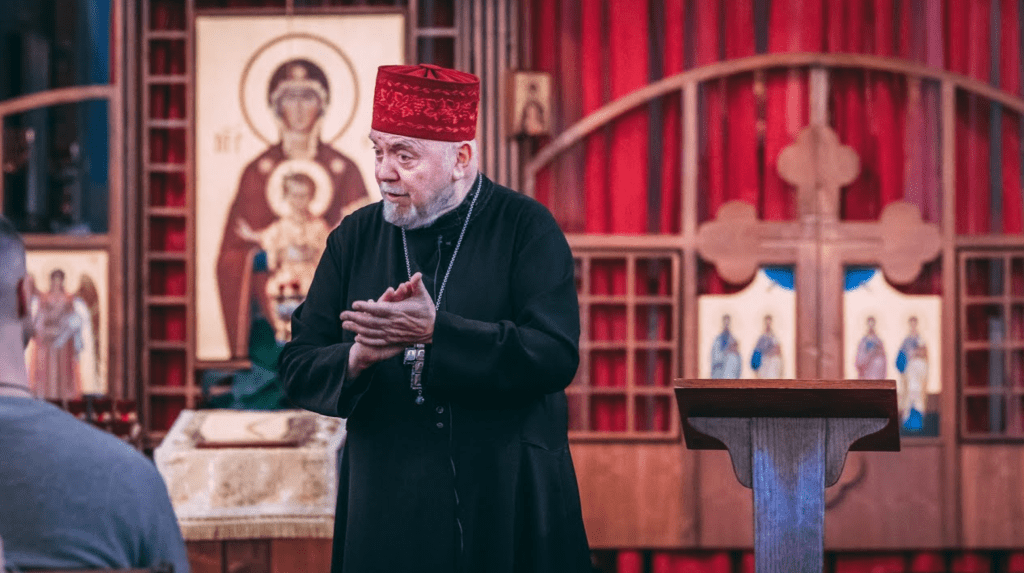
While I was researching another post to Ordinary Time (link HERE), I learned a spiritual mentor and role model whom I never met in person died late last year. He was, to give him his full title, the Very Rev. Archpriest Michael Oleksa, sometimes also known as “Father Alaska” for his life’s work as a Russian Orthodox priest, a teacher and a tireless advocate for Native cultures. He was also a gifted storyteller.
So how, you may be wondering, does an English teacher in central Illinois find a mentor and role model in a Russian Orthodox priest 3,695 miles away in Alaska?
Well, there’s a story behind it.
Twenty years ago when Debi was writing training manuals for the Alaska Domestic Violence Network, I’d tag along when she flew up to roll out a new curriculum. One day I checked out a Russian Orthodox museum in downtown Anchorage, and I was swept away by the music, the displays of Russian and Alaska Native art, and a lovely iconostasis in the little chapel at the back of the museum.
Sadly, the museum closed a few years later. But that afternoon was my introduction to the story of Russian Orthodox missionary work with Alaska’s Yup’ik, Tlingit and Denaʼina people during the 18th and 19th centuries. Out of this blending of religious traditions — or inculturation, to use the technical term — they created a diverse Alaska Creole culture that persists to this day. In general the Russian priests respected the Native cultures more than than their counterparts in the Lower 48, and I made it my business to find out more about them. That’s when I learned about Father Oleksa, and that’s why I consider him a mentor and role model.
At the time, I was teaching course in Native American cultural studies back in Illinois. And I found his attitude toward cross-cultural communication vastly helpful to me as a non-Native teaching about someone else’s culture. I quickly came to value his spiritual insights, but at first I was interested primarily in the cultural angle.
A Pennsylvania native, Oleksa first visited Alaska as a student intern from St. Vladimir’s Seminary in the Lower 48; he spent the next 35 years ministering to Alaska Natives, initially in village churches and later on largely by teaching, writing and presenting at conferences. After his death Nov. 29, 2023, an Anchorage Daily News editorial summed up his career like this:
The man most Alaskans came to know simply as “Father Oleksa” was one of the state’s foremost proponents and teachers of cross-cultural communication, working for decades to help build bridges of understanding between Alaska’s white and Native communities, between his church and the lay people, and between youth, adults and elders of all kinds.
In a remarkable obit for Alaska Public Radio, Rhonda McBride of KNBA Radio in Anchorage, who knew Oleksa well and who also has been a tireless advocate for Alaska Native cultures, said in his heart of hearts he was a storyteller:
Father Oleksa was a man who was many things to many people — a priest, scholar, teacher, historian, author and much more. And the common thread through it all was his ability to weave a great story — a talent that took him all over the state to lecture widely on what he called “communicating across cultures.”
McBride, who is quite a storyteller herself, struck up a conversation with Sven Haakanson, an Alaska Native who who grew up in one of Oleksa’s first parishes and flew back to Alaska for his funeral. She tells his story like this:
When [Oleksa] got his first assignment as a priest in Old Harbor on Kodiak Island, young people in his congregation heard for the word “Sugpiaq” for the first time. Elders knew that it was the name people on Kodiak Island once called themselves. But the people stopped using it, because they had begun to think of themselves as Aleut.
“He wanted to make sure people understood our history, which was something that wasn’t taught or wasn’t spoken about,” Sven Haakanson said. “Aleut is a name that the Russians just called everybody from the Aleutians, all the way up to the Prince William Sound.”
A word or two of explanation are in order here. Aleut is a blanket term applied by Russian fur traders in the 1700s and 1800s to all the indigenous peoples living along the Aleutian Islands and the Kamchatka region of eastern Siberia. It was also applied, inaccurately, to people in the Kodiak islands and the Kenai peninsula south of Anchorage; they are known more properly in Russian as Alutiiq or in their native language as Sugpiaq. Says McBride:
For many in his congregation, Oleksa’s use of the word, Sugpiaq, was healing. Haakanson says the priest’s lessons in history made him curious about his own culture, which started him on his journey to become one of the first Alaska Native anthropologists.
Haakanson flew to Oleksa’s services all the way from Seattle, where he is chairman of the anthropology department at the University of Washington.
For a guy who was teaching an interdisciplinary humanities course to undergrads back in Illinois, where most kids saw nothing wrong with a controversial sports team mascot at the U of I named “Chief Iliniwek,” Father Oleksa’s example was inspiring. I even assigned my students at my Catholic liberal arts college to read one of his lectures on culture:
With our own culture, we can be competent. We grew up with it. We absorbed its rules without even noticing. We understand time and space and nature our way, the way our friends and neighbors do, the way our own native culture did. But here in Alaska, we have the tremendous opportunity to discover new ways of seeing the world, of understanding reality, of comprehending what it means to be a human being […].
I’d love to be able to report my students understood why Native Americans found Chief Illiniwek offensive — most of them didn’t — but at least they were exposed to a new way of seeing the world. I wrote up my experience studying Alaska’s Creole culture for the Sleepy Weasel, our college literary magazine (you can read it HERE), under the title “Alaskan Liturgical Hymns, Our Lady of Sitka and the ‘Presence of the Holy’ in Cross-town Traffic.” In time, it would give me a new way of looking at my own somewhat lukewarm mainline Protestant faith.
In my story for the Sleepy Weasel, I cited a 2008 article of Oleksa’s titled “The Alaskan Orthodox Mission and Cosmic Christianity,” in which he found in both the Native and Orthodox traditions a form of spirituality called panentheism, a belief that God is present in every part of the universe. That link has gone dark now, but he explored the same issue at a World Council of Churches’ conference in 1996, and that talk is available online.
“In the Patristic age, Greek language, Greek culture, Greek philosophical language enriched the life of the church forever,” said Oleksa. “As the seed, the gospel, the church, as Christ’s presence enters into the context of other cultures, these too offer something back to God.” This process of inculturation, the “adaptation of Christian teachings and practices to cultures” to quote Wikipedia, continues. And Oleksa said it is very much at work in Alaska:
I read Holy Fathers. But it was my Eskimo parishioners who revealed to me the depth of the passage, revealed to me the cosmic dimension of the prologue to the gospel according to St. John, showed me the magnificence of the Apostle Paul’s Christocentric experience and vision. This is what inculturation means for the church.
As an example, Oleksa told a story — of how he came to understand the presence of God in living creatures. We tend to speak of it in polysyllabic terms like panentheism and the indwelling of Christ, but the Yup’ik people of Western Alaska called it the Yua, the “spirit that makes a living thing to be alive.” This translates into a reverence for life that extends to all animals, and Oleksa said it made a good fit with Russian Orthodoxy:
Orthodox missionaries did not discourage this belief that life in all its form should be treated reverently. Their Alaskan converts heard the Paschal gospel from within the context of their traditional worldview, and saw Christ in the whole created universe, the Word of God in the Cosmos, in a way even the missionaries had not seen him before. The life of the world, the life of all, yes-all the Yua are really him. And the first chapter to the Colossians took on a meaning that was always there, but had gone unnoticed, or at least under appreciated, for centuries.
In Colossians 1:15-16 St. Paul speaks of Christ as “the image of the invisible God, the firstborn of all creation, for in him all things in heaven and on earth wer. e created, things visible and invisible, whether thrones or dominions or rulers or powers—all things have been created through him and for him.” Citing the Parable of the Sower, Oleksa explicated it like this:
The seed found especially fertile ground, for the text “He is before all things and in him all things subsist” affirmed that what the Alaskans had intuited centuries before was now affirmed in the gospel. Only now they knew his identity. Alaskan Orthodoxy affirms a cosmic dimension to the Christian faith that many, perhaps most, modern Christians fail to grasp. John 3:16 is probably the most widely memorized verse in the New Testament, few who study the Bible in English translation grasp its full meaning the way most Eskimos do. The original text speaks of God’s love for the world, and most suppose the Greek word here is oikoumene, the inhabited earth, the human beings, and indeed the evangelist could have chosen this word. In fact, however, he did not. This famous verse affirms “For God so loved cosmos the sent his son.”
Ever the storyteller, Oleksa drove the point home by telling a story:
The Alaskan church goes forth in procession each January for the great blessing of water, in most places walking on the frozen river, standing on the ice in subzero temperatures, to sanctify the one small piece of the cosmos on which their lives have always depended. The river is their highway, their cleansing, their supermarket, their home, their life. In their pre-Christian past they thanked the animal spirits for offering themselves, sacrificing themselves to feed the people, and put their inflated intestines and bladders through the holes in the ice in order to recycle their Yua. Now they go to the river and bless the waters, putting the cross through a cruciform hole in the ice; it is Christ they bless, Christ they thank, for his sacrifice, prefigured in the cycle of the natural world as they understood it.
It’s certainly a new way of looking at the world. And if I’d known about Father Oleksa’s talk to the World Council of Churches, I don’t think I could have profitably shared with the kids in my 200-level humanities course, whose cultural attitudes were formed by Chief Illiniwek and our relatively mild winters in central Illinois.
But learning about Alaska Native and Russian Orthodox spirituality 15 and 20 years ago planted a seed that germinated years later as I learned in spiritual direction about Fr. Richard Rohr’s “cosmic Christ,” and the Jesuit practice of seeking the presence of God in all things. And it gives me a new way of thinking as I hear the letters of Paul read in my Lutheran church on Sunday mornings.
Links and Citations
“Call for Prayer: Fr. Michael Oleksa of Alaska Suffers Stroke,” Orthodox Christianity, Nov. 29, 2023 https://orthochristian.com/157551.html.
Colossians 1:15-16, New Revised Standard Version, updated edition, Bible Gateway.
“Farewell to one of Alaska’s great communicators,” editorial, Anchorage Daily News, Dec. 2, 2023 https://www.adn.com/opinions/editorials/2023/12/02/editorial-farewell-to-one-of-alaskas-great-communicators/.
Rhonda McBride, “Remembering Father Michael Oleksa: Alaska’s Great Communicator,” Alaska Public Media, Dec. 16, 2023 https://alaskapublic.org/2023/12/08/remembering-alaskas-great-communicator-father-michael-oleksa/.
Michael J. Oleska, “Evangelism and Culture,” 1995, rpt. Missions Institute Of Orthodox Christianity, Brookline, Mass. https://missions.hchc.edu/articles/articles/evangelism-and-culture.
__________, “Listen to the Other Guy’s Story,” keynote address to the Alaska 20/20 Conference: On the Future of Alaska, sponsored by the Alaska Humanities Forum and the First Alaskans Foundation; rpt. my class blog, “HUM 223: A Russian Orthodox priest talks about culture,” Hogfiddle, March 17, 2010 https://hogfiddle.blogspot.com/2010/03/hum-223-russian-orthodox-priest-talks.html.
[Uplinked Dec. 12, 2024]

 Ordinary Time