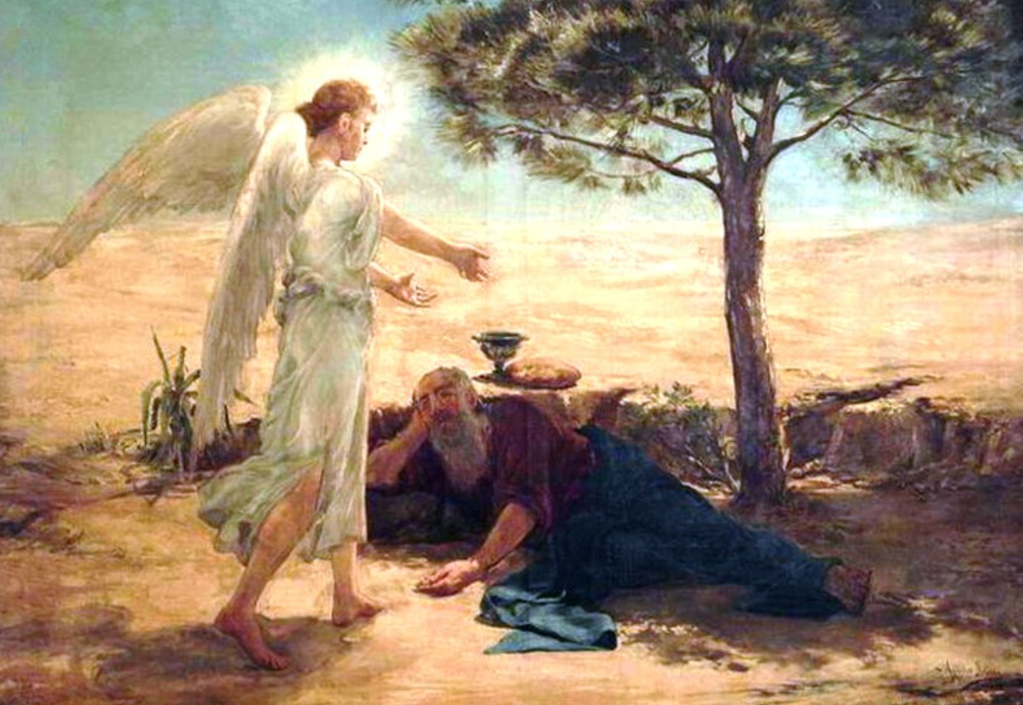
1 Kings 19 (NRSVue): 4 But [Elijah] himself went a day’s journey into the wilderness and came and sat down under a solitary broom tree. He asked that he might die, “It is enough; now, O Lord, take away my life, for I am no better than my ancestors.” 5 Then he lay down under the broom tree and fell asleep. Suddenly an angel touched him and said to him, “Get up and eat.” 6 He looked, and there at his head was a cake baked on hot stones and a jar of water. He ate and drank and lay down again. 7 The angel of the Lord came a second time, touched him, and said, “Get up and eat, or the journey will be too much for you.” 8 He got up and ate and drank; then he went in the strength of that food forty days and forty nights to Horeb the mount of God.
What would the prophet Elijah do if he were transported to 21st-century America and confronted, instead of King Ahab and Jezebel, a newly elected form of “fascism — or at least neo-fascism, or American-style fascism, or some other modification of that fraught and weighty [term]?” Those carefully hedged words are conservative pundit William Kristol’s, and they don’t mention Elijah, but they call his story to mind. At least I think they do after reading Old Testament scholar Walter Brueggemann’s reaction to last week’s election.
An ordained minister and emeritus professor at Columbia Theological Seminary in Decatur, Ga., Brueggemann has written extensively and deeply about the Hebrew prophets and their call to minister to the poor and marginalized. When President-elect Trump was elected to a second term, he was moved to write a column titled “Beyond the Fetal Position” for Church Anew, a blog for church leaders maintained as an outreach ministry of St. Andrew Lutheran Church in Eden Prairie, Minn. While he doesn’t mention fascism, Brueggeman advocates a prophetic attitude toward Trump’s policy goals not unlike Elijah’s opposition to Ahab and Jezebel.
Elijah, let it be recalled, prophesied and worked miracles during the reign of King Ahab in the 9th Century BCE. Scholars agree that some of his exploits, as they are set out in the books of 1 and 2 Kings, sound like tribal folklore. But his fight with Ahab and Jezebel has the ring of history. Jezebel was a Canaanite princess, from Sidon in what is now Lebanon, who brought the worship of the Canaanite god Baal to Israel; today’s scholars agree the dynastic union was good politics. But Elijah, devoted to the God of Israel, not only opposed it; he brought down fire from heaven and, shortly thereafter, slew 7,000 prophets of Baal.
This put Elijah on the royal enemies list, and he fled into the desert. He was exhausted, but an angel of the Lord brought him food and directed him to keep going. It is at this point in the prophet’s career that Brueggeman picks up the story for readers of Church Anew, many of whom are no doubt exhausted by the prospect of another Trump administration. He tells Elijah’s story much better than I can (better in places, I think, than the scribes who put 1 Kings in writing), so I’ll let him set the stage — and tone — with an extended quote:
In the wake of the 2024 presidential election and its acute disappointment for many, consider the case of Elijah, the prophet. Elijah has been bold and brave for YHWH, facing down the prophets of Baal (I Kings 18:20-40). He has lived in defiance of the royal house of Ahab and Jezebel. And then he must run for his life before the death sentence pronounced by the throne against him (19:1-3).
When we meet Elijah next, he is very frightened. Indeed, he wishes he could die, and so escape his impossible situation vis a vis hostile royal power. Now he lingers alone in the wilderness (19:4). Elijah senses that he is abandoned by the God for whom he has been zealous in his faith and his action. In his self-pity, however, a strange thing happens to him. While his visible world has failed him, he gains access to the invisible world of faith that lives “by the conviction of things not seen” (Hebrews 11:1). An angel, a messenger from that other world to which Ahab and Jezebel have no access, comes to him in his sleep. The messenger issues an imperative of care and nourishment:
Get up and eat (v. 5).
He was surprised to discover at hand a baked cake and a jar of water. The messenger does not give him pious talk of either reassurance or imperative. Rather the angel ministers to his elemental, bodily needs…food and water. Elijah eats; he sleeps again. [Ellipsis in the original.]
To continue the story, the angel again directs Elijah to eat and to journey 40 days and 40 nights into the Sinai desert at Mount Horeb (aka Sinai, “the founding place and founding event of the covenant people,” as Brueggemann explains). There he encounters God, as a famous passage puts it, not in the wind, an earthquake or a fire but in a “still, small voice” or, as the New Revised Standard Version has it, “a sound of sheer silence.” The authors of 1 Kings pick up the story from there:
Then there came a voice to him that said, “What are you doing here, Elijah?” He answered, “I have been very zealous for the Lord, the God of hosts, for the Israelites have forsaken your covenant, thrown down your altars, and killed your prophets with the sword. I alone am left, and they are seeking my life, to take it away.” Then the Lord said to him, “Go, return on your way to the wilderness of Damascus […]
Not exactly what Elijah had been hoping for! Brueggemann puts it like this: “Most astonishing, Elijah does not receive further assurance or comfort. No, he is addressed only with a double imperative: ‘Go, return.’ He has been provided food and assurance. But no more!” Elijah will go, he will return. Not only return, but engage in dynastic skulduggery that will overthrow the rule of King Ahab and the gods of Jezebel.
Brueggemann doesn’t overdo the parallels. Trump is no King Ahab, and, judging from other passages in 1 Kings, Jezebel was a gutsy woman who would be quite well able to take care of herself if the president-elect attempted to grab her inappropriately. But Brueggeman is an Old Testament scholar who has written extensively of the prophets, and applies their prophetic vision to the present. He says:
So it is with us! Like the ancient prophets, we are dispatched back to the good work entrusted to us. It is the work of peace-making. It is the work of truth-telling. It is the work of justice-doing. It is good work, but it requires our resolve to stay it, even in the face of the forces to the contrary that are sure to prevail for a season. We are in it for the long run, even as the Holy One is in it for the very long haul, from everlasting to everlasting. We do not ease off because it is hard. We are back at it after the election.
I don’t want to overdo the parallels, either. But the same morning I read Brueggemann’s account of Elijah, Ahab and Jezebel, I read a column by Bill Kristol in Morning Shots, an email newsletter for readers of The Bulwark, an online multimedia site for center-right political commentary set up by dissident Republicans who have opposed Trump since he came down the escalator in 2015.
Kristol has gone through quite an evolution. A leading neoconservative who started out as a White House staffer under Nixon and Reagan, he went on to become an influential pundit in conservative spaces. In that capacity, he recommended then-Alaska Gov. Sarah Palin as the GOP vice presidential candidate in 2008. But he came to question her brand of right-wing populism, which paved the way for Trump. Now he considers himself an ex-Republican and has been known to say, “Virginia doesn’t have party registration, so I always use that as a way of avoiding the ‘What party are you now in’ question.”
Not unlike Brueggemann, Kristol knows how to tell a story. Before founding The Bulwark, he was a founding editor of The Weekly Standard, an influential conservative magazine of opinion that folded in 2018 after its criticism of Trump alienated readers who were part of his base. Two days after Tuesday’s election, he told the story that reminded me of Elijah in the wilderness on the way to Mount Horeb. Said Kristol:
It was a defeat. It was a bad defeat.
There will be analyses. There will be explanations and ruminations, even recriminations and confabulations.
This effort is necessary and proper.
And there will be meetings. And panels. And conferences. Some of these will be interesting, some useful, some important.
There will also be a fair amount of wound-licking and navel-gazing. Most of this will be harmless.
But Kristol says the stakes are unprecedentedly high with Trump’s election, and we are faced with no ordinary presidential transition. This means Democrats also need to organize, seek allies and begin the process of fighting the very real danger of an authoritarian, even fascist, takeover of the federal government. Ever so gingerly, Kristol raised the possibility of fascism in October, in a Bulwark piece headlined “Do We Dare Call It Fascism?” Writing while Democrat Kamala Harris was still in the running, he said:
To be clear: I’m not suggesting that we all now need to scream the word fascism from the rooftops. I’m not suggesting that politicians fighting Trumpism use terms like fascism or neo-fascism or fascism-American-style. They need to win voters over, not antagonize them. So Kamala Harris needs to make her case on abortion rights, and Ukraine, and economic growth, and the peaceful transfer of power. She does not need to dive into deep and treacherous waters of political philosophy.
But there is also a case for some of us not directly involved in electoral politics to strive for intellectual clarity. There is a case for coming to grips with what has happened, and what is happening. There is a case for overcoming some of our inhibitions against being impolite, and for seeing things as they are and calling them what they are.
This unprecedented moment, Kristol said, requires an unprecedented opposition:
Newly elected presidents who’ve won convincing victories have momentum. But that momentum can also be stalled, blunted, blocked, limited, checked. Even reversed.
This requires organized opposition. This requires figuring out what levers of power are available to limit the damage Trump can do, and to thwart or delay or impede Trump’s plans. It requires Democratic elected officials to be serious about leading different aspects of the opposition. It requires others with institutional help or personal credibility to work with them in myriad ways.
Some this opposition is emerging already, especially on the state level of government. Illinois Gov. JB Pritzker, for example, says he’s willing to work with the president-elect — “He won the election, and we must all be willing to work together for the common good,” he said at a news conference — but he sounded a little bit like an old-fashioned Chicago ward boss when he added, “You come for my people, you come through me.”
Kristol, for his part, took his cue from a more genteel source of inspiration. But his message was the same as Pritzker’s. And, insofar as far as I’m concerned, as Walter Brueggemann’s and the prophet Elijah’s:
There should be no honeymoon for the Trumpists, no honeymoons for authoritarians.
And if there is to be one, the Trumpist honeymoon should be interrupted and abbreviated as much as possible, in ways that fully accord with legality and propriety. It may seem harsh to root for a honeymoon to end in chaos and tears. But in this case, excessive sentimentality is not our friend.
Let the unsentimental Edmund Burke be our guide: “When bad men combine, the good must associate; else they will fall one by one, an unpitied sacrifice in a contemptible struggle.”
Links and Citations
Walter Brueggemann, “Beyond a Fetal Position,” Church Anew, Nov. 7, 2024 https://churchanew.org/brueggemann/beyond-a-fetal-position.
Theodora Koulouvaris, “‘You come for my people, you come through me:’ Pritzker, Illinois Republican leaders react to Trump’s victory in presidential race,” WCIA-TV, Champaign, in Yahoo! News, Nov. 8, 2024 https://www.yahoo.com/news/come-people-come-pritzker-illinois-060013091.html.
William Kristol, “Did We Underestimate the Threat?,” in Kristol and Egger, “Do We Dare Call It Fascism?,” Morning Shots, The Bulwark, Oct. 8, 2024 https://www.thebulwark.com/p/do-we-dare-call-it-fascism.
_________, “The Work Begins Now,” in Kristol and Egger, “No Honeymoon for Trumpism,” Morning Shots, The Bulwark, Nov. 7, 2024 https://www.thebulwark.com/p/no-honeymoon-for-trumpism.
[Uplinked Nov. 12, 2024]

 Ordinary Time