As we get deeper into The After Party by Gordon Chang and Nancy French2 for Sundays@6, our autumn parish book study, I’m beginning to see how some of the main concepts fit together. Either their curriculum — for evangelical Protestant congregations split by political hot-button issues — is more skillfully put together than I thought, or I haven’t been paying enough attention up till now.
Or both!
Probably quite a bit of both.
“For the exhausted, the hurting, and the faithful,” Chang and French promise, “The After Party helps reframe our political identity away from the ‘what’ of political positions and toward the ‘how’ being centered on Jesus.” I haven’t been exactly sure what all that means, but this week something prompted me to look back at a graphic I’d skimmed over before.
Sure enough, there it was, lurking in a chapter I read a couple of weeks ago. The what of politics, as Chang and French frame it, is about issues. Immigration, abortion, gun control, Senate Bill this and House Resolution that. “The how of politics begins with the spiritual values that Jesus taught, including love, forgiveness, mercy, justice, truth, and two more values The After Party will especially focus on: hope and humility” (44).
Some of this, I’m thinking, sounds familiar. Where have I seen it before? Why, of course! Rep. John Lewis, D-Ga. The Rev. Dr. Martin Luther King. And that’s just for starters. I’m coming to believe it’s just basic love-thy-neighbor Christianity. (Or Judaism. Or Islam. Or Buddhism, Taoism and the world’s other faith traditions.)
A ‘technological […] OK Corral’
Chapter 4, “The Exhausted,” is largely about social media. It consists largely of reminiscences by co-author Nancy French and Russell Moore, former president of the Southern Baptist Convention’s of the Ethics & Religious Liberty Commission and one of the principals of the After Party project, of times they focused on spiritual values to reconcile with antagonists and move beyond the vitriol endemic to social media.
A word of background (four words, actually): Chang and French speak of four types of people, whom they place on a graph in quadrants and name Combatants, Cynics, the Exhausted and Disciples. It strikes me as a bit formulaic, but a good conversation starter for small groups. (For the record, I score as a Cynic, low on hope and humility alike, but tending toward exhaustion. Quite possibly because I spend too much time on social media! There’s more on my blog HERE, along with a graphic that shows the quadrants.)
Moore has a way with words (which you would expect of a guy who is now editor-in-chief of the evangelical magazine Christianity Today); he says he was fasciated with Twitter at first, but “what had originally been the technological Wild West became the OK Corral — a location of daily shootouts.” He also noted it became addictive, a “hamster wheel of approval” as he solicited “likes” and retweets (109-10).
Moore has other reasons to feel exhausted. He was essentially fired from his position with the SBC after he said a few not-very-nice things about Donald Trump and, worse, went public about sexual abuse among high-ranking Baptists. But Twitter (now “X”) was exhausting enough, and it’s only gotten worse since Elon Musk bought it out.
Nancy French’s experience was different. During the Covid-19 pandemic, she befriended a woman from New York City whom she knew only from drive-by tweets slamming her husband David French’s op ed columns in the New York Times. The woman, who is disabled, was running out of food during the March 2020 lockdown and posted a message in desperation.
Nancy French responded, in spite of misgivings, and, to make a long story short, helped line up a personal shopper for her. They struck up an online relationship, although their political views never changed, and eventually when French and her husband were in the City, they met for lunch at a nearby, accessible pizza joint. Not a dramatic story, by any means, but a story of hope and, I think, of humility as the two set aside their feelings about the “what of politics” and focused on their relationship as human beings.
“She is now, against all odds, a part of our family,” says French, “and our meal was shared slices of pepperoni and cheese” (134).
As an antidote to exhaustion, Chang and Nancy French recommend re-establishing relationships offline with someone who “disappeared” from your life, i.e. cut off relations, over political disagreements. They recommend choosing carefully, and going slowly, “perhaps [starting] via social media” (134-6). They don’t have many good things to day about social media. But I think Nancy French’s experience offers a model:
We’d bonded over this strange COVID-catalyzed effort to find food, and we stayed in contact. We finally had an honest conversation about the trolling, which she told me she regretted. […] When I discovered she enjoyed reading, I sent her some of my favorite novels, which we read together and discussed. We talked about books and God and even watched a sermon together and talked about the diffrences between Christianity and Judaism. (132-33)
My experience, on- and offline, has been different in some ways. In other ways it has been quite the same! “All of us leading The After Party project struggle with our own ambivalent feelings about social media,” say French and Curtis Chang. On the one hand, “X” or Facebook algorithms favor “[c]ontent that triggers negative emotions,” and the result is a “classic addiction loop”; on the other, “just like there are probably good reasons to stay located in your politically homogeneous neighborhood, there are good reasons to stay connected to others via social media” (112-13, 116). It’s a conundrum.
Krazy Kat, FB trolls and the hope of redemption
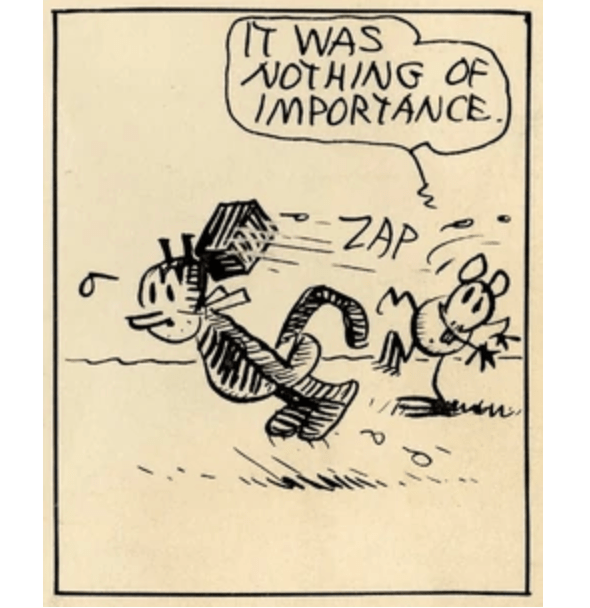
I don’t know enough about algorithms, or the psychology behind them, to have an informed opinion on how they interact with the “classic addiction loop.” But I do have some ideas about what it’s like to throw brickbats — or bricks — online. Not from psychology. Nor from scripture! But from Krazy Kat, an iconic comic strip of the 1920s and 30s that featured a lovable, goofy cat who kept getting hit with bricks thrown by a mouse named Ignatz. (Full disclosure: I identify with the cat.)
That said, I rely on social media more than Chang and French would recommend. And, all things considered, I don’t think that’s altogether a bad thing.
For one thing, much of my social life is conducted online. Just as everyone else was emerging from COVID restrictions, I was diagnosed with cancer and I still have to mask up and avoid crowds. Which means I spend more time on Zoom and social media than most. At the same time, since I first went online the 1990s I’ve loved the way the internet brings together family and people with niche interests together, literally, from all over the world.
So my Facebook friends are an eclectic bunch, including, among others, family and friends in southern Appalachia, Long Island, Norway, Denmark and the farm belt of northern Illinois and Iowa; former students and faculty colleagues at Benedictine University Springfield; dulcimer players and trad music enthusiasts from all over; and friends of friends (FB friends of FB friends?) whom I met online and whose comments and opinions seemed compatible with my own.
Not surprisingly, we skew to the left. What else would you expect from an 82-year-old who grew up in a “government town” named for the prime sponsor3 of the Tennessee Valley Authority Act of 1933? FB has enabled to reconnect with several old friends from Norris High School. We grew up at a time when congressional Republicans dismissed TVA as “creeping socialism,” and we’re still mostly old-school liberal Democrats 60 to 70 years later. Other, more recent FB friends include several folks from Champaign-Urbana I met 10 years ago as volunteers in a congressional campaign.
Chang and French make a point of mentioning friends they have lost over political disagreements — they call them “the disappeared” — but I haven’t had that many people vanish. I did lose a couple of FB friends when President Trump was first elected; they thought what I said about him was offensive, and I thought what he said about people like me was offensive. So I think it all worked out to everyone’s satisfaction. Another was a longtime friend who didn’t approve when I began posting more religious content after I went into chemotherapy and decided it was time for another spiritual awakening. (The first time was when I quit drinking through 12-step recovery in the 1980s and 90s.) But something Russell Moore said speaks more directly to me:
[…] as Twtter became more and more toxic, I was firmly ensconced on a social media platform where people were constantly criticizing and provoking me. I wasn’t sure how to handle a platform that seemed engineered to exhaust users. When we post something and others like it, this creates a little bit of dopamine. But, like anything else, we need more and more of it in order to get the same result. And being on a hamster wheel of approval seeking is the best-case scenario with any of the social media platforms. (109-10)
I don’t think I exactly get a dopamine hit from it — if there’s such a thing as a jolt of ennui, that would be a better comparison — but I’ve had trouble with trolls. One is an old Benedictine student with strong libertarian views and a flair for sarcasm. (Let’s call him Ignatz; that’s not his real name, or even his social media handle, but I think it’s appropriate for reasons that will become apparent.) I don’t mind a good political argument — I developed a pretty thick hide as working press covering a Southern courthouse ring, criminal courts and the Illinois legislature — but my other FB friends (of all political stripes) join in, and before long they’re lobbing the verbal equivalent of tactical nuclear weapons at each other.
So I’ve asked Ignatz to tone it down a little. And, more recently, I’ve taken to deleting snarky comments when he doesn’t. It leads to conversations like this: When I posted a Washington Post article quoting economists who noted “Americans would be hit by higher prices for grocery staples from abroad, such as fruit, vegetables and coffee” if Trump’s proposed tariffs are ever levied, he fired back with an article from Fox News or the National Review quoting experts who said tariffs are just fine and dandy and Democrats levy tariffs too and yada yada yada. I deleted it and posted this in its place.:
[To Ignatz] — as I’m sure you noticed, I had to delete another drive-by comment of yours. If you want to trot out partisan economists who drink the same brand of Kool-Aid as you and Trump, go ahead and do whatever makes you feel good. BUT DO IT ON YOUR OWN DAMN FACEBOOK PAGE. Capice?
A couple of minutes later, the guy posted a response — I think it had something to do with the radical Left censoring the free expression of ideas yada yada — so I replaced it with this:
[Ignatz] I’ve deleted yet another comment, and I would invite you, once again, to comment ON YOUR OWN FB PAGE. Are you beginning to notice a pattern here?
Sometimes other FB friends will chime in, as happened a day or two later when I deleted another comment and posted instead:
[Ignatz] Please stop! I have a strong belief in the hope of redemption, and I don’t want to have to block you.
At this point, another FB friend posted something about censoring conservative opinions. We’d been over this topic already, and I replied:
[Name redacted] I thought I had explained this to you, but apparently I wasn’t clear enough. I don’t want my FB page to turn into a debating club, and out of respect for my other FB friends I have asked all of you all not to stir the pot. I have learned the hard way that a perfectly innocuous comment can trigger a snarky response, and I have to step in *before* things get nasty.
But I still haven’t blocked anybody, and I still put my faith in the hope of redemption.
Notes and Links
1 Krazy Kat was a comic strip created by George Herriman; now considered a classic, it ran from 1913 to 1943. Says the Public Domain Super Heroes website, “Krazy Kat is a gentle, friendly, simple-minded and curious cat who drifts through life in Coconino County without a care. Krazy is completely smitten with the malicious Ignatz Mouse, often prompting a swift brick to the head in response. […] The world that Krazy inhabits is rather abstract and amorphous, filled with shifting scenery and surrealistic landscapes, giving the comic strips an almost dreamlike quality.” I include it with this journal as a model of how not to conduct a political (or theological) discussion. Artwork available under CC-BY-SA license.
2 Curtis Chang and Nancy French, The After Party: Toward Better Christian Politics (Grand Rapids: Zondervan, 2024). See website at https://redeemingbabel.org/the-after-party/.
3 Norris, Tenn., was built in the 1930s as a TVA model community to house workers on the Norris Dam project and demonstrate the benefits of hydroelectric power, then considered an innovation. It was named for US Sen. George Norris, R-Neb.
[Uplinked Oct. 21, 2024]

 Ordinary Time