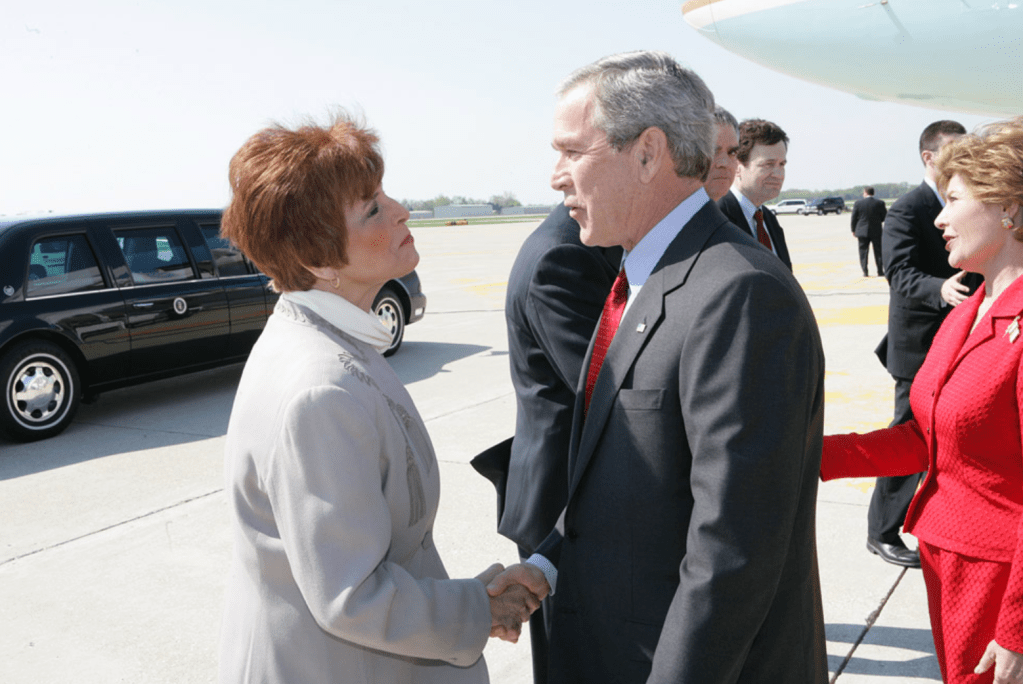
Among the reflection questions in The After Party: Toward Better Christian Politics by Curtis Chang and Nancy French is this: “Identify a story in your life when you finally discovered you were wrong about something important. The story doesn’t have to be about something political per se” (96). After Party explores how congregations can move past political discord by encouraging hope and humility. This question comes up in Chapter 3, which is about a type they call “the Combatant,” and it’s not hard to see where humility fits in.
In fact the hard part, for me, is choosing which time I discovered I was wrong. There are so many to choose from! But we’re going over Chapter 3 this coming Sunday for a parish book study called Sundays@6. So I have to choose one.
After thinking it over, I decided I’d go with the time I didn’t vote for Judy Baar Topinka.
An old-fashioned Republican from the Chicago suburbs, Topinka was the Illinois state treasurer who followed my old boss, a “Chicago reform Democrat” (if you’re OK with a triple oxymoron) named Patrick Quinn. She was a good treasurer, handling the duties of that ministerial office efficiently and without too much scandal (for Illinois), and she treated Democratic holdovers in that down-ballot elected office fairly.
The Statehouse press corps liked Topinka, too. She was candid and outspoken, always good copy. She was especially famous, in fact, for a fart joke. A reporter for NPR Illinois recalled:
Topinka was part of the 1994 Republican wave that captured all six statewide offices, the state Senate, and even the Illinois House. Topinka talked about that during her inauguration speech. But she never took herself too seriously, even making time for a joke about flatulence.
“You cannot believe what it’s like to campaign for 22 months, especially in those areas that specialize in ham and beans [at local political events],” Topinka said. “It was a small van.”
By then I had left the Statehouse for a teaching job, but I arranged for one of my journalism students, a young woman from the Czech Republic, to interview her. Topinka’s heritage was Czech, and she spoke the language fluently; she took time out of her schedule to meet the kid, and hearing about it was one of the highlights of my teaching career.
In 2006, after two terms as state treasurer, Topinka won the GOP gubernatorial primary with 37 percent of the vote after a divisive, negative campaign that featured two hard-right contenders, one of whom ran negative 30-second spots “using ‘fake’ headlines on the images of actual Illinois newspapers.” We didn’t know it at the time, but it was a foretaste of what was to come in Illinois Republican politics.
Topinka’s opponent in 2006 was incumbent Democratic Gov. Rod Blagojevich, who later would be impeached, removed from office and convicted of federal charges of extortion and lying to the FBI in connection with a scheme to sell Illinois’ US Senate seat (vacated by President-elect Obama) “to the highest bidder.” In 2006, all of that lay in the future, of course, and some decent legislation had passed during his first term.
But already there were warning signs. For one thing, state Attorney General Lisa Madigan, a Democrat, refused to endorse Blagojevich for re-election, citing a conflict of interest because the AG’s office was actively investigating him. There were other rumblings of sleazy dealings, too, so with hindsight I realize we should have seen what was coming.
But I voted for Blagojevich anyway.
I’d like to be able to say it was because of his legislative record. After all, he did support gun control and an ethics bill sponsored by then-state Sen. Barack Obama, D-Chicago. And Topinka had been around Illinois politics long enough to have a scandal or two of her own, like a hotel deal that would have benefitted Springfield real estate developer (and GOP kingmaker) Bill Cellini. That would have given me an excuse, but I didn’t even think of it.
No, I liked Judy Barr Topinka, but I voted against her.
And I had, putting it charitably, reservations about Blagojevich. But I was so damn mad at President George W. Bush in 2006, I voted the straight Democratic ticket.
You see, the Illinois governor’s race wasn’t the only one on the ballot. In the fall of 2006, the Iraq war was going badly and the Democrats were on track to regain control of Congress. The result? A “remarkably ugly” campaign, in which “Bush all but accused Democrats of committing treason,” as John Dean put it in a column on the FindLaw website. (Yes, that John Dean, the former White House counsel of Watergate fame.) Bush’s rhetoric at a rally in Georgia was especially ugly.
“However they put it, the Democrat [sic] approach in Iraq comes down to this: The terrorists win and America loses,” said Bush, as reported by the Washington Post. How mild-mannered and quotidian it all seems by today’s standards! But it was enough for me.
That November I voted the straight Democratic ticket (with the “-ic” restored at the end).
Reflection Questions
Chang and French have several. Taking them one by one: Identify the process by which you discovered that you were wrong about this issue. How did this discovery happen?
It didn’t take long. If there were warning signs in Blagojevich’s first term (and there were plenty), his second removed all doubt. He was transactional, and he went after his political enemies with a vengeance. He zeroed out budget line items because of personal snits with individual legislators; his meddling with the Department of Children and Family Services funding, in fact, caused a couple of little social service 501c3’s I knew of to go out of business. More chillingly, I began to hear rumors of midlevel management types in the state agencies who felt pressured to commit acts that were prima facie violations of the law.
In the meantime, we started reading in the Trib and Sun-Times that Blagojevich had double-crossed his political mentor (and father-in-law), a Northwest Side Chicago alderman, and the old man’s precinct captains were ratting him out to the US Attorney’s Office for the Northern District of Illinois.
It all came to a head Dec. 9, 2007, when Blagojevich was busted on federal charges of bribery and wire fraud. (Ultimately he would be sentenced to 14 years in prison, and serve time until his sentence was commuted by President Trump.) It wasn’t so much an epiphany as confirmation of something I should have known when I voted that straight ticket on Nov. 7, 2006.
Judy Barr Topinka’s subsequent political career was more successful than the guy I voted for. But the signs of trouble ahead in her Republican Party were already apparent, at least with hindsight. Wikipedia puts it nicely. “The [2006] Republican primary was deeply divisive; her tenure as Party chairman destroyed her support from the conservative wing of her party, and it was feared that her pro-choice and positive gay rights positions would be detrimental to her standing with the same conservatives.”
Topinka would go on to be elected state comptroller, another down-ballot ministerial office, in 2010 and 2014. She died in December 2014. But by that time, it was already clear her party was becoming more extreme and partisan and her brand of politics was on the way out. Brian Mackey of NPR caught the mood nicely, quoting Topinka’s remark that her job as comptroller required her to be ” the skunk at the picnic” when she brought bad fiscal news:
Of course, the reality is Topinka was just the opposite of a skunk at a picnic. The tributes that have followed her death show she was well-liked across the political spectrum.
Her absence from the political scene leaves that unique attribute in considerably shorter supply.
A bit understated perhaps? With the benefit of hindsight, I’d say it was wildly, boisterously, extravagantly understated.
As you reflect on that story, what wisdom do you want to take from it and apply to how ou relate to others around politics?
Ah, this question is a little trickier than it appeared at first. It would be very easy to say I was snookered by partisan politics into voting for a guy who was transactional, vengeful, impulsive and a threat to democracy. And there’s some truth in that.
Certainly I can look back at President Trump’s first term in office, and what he promises for the second, if elected, and the parallels are eerie. He and Blagojevich were birds of a feather (as Trump amply demonstrated, in my opinion, when he said the Democrat’s sentence was “ridiculous” and commuted it). But if there’s a lesson in the parallels, for me, it’s confirmation there are scoundrels in both parties.
Another possible lesson: In many ways, Judy Barr Topinka was the last of a type of old-school, “moderate” Illinois Republican. I’m a lifelong Democrat, but I’ve crossed over and voted for individual Republicans whenever they were clearly better qualified than the slated Democrat. In fact, I voted for Topinka a couple of times. In the last 10 years or so, since the GOP has been all but hijacked by extremists, I think it’s especially important to have two viable parties.
But I’m not going to make the case my vote would have affected the outcome in 2006. Do the math: Blagojevich’s popular vote in the governor’s race was 1,736,731; Topinka’s was 1,369,315. Would it have changed history if the tally were 1,736,730-1,369,316?
But here’s what I did — I missed a chance to vote for a decent human being who worked for the common good, even if I didn’t agree with all of her policy positions (and who even regaled the Statehouse pressroom with fart jokes). I think I was angered by Bush and Vice President Cheney with good cause — I don’t like being accused of treason — but the governor of Illinois wasn’t responsible for the Iraq war.
And by casting an irate, purely partisan vote, I was buying into precisely the “us-vs.-them” mentality I objected to in Bush and Cheney. So I have to keep asking myself: Are my hands clean?
Which, maybe, isn’t such a bad thing after all.
Identify a situation in your life where you see the us-versus-them mindset predominating. It could be a situation about politics per se, but it culd be some other kind of division in your neighborhood, school, extended family, church, etc.) Put on the “mind of Christ” and imagine Jesus entering this situation […]
Hoo boy! The possibilities here are endless. And so are the challenges. For one thing, I can’t imagine Jesus voting in an Illinois election. Would he back the Chicago machine Democrats or the tub-thumping downstate populists who hijacked the ILGOP since Judy Barr Topinka’s day? For another: How can I be sure I’m not creating the “mind of Christ” in my own image? (“Why of course I’d vote the straight Democratic ticket,” I can hear my Jesus saying. “Isn’t that the first and greatest commandment of St. Richard Daley?”) Chang’s and French’s question is thought-provoking, and I can see already I’ll have to give it careful thought.
So why not roll it over till next week?
Besides, I’ve been sneaking peeks at the next chapter, and it’s going to discuss social media. I’ve been bothered lately by political snitstorms (my word for them) on my Facebook feed, and Chapter 4, “The Exhausted,”may give me some insights on how to handle them. It’s a conundrum. Sometimes I’ll trigger the snitstorm by posting a snarky meme, and sometimes a perfectly innocuous post will trigger a snarky comment. Still other times, an innocuous comment will trigger a snarky reply. Either way, unless I nip it in the bud, my poor little FB feed will blow up into a Category 5 snarkopalooza. Chang and French are right — political combat is nothing if not exhausting.
So when Russell Moore, former president of the Southern Baptist Convention’s public-policy arm, speaks in the next chapter of “Twitter hysteria” amid the “constant barrage of developments, outrage, and trivia in our never-ending news cycle” (111-12), I’m ready to listen. And to see what I can take away from his experience and use in my own spiritual life.
I disagree with Moore on several important points, both political and theological, but he knows something about moving beyond exhaustion. After he was forced out of SBC leadership, he wound up as editor-in-chief of Christianity Today; its theology is a little too Calvinist for my taste, but it was founded by evangelist Billy Graham and it’s widely respected beyond evangelical Protestant circles. Not a bad comeback for Moore! I’m betting I can learn something from him about how to move beyond the little snitstorms on my FB feed.
Links and Citations
Michael Abramowitz, “Bush Says ‘America Loses’ Under Democrats,” Washington Post, Oct. 31, 2006 https://www.washingtonpost.com/wp-dyn/content/article/2006/10/30/AR2006103000530.html.
Curtis Chang and Nancy French, The After Party: Toward Better Christian Politics (Grand Rapids: Zondervan, 2024): 96-97, 104-5, 111-12.
John W. Dean, “Are Congressional Wars Coming? Since Cheney Has Already Said He’ll Ignore the Democratic Congress, It Seems Likely,” FindLaw, Dec. 1, 2006 https://supreme.findlaw.com/legal-commentary/are-congressional-wars-coming-since-cheney-has-already-said-hell-ignore-the-democratic-congress-it-seems-likely.html.
Brian Mackey, “Topinka Remembered For Sharp Tongue, Common Touch,” NPR Illinois, Dec. 10, 2014 https://www.nprillinois.org/statehouse/2014-12-10/topinka-remembered-for-sharp-tongue-common-touch.
“Timeline of of Blagojevich’s political career, criminal case,” Associated Press, Feb. 18, 2020 https://apnews.com/general-news-12dd99b4d8bdcd5bd68dfba8506a0ff9.
[Uplinked Oct. 11, 2024]

 Ordinary Time
Great post! One of your best.
LikeLiked by 1 person
Why thank you! That curriculum you found really gets me to thinking.
(Which is what it’s supposed to do, I guess. Anyway, it’s exceeded my expectations.)
LikeLiked by 2 people
I liked judy
I never voted for Rodney
I believe hindsight is our most trusted friend.
LikeLiked by 1 person
I wish I remember the details, but I liked the way she was accessible to Pavla. (I think she was at SCI a little before your time. Very bright, motivated kid. Came to the States with no financial backing, got scholarships at a Dominican high school in suburban Chicago, SCI and a four-year college down south somewhere.)
LikeLike