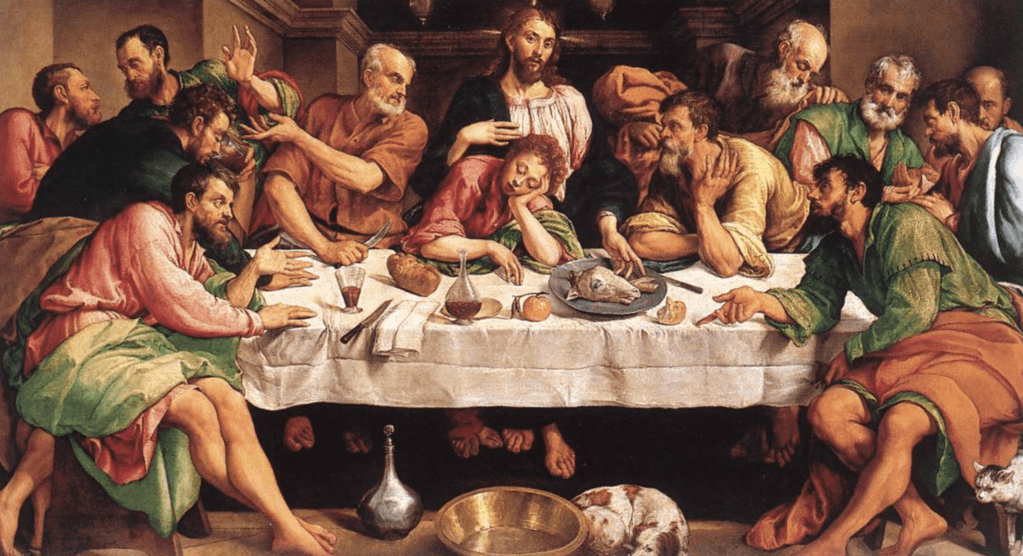
Next week’s session of Sundays@6, an online parish book study group Debi and I facilitate, will take up the first chapter of The After Party: Toward Better Christian Politics, by Curtis Chang and Nancy French; it’s an interactive group study curriculum for mostly evangelical Protestant churches that have been split by right-wing populism and hope to heal the resulting political discord. We thought it would be timely in the runup to the Nov. 5 election.
One of the exercises was right down my alley, since it was remarkably similar to Jesuit spiritual exercises I already practice on occasion. (But this time, with a twist.) Which is a plus. Like St, Ignatius’ exercises, it led me in unexpected directions. Another plus!
Noting that Jesus’ 12 disciples include “Matthew the tax collector” and “Simon the Zealot,” Chang and French suggest that considering the political divisions in 1st-century Palestine, the disciples were a pretty mixed bag. Tax collectors collaborated with the Roman occupation, and the Zealots worked for a violent uprising against it. An intifada, if you will. Things must have gotten as tense as Thanksgiving dinner in a 21st-century swing state.
“Maybe Matthew would hear about the most recent act of Zealot violence against a fellow tax collector, and he might mutter, just loud enough for Simon to hear, ‘It’s time some Roman swords put a stop to these things’.” Chang and French suggest. “Or imagine Simon, upon hearing the announcement that tax rates had been raised again, smirking at Matthew and asking, ‘So, what do you think about that, huh?'” (41-42).
So here’s the exercise
“Take a minute,” say Chang and French, “to imagine the first dinner party that Jesus threw with all twelve [disciples] included.” They suggest four writing prompts:
- Where do you picture Matthew and Simon sitting?
- How are they looking at each other?
- What is going through each of their minds?
- In your imagined seatings, where is Jesus sitting?
- What do you think is going on in Jesus’ mind? (41)
OK, I’m game! I’m fascinated with Historical Jesus research (for one thing, it helps me wrestle with the whole issue of incarnation). And as a history buff I enjoy a spiritual exercise that allows me to “compose the place,” as Ignatius called it, by imagining myself in a gospel story.
But sometimes I get hung up on historical accuracy. For one thing, I don’t know what the equivalent of a modern dinner party would look like in 1st-century Capernaum.
I do know, from reading historical Jesus scholar John Dominic Crossan and archaeologist Jonathan L. Reed, what Jesus’ home in Capernaum looked like — and how people gathered to eat, “not on plates, but on bread, onto which they ladled olive oil, lentils, beans. or vegetables in some for, sharing olives and perhaps a bit of cheese or fruit” (96). Most religious art through the centuries, which I like to consult when I’m composing the place for a meditation, is based on Leonardo daVinci”s Last Supper, and it doesn’t get me into that 1st-century Palestinian dwelling in Capernaum. Even Jacopo Bassano’s 1542 rendition in the Galleria Borghese, which suggests what a motley crew the disciples could be, shows them gathered around a long table instead of a pot of lentils.
So I decide to pull a switcheroo and transpose the scene to modern America, where I can recognize subtle differences in political orientation, social class and other telltales. Since I’m using my imagination, I decide it isn’t cheating to call on my guardian angel and transpose the scene. The angel appears, and I explain my dilemma. He reminds me a little of my father, very methodical, soft-spoken and careful.
“So you’re having dinner with Jesus,” my angel asks. “What’s the best restaurant you’ve ever been to?” That’s a tough one, I think. There are so many! Then I recall an unpretentious little Cuban restaurant I visited once in a working-class majority Cuban neighborhood in Tampa. It shared half of a storefront with a bodega, and inside it was packed with with people at formica-top tables.
The place was crowded that night, maybe half the people at the tables speaking Spanish. I was in town for a conference of the National Association for Foreign Student Affairs (now rebranded as NAFSA: Association of International Educators), and a group of us went there with a guy from the local arrangements committee. He recommended we try the chicken paella. We did, and it was wonderful! I’d never had saffron rice before, and I’ve never forgotten that seedy little restaurant.
“OK,” says my guardian angel as he produces a time machine and twiddles the knobs. “Let’s try this.” And I’m transported in my imagination to a nondescript little neighborhood restaurant that’s almost an exact replica of the one in my memories of NAFSA conference in Tampa. I walk in the door, and explain to a waiter I’m here to meet Jesus and his disciples. He leads me to a little side room.
And there, I see what I can only describe as a foretaste of the kingdom of God.
There must be 30 or 40 people there, ranged around half a dozen tables or just standing around, chatting with each other and entirely oblivious to a TV mounted on the wall. None of this Renaissance painterly iconography with 12 men in robes gathered along a long table with a white tablecloth and a backdrop of arches and columns in four-point perspective. As I look around, I notice they’re sitting or standing in little groups, talking with each other. It reminds me a little bit of a Chamber of Commerce mixer, where more than half the people don’t know each other.
I hear both English and Spanish being spoken — after all I asked my guardian angel to find me a restaurant in Tampa — and people are dressed in everything from work clothes to business casual and nice dresses. That’s right. A diverse group. A motley crew. Not just 12 dudes around a table. More like one of the dinner parties in Jesus’ parables than Leoardo’s painting. Several children are running around, too. Playing tag? They’re having fun, whatever they’re doing.
As I look around the room, I notice a big, burly guy with a red beard holding forth to a little crowd. He’s wearing jeans and a flannel shirt, and he’s talking about the weather forecast. I wonder if he works for one of the commercial fisheries in the Tampa Bay area. St. Peter? I bet he is. There’s a guy in the group who looks a lot like him. Clean-shaven, though, a little older maybe. Isn’t saying much. His brother Andrew, I’ll bet. The group isn’t limited to 12, like I said, or to men only. I’m pretty sure I recognize Mary Magdalene chatting up a couple of guys dressed in business casual. Latina. She reminds me of Ana Navarro of The View. Assiduously working the room are John and James, sons of Zebedee, aka the Sons of Thunder. Also working the room, briefly chatting up first one disciple and going on to another, is Jesus.
But where are Matthew the tax collector and Simon the Zealot? Off to the side, standing near the door, I notice a guy wearing a business suit eyeing the crowd He must be Matthew — he’s the only guy in a suit and tie, and he looks like he’s in middle management with the IRS. He’s not saying much. Speaks when spoken to, but mostly he looks like he’s just watching to see what happens next.
As I look around the room, I notice another guy who kind of sticks out like a sore thumb. He’s seated at a table with a couple of other guys, talking quietly and occasionally looking at his phone. He isn’t really interacting with anyone else, and I wouldn’t connect him with Simon the Zealot if he weren’t wearing an especially bright Hawaiian aloha shirt. I’ve noticed in the TV coverage of protest marches and BLM demonstrations, some of the white supremacist militias deck themselves out with assault rifles and Hawaiian shirts. I can only guess what he’s thinking, but I imagine he’s biding his time, like Matthew the IRS guy, and waiting to see what happens next.
Dinner is served, and there’s a seat open at the Hawaiian shirt guy’s table. I ask him if he’s part of a militia. “Oh, no,” he says. “The Boogaloo Boys wear these, but I’m not into violence.” Still, he says, the Boogaloo Boys, the Proud Boys have some pretty good ideas. We live in a dying empire, and it maybe we should just tear it all down and start over. And so on. We talk some more. “I just want to see what this Jesus dude has to say. He’s always talking about the wrath of God, and I could get into that. But he’s got a whole new way of looking at things,” adds Simon the Zealot.
After dinner, Jesus gets up and asks if he can say a few words. “The kingdom of God is drawing near,” he begins.
And yes, I think, it is. This is how it begins.
Unpacking the exercise
Usually when I do an Ignatian exercise, I end up thinking St. Ignatius would be horrified with my version of his spiritual practice. With this one, I have a nagging suspicion Chang and French would think I missed the point of theirs. At least I left some of the questions in their prompt unanswered. How are [Matthew and Simon] looking at each other? In my imagination, they don’t. Both stay on the margins of the crowd, of the developing community of disciples. (Am I projecting? That’s what I would do if I were either.) Jesus isn’t sitting — this isn’t Leonardo’s painting — but hosting the gathering instead. Talking with everybody. Making sure they feel included.
In short, he’s acting like the leader of a nascent movement. Bringing people together. But he’s playing a long game. What do you think is going through Jesus’ mind? Maybe something like this: The Kingdom of God is drawing near. It’s here among us, in fact. You can’t say, “Look, here it is,” or “there it is.” It’s inside us. But, now what do I have to do to get all these guys to realize it?
At least that’s how I unpack it. It’s more about building community — and bringing in the kingdom of God incrementally — than getting Simon the Zealot and Matthew the tax collector on the same page. Chang and French take a different tack, but I think maybe we end up in more or less the same place. Here’s how they unpack it:
So lets’s imagine that first Jesus party. None of the disciples really grasped Jesus’ agenda. Yet here they were. In my version of this imaginative exercise, Matthew and Simon anchor opposite ends of the dinner table, with their arms folded, their eyes alternate between avoiding each other and glaring at each other, their bodies tense with suspicion and alarm. And sitting in the middle is Jesus, wearing (in [the authors’] imagination) a knowing smile. (42)
I can see that happening at a future party in another meditation, or, perhaps better, a tense exchange followed by a quiet conversation between Matthew and Simon when they’re away from the other disciples. One of the key points in The After Party is a conscious shift from what Chang and French describe as the “the what of politics” — issues and talking points, basically — to “the how of politics.”
And that boils down to spiritual values, relationships and practice, beginning “with the spiritual values that Jesus taught, including love, forgiveness, mercy, justice, truth, and two more values The After Party will especially focus on: love and humility” (24).
In a word, to building — or restoring — community.
Works Cited
Curtis Chang and Nancy French, The After Party: Toward Better Christian Politics (Grand Rapids: Zondervan, 2024).
John Dominic Crossan and Jonathan L. Reed, Excavating Jesus (San Francisco: HarperSanFrancisco, 2001).
[Uplinked Sept. 25, 2024]

 Ordinary Time
Nice! Yes, you do have fun with these exercises …
LikeLike