Well, well, well, it looks like I’m on Facebook’s naughty list.
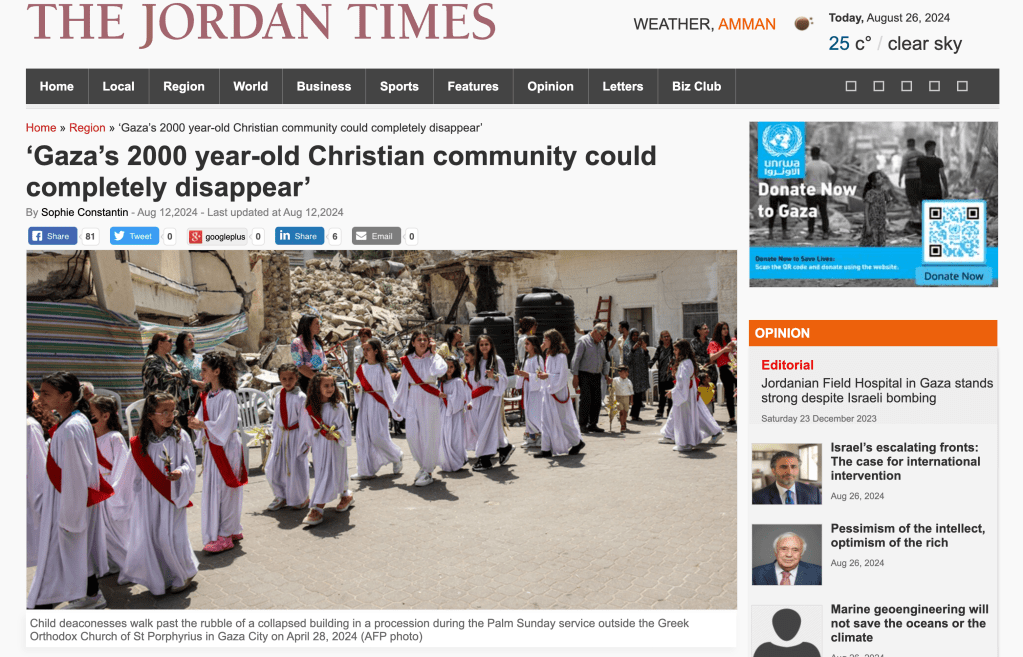
Here’s how I got there. I tried to copy an article in The Jordan Times, an English-language newspaper published in Amman, the capital of Jordan, on the plight of Christians in Gaza. Written by Sophie Constantin, an archaeologist and art historian with a masters from the Université libre de Bruxelles who now lives in Amman, it notes that Christianity dates back to the first century CE in Gaza, and now is in danger of disappearing altogether.
Recently I co-facilitated a parish small-group discussion on ELCA Sumud, a Lutheran advocacy group that supports Palestinian Christians and NGOs of all faith traditions. Constantin’s article was unusually well documented, tracing the origins of Christianity in Gaza. She summed it up briskly, in a few paragraphs:
Christian Palestinians trace their origins back to the first Aramaic-speaking Jewish converts, who were later joined by Latin and Greek-speaking Romans, Greeks and descendants of various people, including Phoenicians, Aramaeans, Arabs, among others, as noted by the scholar Gerd Theisen, theologist of the New Testament.
Following the Muslim conquest, many non-Arabic-speaking Christians gradually adopted Arabic, blending into the broader Arab Christian identity, alongside communities like the Arab Ghassanids, who remained Christian and integrated with Melkite and Syriac communities across the region, explained the historian Nur Masalha in a paper for the Centre of Palestine Studies at the University of London.
Today, Palestinian Christians represent a rich tapestry of denominations, including Eastern Orthodoxy, Oriental Orthodoxy, Catholicism (including both Latin and Eastern Rites) and Protestantism, forming a small yet significant part of the Palestinian population.
The Lutherans we studied in my parish book group, in other words, are a small yet significant part of a small but significant part of the Palestinian people. I thought Constantin’s Jordan Times story might be of interest to my FB friends who have seen other my posts on Palestine.
So I posted her story.
Or — more accurately — I tried to post it.
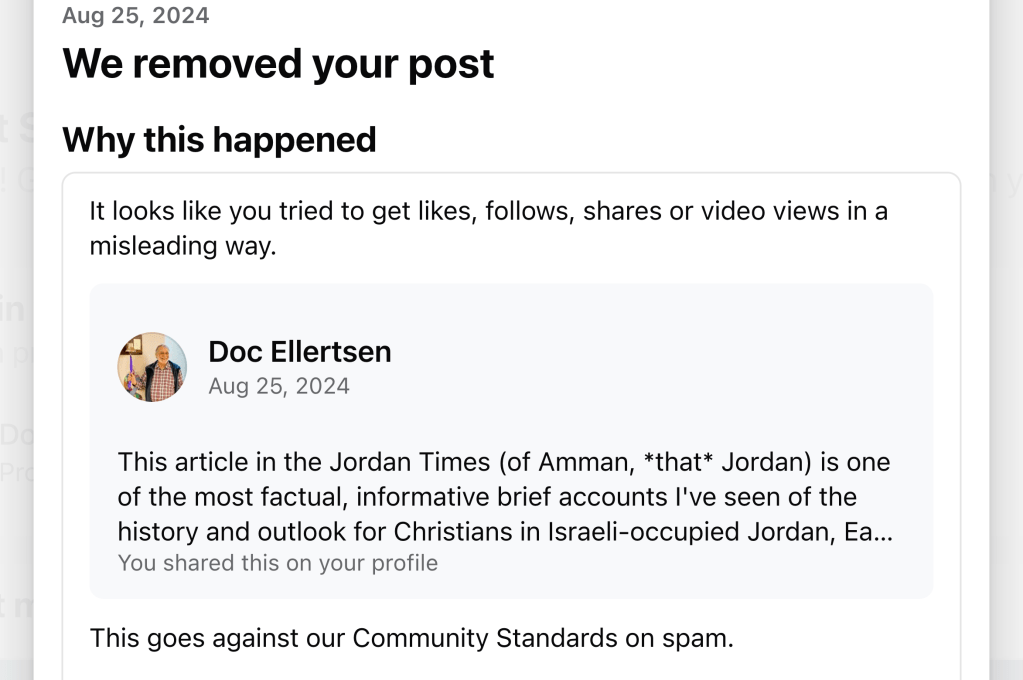
But I got a string of error messages, then this notice:
I don’t know exactly what triggered FB’s algorithms, but I can make an educated guess. In December 2023, an international human rights NGO tallied 1,050 posts on FB and Instagram that were taken down in October and November, after the current armed conflict in Gaza began on Oct 7. The breakdown was telling:
Human Rights Watch publicly solicited cases of any type of online censorship and of any type of viewpoints related to Israel and Palestine. Of the 1,050 cases reviewed for this report, 1,049 involved peaceful content in support of Palestine that was censored or otherwise unduly suppressed, while one case involved removal of content in support of Israel.
A New York-based NGO with a Nobel Peace Prize to its credit (in 1997, for campaigning against landmines), Human Rights Watch has been accused of being “biased against Israel,” among other governments it has criticized, but overall has a sterling reputation for thoroughness and objectivity. HRW found a “systemic and global” pattern of cracking down on pro-Palestinian posts that predated Oct. 7 and noted that complaints were still coming in after the reporting deadline.
That pattern has continued, according to a HRW report to the United Nations in July. One detail in that report, to the UN’s Special Rapporteur on Freedom of Opinion and Expression, caught my eye:
In cases where removal or restrictions on content and accounts were accompanied by a notice to the user, Meta’s most widely cited reasons were Community Guidelines (Instagram) or Standards (Facebook) violations, specifically those relating to “Dangerous Organizations and Individuals” (DOI), “Adult Nudity and Sexual Activity,” “Violent and Graphic Content,” and “Spam.”
In hundreds of cases documented by Human Rights Watch, the slogan “From the river to the sea, Palestine will be free” as well as comments such as “Free Palestine,” “Ceasefire Now,” and “Stop the Genocide,” were repeatedly removed by Meta’s platforms under “spam” Community Guidelines or Standards without appearing to take into account the context of these comments. These statements and the context in which they are used are clearly not spam nor appear to violate any other Facebook or Instagram Community Guidelines or Standards.
Spam? That rings a bell. When FB informed me it removed my post, the explanation was: “It looks like you tried to get likes, follows, shares or video views in a misleading way. […] This goes against our Community Standards on spam.”
My suspicion is that whatever triggered FB’s algorithm, it wasn’t a dangerous organization (the Christian churches in Palestine?); or “Adult Nudity and Sexual Activity” (a picture of young girls wearing white robes for Palm Sunday outside St Porphyrius Greek Orthodox Church in Gaza City?). Nor were the girls, youth deaconesses at St Porphyrius, engaged in “Violent and Graphic Content.” Since it didn’t fit the other categories, I’m guessing, they called it spam.
“Spam,” as far as I can tell, in this instance means something like I-can’t-tell-you-what-it-is-but-I-don’t-like-it. I think spam, if you can disregard the word picture raised by the cliche, like beauty, is in the eye of the beholder.
I also think it’s important to point out that Human Rights Watch doesn’t accuse FB, or its parent company Meta, of outright bias either for or against Israel. Instead, in its report to the UN ‘s Special Rapporteur, the NGO suggests, “the problem stems from flawed Meta policies and their inconsistent and erroneous implementation, overreliance on automated tools to moderate content, and undue government influence over voluntary content removals.”
An article by Bani Sapra in Wired sheds more light on the subject. While Human Rights Watch didn’t elaborate on its claim of government influence, Sapra does. She quotes Mona Shtaya, who works with the Arab Center for Social Media Advancement (a digital rights organization more commonly known as 7amleh):
Government requests to take down content also play a role, [Shtaya] says, citing a 7amleh report that said Facebook accepted 81 percent of requests made by Israel’s Cyber Unit to remove Palestinian content, while Twitter suspended dozens of Palestinian users based of information from Israel’s Ministry of Strategic Affairs.
Again, I have no evidence that my post was taken down at the behest of Israel, or any other state actor. But, since I wasn’t able to contact FB to find out why they took it down, I don’t want to trigger the algorithm again when I share this post to social media.
So I’ll conclude by speaking in the most general, and anodyne, of terms: Sophie Constantin’s article brings together up-to-date information about the Christians who are sheltering Gaza City’s Saint Porphyrion Orthodox Church, Holy Family Latin (Catholic) Church and the adjacent convent of Sisters of Mother Teresa. It also details Israeli attacks on both churches as well damage done by airstrikes and bombardment to Gaza’s Baptist church, two Byzantine-era churches and Ahli Hospital, the only Christian hospital in the Gaza Strip, run by the Anglican Church. Constantin concludes:
The relentless war and blockade have accelerated the exodus of Christians from Gaza. The International Christian Concern has warned that the Christian community in Gaza, now reduced to less than 800, could disappear entirely if the current situation persists. As Israeli airstrikes continue to devastate Gaza, churches, hospitals and ancient Christian sites face destruction, threatening the survival of this ancient community.
(International Christian Concern is an ecumenical, nonpartisan human rights NGO headquartered in Washington, DC.) If you want to know more Christians in Gaza, or to see Pope Francis’ reaction to the shooting death of two parishioners at Holy Family parish just before Christmas, link below.
Links and Citations
Sophie Constantin, “‘Gaza’s 2000 year-old Christian community could completely disappear’,” Jordan Times, Aug. 1, 2024 https://www.jordantimes.com/news/region/%E2%80%98gazas-2000-year-old-christian-community-could-completely-disappear%E2%80%99.
“Human Rights Watch’s Submission to the United Nations Special Rapporteur on Freedom of Opinion and Expression,” Human Rights Watch, July 31, 2024 https://www.hrw.org/news/2024/07/31/human-rights-watchs-submission-united-nations-special-rapporteur-freedom-opinion.
“Meta’s Broken Promises,” Human Rights Watch, Dec. 23, 2024 https://www.hrw.org/report/2023/12/21/metas-broken-promises/systemic-censorship-palestine-content-instagram-and.
Bani Sapra, “Facebook’s algorithms silenced Palestinian voices. Can its biases ever be fixed?,” Wired, July 27, 2024 https://wired.me/business/big-tech/facebook-content-moderation-palestine/.
[Revised and uplinked, Sept. 5, 2024]

 Ordinary Time
Hopefully they won’t bother you here …
LikeLiked by 1 person
I think we’re good. It’s annoying when FB does that, but I don’t think it was an intentional act of censorship. Just one more small indication of why I think the Silicon Valley tech bros who control social media aren’t capable of managing a drive-in hamburger joint.
LikeLiked by 1 person