Lasr of four journals based on my answers raised by “discernment questions” sent to Dominican Associates in advance of an Aug. 24 retreat at the motherhouse in Springfield, Today’s concern Associate Life, i.e. how lay Associates incorporate the Dominican charism of prayer, study, community and ministry; and the mission “to seek truth, make peace, and reverence life” in their daily lives. See HERE for more info on the discernment process, the questions and the retreat in the first journal. — 2024 Discernment Materials for Renewal of Associate Commitment, Springfield Dominican Sisters.
Two years ago, I formally committed to “share in the spirit and mission of […] the Dominican Sisters of Springfield, Illinois,” and to “join [them] in preaching the Word and witnessing Gospel values” as a lay associate. It was a milestone in a journey that had taken me at least three decades. Now I’m finding out it was more of a turning point than a culmination.
Thirty years before, I couldn’t have imagined I’d ever be doing any such thing.
In the 1980s I was a reporter for the Rock Island Argus. A recent Southern expatriate, I fancied I could do a kinda funny imitation of a down-home sidewalk preacher, especially after sharing a pitcher of beer; I’d call myself “Brother Petey Bob,” and I’d regale other media types with my barroom homiletics across the river in Davenport, Iowa. Especially after we’d shared a couple of pitchers, they thought it was kinda funny.
Fast forward to May 2022, and the same barroom clown affiliates with the Order of Preachers, as the Dominicans are formally known. An odd transformation? Well, yes, maybe, but we live in odd times. It’s getting to be well known among Catholics that the “Nones,” as the Pew Research Center terms atheists, agnostics and people who describe their religion as “nothing in particular” in survey research, have more than you might think in common with women religious, “who mostly prefer to be called sisters,” as Kaya Oakes puts it, “but will settle for being called nuns.”1
One thing many Nones and nuns (or sisters) have in common, says Oakes in an article headlined “What can nuns and ‘nones’ learn from one another?” in the Jesuit magazine America, is a “depth of spiritual seeking” combined with a desire — I’d call it a thirst — for social justice.
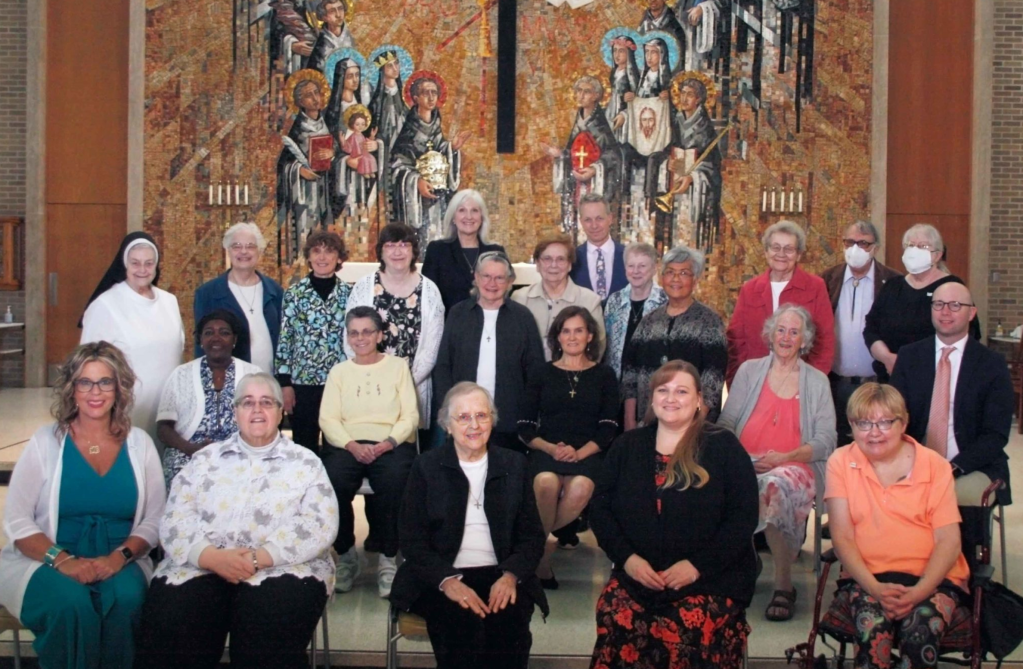
Anyway, the afternoon of May 1, 2022, Debi and I proclaimed our commitments and were formally received as Springfield Dominican Associates. It has turned out to be, as I suggested above, more of a milestone, even a starting point, than a culmination.
“Dominican associates embrace the Dominican traditions of prayer, study, community, and ministry,” said Sr. Beth Murphy OP in a press release. “They respond to God’s call to share the Gospel by preaching it through the witness of their lives.”
I can’t think of a better segue to journaling on the discernment questions:
What is my commitment to Associate Life? When I was received as a Dominican associate on May 1, 2022, I pledged to do four things:
- Co-facilitate, with Debi, an adult faith formation study group (a fancy word for book study) over Zoom for our parish church, Peace Lutheran of Springfield;
- Continue the historical research I was doing at the time on 19th-century Swedish Lutheran churches in Chicago and the upper Midwest;
- Learn more about the Dominican charism (a gift of the spirit, or, in my mind a kind of mission statement), especially the sisters’ work with Jubilee Farm; and
- Continue spiritual direction (which I had been doing with the Dominican sisters.
Some of this came to happen; some of it didn’t. And some of it went off in unexpected directions. Instead of Jubilee Farm, I wound up joining a newly formed associates’ anti-racism committee, an offshoot of SDART (pronounced ess-dart, short for the Springfield Dominican Anti-Racism Team), which “commit[s], as a publicly identified anti-racist congregation, to work toward an inclusive and anti-racist church and world.”
For me, meeting with the SDART people has been 99.9 percent a learning experience. Sometimes (especially perhaps for a retired college professor) the best way to contribute is to shut up and listen.
One commitment fell by the wayside. When I was diagnosed with cancer in the fall of 2022, I put aside my work on Swedish immigration and haven’t gotten back to it. I need to rethink the project, anyway, in light of the recent upsurge in white Christian nationalism. I still blog (well, duh, of course, you’re reading this on a blog!), and I’ve turned into something of a keyboard warrior on social media. But I don’t know whether to count that as preaching with the witness of my life, an addiction or a form of procrastination.
I do post religious and spiritual content — I think it’s important not to allow right-wingers and white Christian nationalists to hijack the trappings and language of religion — but I don’t expect to be greeted at the Pearly Gates with cries of “Oh, you’re the guy who posted the meme about Donald Trump and the Golden Calf!”
So when I rewrite my commitment statement, I’ll have some revisions to make.
But the overall thrust will be the same as in May 2022. In fact, most of what I pledged to do then was stuff I was already doing. And most of it I’m still doing. Trying to line my life up with the Dominicans’ charism and traditions hasn’t led me off in new directions as much as it has given me a focus and some guidelines. I’m still in spiritual direction. And Debi and I still co-facilitate the Zoom book study — we call it Sundays@6 — in fact, one of the books we studied was one we first read for SDART associates’ committee meetings, Caste by Isabell Wilkerson.
How do you live our the Mission to seek truth, make peace and reverence life? With this question, I can be very brief. I pretty much keep doing what I’ve been doing all along, but I have tools to help keep me focused. One of the most important is what Dominicans call the “Four Pillars” of Prayer, Study, Community, Preaching and Ministry, or Service.
How do you live out the Four Pillars of Dominican Life? Sporadically, might be the best answer! Prayer, I struggle with. I’d say it’s been the main focus of my spiritual direction. At best, you might say it’s a work in progress. Study? I’ll give myself at least a B+ there. What else is an old college professor gonna do? Much of my study has been inspired by taking part in the SDART associates’ committee. That may seem ironic, since I decided early I’d contribute the most by keeping my mouth shut and my ears open. But I suspect there’s a lesson in there somewhere — maybe to be less professorial, to shut up and let other people talk.
The original SDART, made up of 20 sisters and 20 lay people of color, was founded in 2004; they’re been at it 20 years now, and it was clear to me from the beginning that these people walked the talk. In addition to study, taking part in the associates’ committee has promoted community, as I have gotten to know other members through our Zoom sessions, and service through Sundays@6, our parish book study.
I knew the Dominican sisters had actively worked for better race relations in the larger Springfield community. In fact their social justice advocacy was what drew me to consider the Dominican associates’ program in the first place. But I didn’t realize they began at home — by examining the effects of institutional racism on Dominican policies and procedures.
As a result, hiring procedures and other policies have been changed at the motherhouse and sponsored ministries have been elsewhere in the Springfield congregation. In an 2020 article in America magazine, William Critchley-Menor SJ says they can set a model for the rest of the country:
The Springfield Dominicans believe that an attitude of white superiority pervades the collective convictions, conventions and practices of social interaction in the United States, including their own religious order. They feel they contribute to the culture of racism if they do not actively interrupt it. So rather than work to dismantle racism elsewhere in the world, they have committed to examining it within themselves and their order.
In other words, they walk the talk. And sitting in on their Zoom meetings, they inspire me to do the same.
Notes
1 Wikipedia explains the difference between nuns and sisters like this: “A religious sister (abbreviated: Sr.) in the Catholic Church is a woman who has taken public vows in a religious institute dedicated to apostolic works, as distinguished from a nun who lives a cloistered monastic life dedicated to prayer and labor […] Nuns, religious sisters and canonesses all use the term ‘Sister’ as a form of address.”
Links and Citations
William Critchley-Menor SJ, “The Catholic sisters who confronted their own legacy of racism,” America, March 5, 2020 https://www.americamagazine.org/politics-society/2020/03/05/catholic-sisters-who-confronted-their-own-legacy-racism.
Sr. Beth Murphy OP, “Twelve Springfield Dominican Associates Make Commitment,” Dominican Sisters of Springfield, Illinois, May 1, 2022 https://springfieldop.org/twelve-springfield-dominican-associates-make-commitment/
Kaya Oakes, “What can nuns and ‘nones’ learn from one another?,” America, Sept. 4, 2018 https://www.americamagazine.org/faith/2018/09/04/what-can-nuns-and-nones-learn-one-another?
“Religious ‘Nones’ in America: Who They Are and What They Believe,” Pew Research Center, Jan. 24, 2024 https://www.pewresearch.org/religion/2024/01/24/religious-nones-in-america-who-they-are-and-what-they-believe/.
Sr. Marilyn Jean Runkel OP, Dominican Spirituality: The Four Pillars, PowerPoint presentation, Springfield Dominican Associate Program, Oct. 13, 2019 https://springfieldop.org/wp-content/uploads/Four-Pillars-PPT-2.pdf.
[Uplinked Aug. 17, 2024]

 Ordinary Time