Third of four journals based on my answers raised by questions sent to Dominican Associates in advance of an Aug. 24 retreat at the motherhouse in Springfield. See HERE for more info in the first journal. Today’s questions, on My Relationship with Church/ Community, ask: “What is the mission of the church? How do I participate in the mission of the church? In what ways does the church affect your life?” — 2024 Discernment Materials for Renewal of Associate Commitment prepared, Springfield Dominican Sisters.
Ever since I got interested in spirituality 25 or 30 years ago, I’ve considered myself a spiritual mutt. Or, to put it more politely, an ecumenical mutt. So my definition of the church may be broader than other people’s.
I take it from a highly sectarian document, the Augsburg Confession of 1530, in which the first generation of Lutheran clerics set out the fundamentals of their new denomination in advance of a meeting with Holy Roman Emperor Charles V in Augsburg. According to Article VII, Lutherans teach:
[…] that one holy Church is to continue forever. The Church is the congregation of saints, in which the Gospel is rightly taught and the Sacraments are rightly administered.
And to the true unity of the Church it is enough to agree concerning the doctrine of the Gospel and the administration of the Sacraments. Nor is it necessary that human traditions, that is, rites or ceremonies, instituted by men [sic], should be everywhere alike. As Paul says: One faith, one Baptism, one God and Father of all, etc. Eph. 4, 5. 6.
Lutherans, like everybody else, can be persnickety about how the gospel is “rightly taught” and the sacraments “rightly administered.” (We’re not even sure how many there are. Luther counted only baptism and Holy Communion, and he was ambivalent about confession.) But I take my cue from that last part — it’s not required that rites and ceremonies “should be everywhere alike.” Most of what we argue about, Luther considered adiaphora, or, as we said in the Episcopal Church I grew up in, “matters indifferent.” No doubt, Luther would be horrified by my interpretation, but from that I take permission to be broadly ecumenical.
Growing up in one denomination, belonging to a parish church of another and commiting myself to live according to the charism of a third as a Dominican associate, I guess you could say I have a mix-and-match spirituality. I consider all Christians, everywhere and in every time, to be the church.
That came home to me powerfully in 2012 when Debi and I toured the churches and shrines of the Holy Land (along with Lutheran NGOs) with a group from St. John’s Lutheran in Rock Island. We were on a tourist, or pilgrimage, circuit — Caesarea, Nazareth, the Galilee, the Jordan River, Bethlehem and Jerusalem. On the circuit with us were tour groups from all over the world, many wearing matching ballcaps or backpacks to help the groups stay together after they piled off the tour buses.
Two groups in particular stand out in my mind. One stood out as they wore West African dashikis in Jerusalem, Bethlehem’s Church of the Nativity and several points in Galilee. They woreand they sang together in powerful four-part harmony. Just hearing their driving rhythms and deep bass over the water, I knew who it was, even before I saw the dashikis, as their boat pulled into shore next to ours on the Sea of Galilee. Another tour group wore yellow caps and carried Brazilian flags. It all gave me a sense of how wonderfully diverse is the body of Christ.
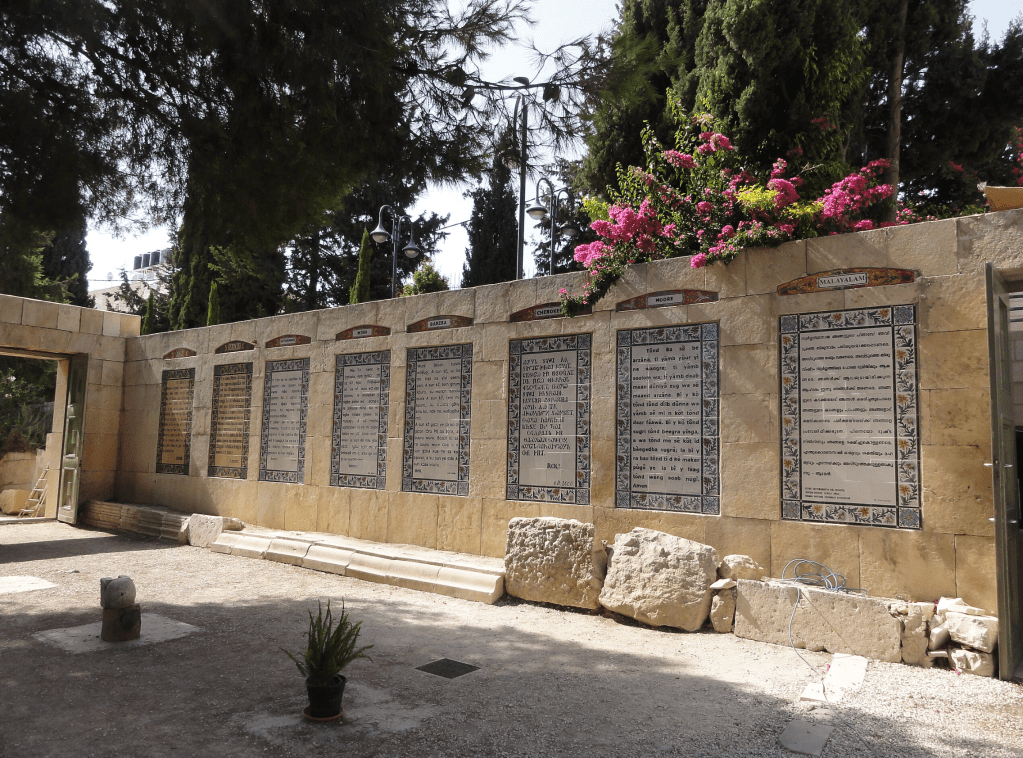
At the Church of the Pater Noster in Jerusalem stood another reminder. A French Carmelite cloister built in the 1800s and early 1900s on the site of a fourth-century Byzantine church, it features plaques on the cloister wall showing the Our Father or Lord’s Prayer in more than a hundred modern and ancient languages. I even recognized one in Cherokee.
So when I read the first discernment question to prepare for the Dominican sisters’ Aug. 24 retreat, “What is the mission of the church?,” my first reaction is to fall back on the definition in Luther’s catechism — but with the understanding that not all institutions that call themselves churches will agree on how to administer the sacraments or preach the gospel. (Lutherans only claim two sacraments, as the joke goes, but add coffee in the narthex as a third.) My attitude has changed over the years, but it’s always been about word and sacrament.
What is the mission of the church? Growing up in the Episcopal Church, I’d get bored during the sermon. Most kids do. But as an Episcopalian, I had a resource other kids didn’t — I could always flip through the Book of Common Prayer looking for something to occupy my mind. There was a table of moveable feasts that allowed me to find the dates of Easters past, present and future. And in the back were the XXXIX Articles; drawn up in 1571 under Queen Elizabeth I, they’re a foundational document similar to the Lutherans’ Augsburg Confession of 1530. Article 19, in the sonorous lanaguage of the 1928 prayer book I grew up with, states:
The visible Church of Christ is a congregation of faithful men, in which the pure Word of God is preached, and the Sacraments be duly ministered according to Christ’s ordinance, in all those things that of necessity are requisite to the same.
Sound familiar?
Even as a kid, especially growing up down South in the 1950s, it seemed to me like the Christian churches — the church, as I understood it, writ large — weren’t as much about word and sacrament as they were about dancing and drinking, card playing and going to movies on Sunday, all of which were forbidden, at least frowned on, in East Tennessee. It was against state law to “teach any theory that denies the Story of the Divine Creation of man as taught in the Bible, and to teach instead that man has descended from a lower order of animals. We had the “culture wars,” in other words, long before the rest of the country ever thought to coin the term.
All of which left me soured on religion. I had nothing against the Episcopal Church I grew up in, but I left the church as soon as I went off to college.
I spent next 30 to 40 years as one of the “Nones,” spelled n-o-n-e-s — we didn’t have the word yet, and I don’t recall being polled on the subject, but if I’d been asked my religion, I would have answered “nothing in particular.”
Very little that I read in the media caused me to reevaluate my feelings. I always respected the Black church’s stand on social justice, and what little I read about Catholic worker priests in South America, but the antics of fundamentalist TV evangelists and, later, the self-proclaimed Moral Majority and Religious Right political movements — and now the everlasting culture wars — left me cold.
Then, when I was in my 50s, a series of coincidences, including a spiritual awakening in 12-step recovery, led me back to the church. Surprise, surprise! I wound up back in a liturgical mainline Protestant church that proclaims the word and administers the sacraments.
So what, to me, is that word? It’s really pretty simple, and, once again, it goes back to my spiritual formation. In the language of the 1928 prayer book, I learned the as it is often known:
THOU shalt love the Lord thy God with all thy heart, and with all thy soul, and with all thy mind. This is the first and great commandment. And the second is like unto it; Thou shalt love thy neighbor as thyself. On these two commandments hang all the Law and the Prophets.
It still doesn’t get any better than that.
In later years, I learned the Great Commandment — which Jesus proclaimed in a discussion with the scribes and Pharisees, according to the synoptic gospels — restates two passages in the Hebrew Bible: “You shall not take vengeance or bear a grudge against any of your people, but you shall love your neighbor as yourself: I am the Lord (Leviticus 19:18); and ” Hear, O Israel: The Lord is our God, the Lord alone. You shall love the Lord your God with all your heart, and with all your soul, and with all your might” (Deuteronomy 6:4-5). Reciting the second prayer, the Sh’ma Yisrael (“hear, O Israel” in Hebrew) is both a mitzvah and a central act of Jewish worship.
Boil it down, and you’ve got the Golden Rule, common to most world religions. Wikipedia (my equivalent of St. Thomas Aquinas’ Summa Theologica, or summary of all theology) defines it as “the principle of treating others as one would want to be treated by them.” Wikipedia’s page is worth studying, by the way, because it compiles quotes from them all.
The Buddha, for example is quoted in an early text known as the Sutta Nipata as saying, “Comparing oneself to others in such terms as ‘Just as I am so are they, just as they are so am I, he should neither kill nor cause others to kill.” When I was working the steps, as we call the spiritual formation stages of 12-step recovery, I read a lot of Buddhist authors. (I was that turned off by the public face of Christianity in the 1990s! So I looked at other faith traditions before I landed back home. Now I try to be firmly rooted in the Christian liturgy, but I have a decidedly ecumenical slant. Did I mention I’m a spiritual mutt?) I like that passage from the Buddha, just as I am so are they, just as they are so am I. Again, it doesn’t get better than that.
How do I participate in the mission of the church? I’ll try to be brief here! From the Springfield Dominican sisters, I’ve learned to follow — or try to follow — what are known as the four pillars of Dominican life: Study, prayer, community and ministry, or preaching. Especially relevant here are study and preaching.
As part of the formation process for Dominican associates, I learned quite a bit about the Catholic Church and its traditions. I’ve continued that reading, both on my own and in consultation with a spiritual director. I’ve also made an effort, largely as a result of spiritual direction, to look back to my childhood faith and connect it to my spiritual life in my current Lutheran parish. That would be the study piece.
As a result, I’ve been struck by how much alike the Catholic, Lutheran and Episcopal traditions are. I’m also more cognizant of what other mainline Protestant churches do for social justice. And, lately, I’m trying to learn more about the white evangelical churches — i.e. to get past the headlines and learn more about their theology and ministries. I’m trying to give them a break, in other words, in spite of the culture wars.
When I say I’m trying to live up to the Dominican pillar of preaching, that doesn’t mean I actually get up in a pulpit. Nor does it mean I do anything that most churches would qualify as evangelizing. I have too many memories of sidewalk preachers down home handing out tracts in Knoxville to ever be comfortable with that.
But the Dominicans have a concept of preaching from the pulpit of our lives — or, as Sr. M. Jadwiga of the English Congregation of St. Catherine of Siena at Stone in the UK puts it, a sense that preaching is “more than talking or teaching or (especially) standing up in a pulpit.” She adds:
In the loosest sense, every Christian is a preacher, willy-nilly, by the way he or she lives. (And most of us, in that sense, may not be very good preachers.) But what I think St.Dominic did was to take ‘preaching’ out of the models of ‘talking (at)’, or of ‘teaching’ (as standing in front of a class, or lecturing) and particularly of ‘preaching from the pulpit’ to a captive congregation from the vantage of endowed (though not always deserved) authority.
Nor, I’m tempted to add, would St. Dominic have handed out ill-printed tracts to random passers-by on the sidewalks of Knoxville, Tenn. Taking my cue from Sister Jadwiga, I try to preach by example from the pulpit of my daily life. To walk the talk, in other words. One text I want to preach is that self-identified Christians don’t have to be the right-wing hypocrites we read about in the headlines. Another, probably more imporant, there are different ways of being Christian. You can be a spiritual mutt.
In what ways does the church affect your life? On this one, I can definitely be brief. I’m active in my Lutheran parish, and with my wife I co-facilitate a book discussion group as part of our adult faith formation effort. We meet over Zoom, so we’re able to serve some of our older parishioners who are immunocompromised. So that checks the study and community boxes on the Four Pillars chart — ministry too, if you buy Sister Jadwiga’s idea that preaching is dialog.
But the big one is the Eucharist or Holy Communion. Through the church, which is the body of Christ after all, I receive the body of Christ so I can go out and be the body of Christ in the world. That’s probably mixing metaphors, but I’d like to think maybe, just maybe Luther and St. Dominic would approve.
Links and Citations
The 1928 U. S. Book of Common Prayer, rpt. London: Society of Archbishop Justus http://justus.anglican.org/resources/bcp/1928/BCP_1928.htm
Augsburg Confession: The Confession of Faith Which Was Submitted to His Imperial Majesty Charles V at the Diet of Augsburg in the Year 1530, by Philip Melanchthon, 1497-1560 https://www.gutenberg.org/files/275/275-h/275-h.htm#link2H_4_0008.
Sr M. Jadwiga OP “Dominican Preaching,” English Dominican Congregation of St Catherine of Siena, Stone, Staffordshire, UK https://www.stonedominicans.org/en/news/48-dominican-preaching-by-sr-m-jadwiga.
“The Pillars of Dominican Life,” Dominican Sisters of Springfield, Illinois https://springfieldop.org/dominican-life/.
[Uplinked Aug. 15, 2024]

 Ordinary Time