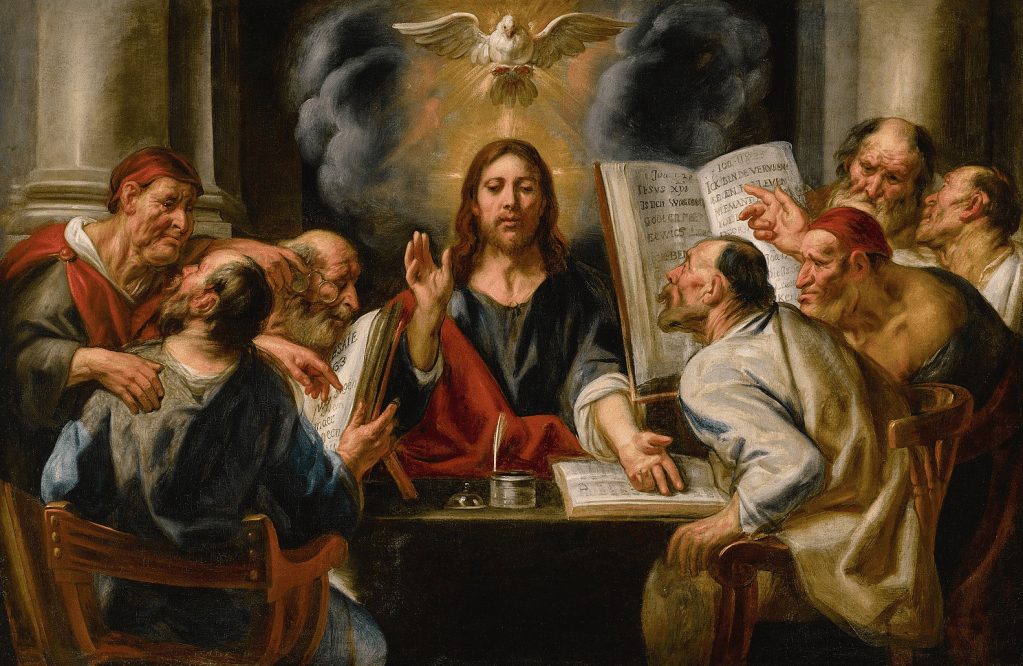
John 6 (NRSVUE). 41 Then the Jews began to complain about him because he said, “I am the bread that came down from heaven.” 42 They were saying, “Is not this Jesus, the son of Joseph, whose father and mother we know? How can he now say, ‘I have come down from heaven’?” 43 Jesus answered them, “Do not complain among yourselves. 44 No one can come to me unless drawn by the Father who sent me, and I will raise that person up on the last day. 45 It is written in the prophets, ‘And they shall all be taught by God.’ Everyone who has heard and learned from the Father comes to me. 46 Not that anyone has seen the Father except the one who is from God; he has seen the Father. 47 Very truly, I tell you, whoever believes has eternal life. 48 I am the bread of life. 49 Your ancestors ate the manna in the wilderness, and they died. 50 This is the bread that comes down from heaven, so that one may eat of it and not die. 51 I am the living bread that came down from heaven. Whoever eats of this bread will live forever, and the bread that I will give for the life of the world is my flesh.”
So we’re in church on a Sunday morning, a few of us in a bible study/discussion group after the service and coffee in the narthex. We’re reading an upcoming pericope, or assigned gospel reading, for the 12th Sunday after Pentecost. It’s from the gospel according to St. John, and we’re following a format called Dwelling in the Word that’s recommended by our central- and southern Illinois synod of the Evangelical Lutheran Church in America. It encourages us to listen and ask ourselves:
- What captures my attention?
- What questions do I have? What do I wonder?
- Where might God’s Spirit be nudging us?
Well, John captures my attention right off the bat when he starts going after “the Jews.” Captures? No, that’s not the word. There’s some lovely stuff in John, but when he gets up a head of steam about “the Jews,” he kidnaps my attention, hijacks it and takes it to a place where I don’t want to go.
So my reaction is OK, buddy, that’s it! You’re done. I’m out of here.
I can distance myself by putting “the Jews” in scare quotes and/or substituting the New Testament Greek — hoi Ioudaioi — and I can remind myself that biblical scholars argue John (or his late first-century editor or redactor) isn’t ranting against all Jews here, he’s talking about Judeans, the Pharisees or the Temple priesthood. Or, according to a theory I find especially convincing, about a synagogue down the street in Ephesus that had just kicked John and his community out around 90 CE.
But I can’t help thinking about 20 centuries of Christian antisemitism, about the Spanish Inquisition, Luther, Tsar Alexander, Easter Sunday pogroms, Nazi Germany, the Shoah and antisemitic outbursts continuing to the present. We have a lot, as Christians (and as Lutherans), to answer for.
So I spoke up, briefly. I didn’t want to hijack the discussion. We already had one diatribe — John’s — and one’s enough. So we talked a minute or two about John, “the Jews” and today’s uptick in real and perceived antisemitism, and I moved on. There’s a lot more going on in the sixth chapter of John, and the pericope only gets into part of it. Let’s put it in context.
As the scene opens, Jesus and the disciples sail to the east side of the Sea of Galilee, with a large crowd “following him because they saw the signs [miracles] that he was doing for the sick.” There Jesus gives thanks — the Greek word is eucharistēsas. Ring a bell? — and feeds the crowd with five barley loaves and two fish contributed by a young boy. This miracle is one of the few in all four gospels, a clear hint to pay attention. But that’s not all.
After the multitudes are fed, they proclaim, “This is indeed the prophet who is to come into the world.” Realizing they “were about to come and take him by force to make him king,” Jesus retreats to a nearby mountain. We could have a small-group discussion on that one verse alone, and that’s still not all. Compared to the rest of John, which is given to theologizing and Christological disquisition, Chapter 6 is chock full of action.
Night falls, and the disciples take a boat back to Capernaum. A storm blows up, they see Jesus walking on the water, he says, “Do not be afraid, it is I.” (The Greek is ego eimi, or “I am,” and we’ll come back to it.) The storm stills, and suddenly they’re all back on the other side of the lake. The crowd follows, and the next morning Jesus tells them, “Very truly, I tell you, you are looking for me not because you saw signs but because you ate your fill of the loaves.” This leads to the bread-of-life passage we read Sunday after church.
“Our ancestors ate the manna in the wilderness, as it is written, ‘He gave them bread from heaven to eat’,” the crowd tells Jesus.
“I am the bread of life,” Jesus replies. “Whoever comes to me will never be hungry, and whoever believes in me will never be thirsty.”
This leads to Jesus’ back-and-forth with “the Jews” — hoi Ioudaioi (Temple priests up from Judea?) — about the bread that comes from heaven that brings eternal life. Our pericope centered on that discussion.
Now I don’t want to go down a Christological rabbit hole here, but I’m not as interested in what Jesus says as I am in the context — where it fits in John’s storyline. (Every time I read John lately, I’m reminded of something Pádraig Ó Tuama, the Irish poet, learned from a spiritual mentor. Jesus is a very different character in John than he is in Mark, and “Mark’s Jesus would have told John’s Jesus to shut up.” I blogged about it HERE.) I’ll be candid — when John’s Jesus starts theologizing I lose patience. So I have to look at John from a different angle. Here’s something else Ó Tuama said, in a Christian Century interview — “I don’t believe in God as character, but I do believe in God as plot — and the emergence of God as plot is always small and risky.” I don’t know exactly what he means by that, but he’s a poet and I’m an old English teacher. I’m game. Let’s give it a try.
I think John’s telling a story here, and the story is about the Eucharist, Holy Communion, the Mass, the Lord’s Supper.
Jesus breaks bread. He gives thanks — the Greeek word, eucharistēsas, is the tipoff. Later, in the storm on the Sea of Galilee, he tells the disciples, fear not, ego eimi (“I am”). Again, I don’t want to sound too much like an old intro to lit teacher, but the Greek is important. Where else do we find that phrase? According to Wikipedia, which I regard as my personal Summa Theologica, it’s the first-person form of the verb “to be.” (My old English teacher-y heart is going pitter patter with all this grammar!) Significantly, it occurs in Exodus 3:14, “And God spoke to Moses, saying, I am (ego eimi) THE BEING” (as Wikipedia translates the Septuagint, the ancient Greek version of the Hebrew Bible that John would have known).
And wait, there’s still more. After lecturing “the Jews” about the difference between manna and the “living bread” that comes down from heaven — our pericope — Jesus gets into this exchange with them:
The Jews then disputed among themselves, saying, “How can this man give us his flesh to eat?” So Jesus said to them, “Very truly, I tell you, unless you eat the flesh of the Son of Man and drink his blood, you have no life in you. Those who eat my flesh and drink my blood have eternal life, and I will raise them up on the last day, for my flesh is true food, and my blood is true drink. Those who eat my flesh and drink my blood abide in me and I in them. […]”
There’s a lot there to unpack. Where to begin? Let’s skip over the disputatious Jews this time. Whatever problems John might have had with the first-century Birkat haMinim or the synagogue down the street in Ephesus doesn’t concern me at the moment. Let’s not relitigate it. And we can take note of John’s “high Christology” (i.e. “the view that Jesus was a pre-existent divine being who became a human,” as Wikipedia defines it) and move on.
Frankly, the pericope or assigned gospel reading for the 12th Sunday after Pentecost doesn’t do a lot for me. Not by itself. But in context, it’s about the Eucharist and the Eucharist is pretty central to the way I try to live. Every week I receive the body of Christ, as the formula goes, and go forth to be the body of Christ, to be the church, in the world. “Those who eat my flesh and drink my blood,” says John’s Jesus, “abide in me and I in them.” He will develop the theme at great length in what is known as the Farewell Discourse, when he gives his final blessing — and a lengthy speech — to the disciples after the Last Supper.
Luther had another way of looking at things, one I have taken to heart (in ways that would no doubt horrify Luther if he heard me). In a 1537 letter to his parish priest, or pastor, he wrote in Latin, Christi sumus in nominativo et genitivo. Jaroslav Pelikan, his editor, translates it, “we are Christs — with and without the apostrophe.” In other words, without the apostrophe we are little Christs (as Luther puts it elsewhere), acting on behalf of Christ; and with the apostrophe, we are Christ’s, we belong to Christ. It’s a central part of how I define my faith (and I blogged about it HERE.) But it goes back to John, which, by the way, was a favorite gospel of Luther’s.
None of this lets John off the hook for his diatribes about “the Jews.” (The same applies to Luther, who wrote a 65,000-word screed in 1543 called On the Jews and Their Lies — there we go with “the Jews” again! — widely read 400 years later in Nazi Germany.) Especially in a day of resurgent antisemitism and false accusations of antisemitism, I think Christians (especially Lutherans) are well advised to look for the beam in our own eye. And that begins with the gospels.
But one of the questions recommended by the synod’s Dwelling in the Word curriculum is, “Where might God’s Spirit be nudging us?” Well, it’s nudging me to give John — and John’s speechifying, high-Christology, eucharistic Jesus — another look.
Links and Citations
John 6, Interlinear Bible, Bible Hub https://biblehub.com/interlinear/john/6.htm.
Pádraig Ó Tuama, “The making of God,” interview by Lisa M. Wolfe and Leslie Long, Christian Century, May 15, 2024 https://www.christiancentury.org/interviews/making-god.
Jaroslav Pelikan. Introduction, Sermons on the Gospel of St. John, Chapters 1-4, Vol. 22 in Luther’s Works (St. Louis: Concordia, 1957), pp. ix-x.
“Trump: ‘If you’re Jewish and vote for a Democrat, you’re a fool’,” CNN, July 31, 2024 https://www.youtube.com/watch?v=r83Z7a5bjMA.
Wikipedia Birkat haMinim, Christology, Ego eimi, Farewell Discourse and pericope.
[Uplinked Aug. 1, 2024]

 Ordinary Time