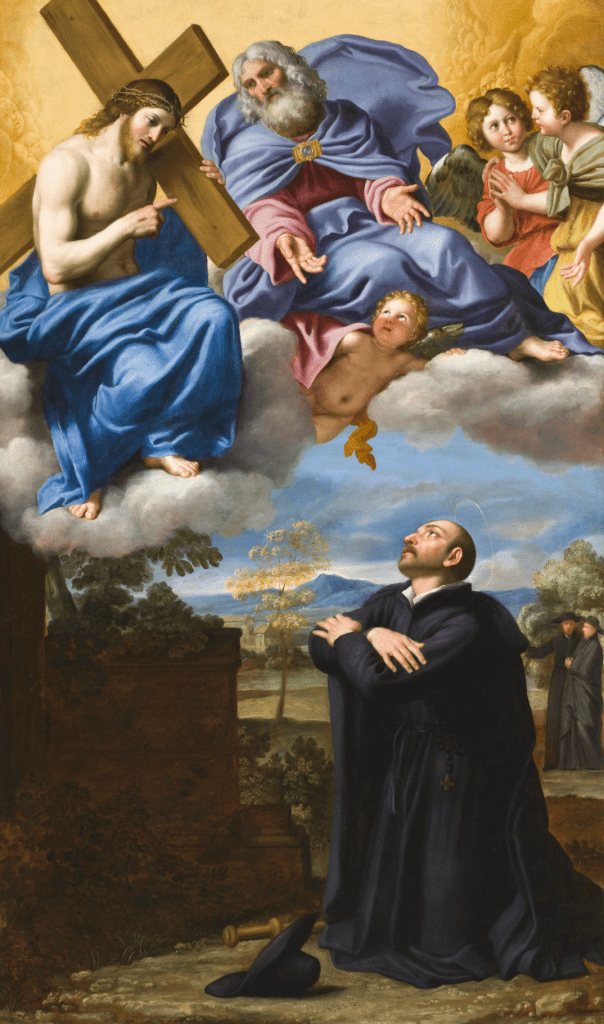
I’m not going to call what happened last night anything other than what it was: A dream. No heavenly light on the road to Damascus (not even New Berlin or Jacksonville). No visions of God the Father and God the Son bearing the Cross by the chapel at La Storta. No angels. No voices from on high. Just a dream.
But there was some day residue involved in last night’s dream that might be worth recording.
And, I think, a brilliant example of Jesuit spirituality in practice.
I’m sure St. Ignatius of Loyola would be horrified with the liberties I take with his spiritual exercises, but it workedv for me last night. In a word, it’s getting me out of what might be technically described as a three-alarm freakout.
First, the dream
Most of the details vanished, of course, when I woke up, but basically it went like this. I was at a ceremony for Dominican associates to renew their commitments. But it wasn’t at the motherhouse here in Springfield. You know how dreams go. It was a big conference room. In fact, it looked exactly like the conference rooms in the Hyatt Regency in Chicago, where I used to attend meetings of the Illinois Association of School Boards. That big.
The next part is hazy now I’m awake, but I had a hard time keeping up with the commitment service. Stand, sit, kneel, sit, stand, kneel again. At my age, that’s a real cardio workout. So I missed out on part of the service. But one of the Dominican sisters noticed and went to find a priest in the interim before lunch. About this time, the scene shifted to another part of my subconscious. Now we were in a corridor on a ramp that led down to a banquet room exactly like those in a dozen motels in Springfield and the Quad-Cities where I covered rubber-chicken dinners as a political reporter.
While guests were filing into the rubber-chicken banquet room, Sister came back with a priest and a half dozen people who had also missed the blessing. (Don’t ask me how the recommitment ceremony got to be a blessing. It all seemed perfectly logical in the dream.) The priest blessed us; I was able to genuflect, i.e. to drop down on one knee; and that’s about the time I woke up. Mission accomplished.
The day residue.
It’s true that I’m a Dominican associate. It’s a program for lay persons who commit to living out the order’s Four Pillars of prayer, study, community, and service. (It’s open to non-Catholics, including Zen Luther-o-palian spiritual mutts like me.) And it’s true that we have a retreat coming up in August at which we’ll reflect and renew our commitments. So I’ve been thinking about spirituality lately.
Creaky knee joints and the challenges of old age have been very much on my mind, too.
Not so much my own challenges. (I’m doing fine, thank you!) My oncologist has green-lighted me to go out in public, as long as I mask up and I’m careful about social distancing. I may even be able to attend the retreat at the motherhouse, unless there’s a scary new SARS-CoV-2 variant running wild in August. But I’m President Biden’s age, so the political frenzy over Biden’s lapses and gaffes has aging at the top of my mind lately.
Add to that the very real possibility that he’s on track to lose the Nov. 5 election to a hard-right populist Donald Trump with a flair for fascist rhetoric and permission from the US Supreme Court to violate federal law as long as he deems it an “official act.” Also at risk now is the US House, which Democrats had hoped would be a bulwark against overreach by a second Trump administration. I think it’ll be more like Huey Long’s Louisiana than Hitler’s Germany, but Trump’s promises to “terminate the constitution” and “demolish the deep state” are — no pun intended — deeply concerning.
I’ve been depressed anyway by Israel’s indiscriminate war on Gaza, and US complicity in the war crimes committed there. It came home to me when an Israeli air strike destroyed a branch campus of Lutheran-affiliated Dar al-Kalima University in Gaza City. (During Holy Week!) When Debi and I visited the Holy Land, we toured the main campus in Bethlehem, so I felt especially complicit. Did my tax dollars pay for the bomb that flattened Dar al-Kalima? But I’m powerless to influence my government to stop it.
The exercise
So last night when I went to bed, I remembered a Jesuit exercise sometimes known as the discernment of spirits. In 2022, when I was first diagnosed with what has turned out to be stage 4 bladder cancer, I blogged about it HERE under the title “Practical ways on a Jesuit website in Ireland to ‘face into the storm’ of cancer diagnosis and treatment.” I summarized it like this:
I’m especially interested in a process called the discernment of spirits. It was developed by St. Ignatius Loyola, founder of the Jesuit order, for “examining the motives, desires, consolations, and desolations in one’s life.” (The exact terminology, including “consolations” and “desolations,” is Ignatius’, and the links embedded in the quote are Wikipedia’s.) The concept of spirits working on us for good or evil seems awfully 16th-century to me (so does a lot of Luther), but I think there’s good common sense behind it. “The good spirit brings us to peaceful, joyful decisions,” explains Wikipedia. “The bad spirit often brings one to make quick, emotional, conflicted decisions.” [Links in the original post.]
Especially helpful then was an intro to discernment titled “Ten Ignatian tips for surviving autumn lockdown,” that Brendan McManus SJ put up on the Jesuits in Ireland website in October 2020, at the height of the COVID-19 pandemic. “Remember God didn’t send Covid like an Old Testament plague, so forget about conspiracy theories or superstition,” said McManus. “Faith doesn’t protect you from the storms of life but it gives you courage to steer a course.” By substituting cancer for Covid, I found exactly the advice I needed at the time. Like this:
Learn how to discern (tune in to God’s guidance) In terms of Ignatian decision making or discernment, it is about identifying what is the unhelpful inner movement (anxiety, shame and paralysis; desolation) and moving towards a more positive one (connection, reconciliation, positive action; consolation). God is normally calling us through our humanity, our deeper feelings, not normally in miracles and ‘signs’.
In his other writing Fr. McManus has compared the Jesuit practice to cognitive behavioral therapy, which he says, citing the American Psychological Association, is “based on the concept that negative thoughts and feelings like anxiety and fear, can influence physical sensations and actions, and equally changing thinking and acting patterns can help break the negative cycle.” I don’t know much about CBT, but, like so much Jesuit spirituality, what McManus is saying here seems eminently practical.
More recently, on Oct. 10, 2023, to be exact, McManus has outlined a “process for praying with anxiety” that brings together several of his tips, explanations and suggestions in seven steps that I’ve found useful. Since I don’t always do it right, I’ll quote it at length:
- Prepare yourself; clear a space, use music or breathing to focus, do a body scan, ask yourself how you are physically, emotionally & spiritually. Notice how the anxiety manifests in your body.
- Ask for a grace; ask for what you want sure directly, bring your ‘mess’ to mind, name what you want from God, formulate it as a grace, a gift from God.
- Make the prayer; use one of the mantras above [e.g. “Into your hands Lord I commend my spirit” (Luke 23:46, Jesus quoting Psalm 31:5); or “Lord Jesus Christ, Son of God, have mercy on me, a sinner.” (The Jesus Prayer)].
- Make up a ritual/action which expresses your desire for inner peace e.g. open your hands asking for God’s peace, then bring your hands to your heart asking for this peace to be experienced within.
- Reflect at the end: look back over the prayer, what stands out, where were you distracted, what was God saying to you. What would you change next time?
- Closing prayer: give thanks for what you have received, ask forgiveness for mistakes, hand it all over to God, pray for others (petition)
- Act: commit yourself to some action, ask for advice or get some help, mend a relationship, change your fearful habits, act against negative thoughts, do more prayer etc.
My practice, if you can even dignify it by that name, is simpler.
Here’s what I did last night. When I couldn’t go to sleep, I prayed. No mantras, no ritual actions, though. When I pray, I sound like the kid in Judy Blume’s Are You There, God? It’s Me, Margaret. But I did ask for a grace (step 2). Hey, God, it’s me, Pete. The world’s going to hell in a handbasket, if you’ll excuse the expression, and I’m feeling really, really anxious. I need some clarity, and strength to do better. As I inhaled, I repeated consolation each time, and as I exhaled, desolation. St. Ignatius must have been appalled. Again, this was more like what I learned as a Boy Scout taking First Aid lessons, “out with the bad air, in with the good,” than anything resembling spiritual practice. But it worked. I fell asleep.
And, as if in a vision of old, I dreamed about the upcoming Dominican retreat. Not only that, but I woke up thinking about my commitment to positive goals — how do I preach, as the Dominicans like to say, from the pulpit of my life? how do I set an example? — no matter what the world, the flesh and the beasts that stalk an apocalyptic election year might send my way.
Further reading on discernment
Brendan McManus, SJ, “Praying with anxiety: Ignatian survival tips,” Jesuits in Ireland, Oct. 10, 2023 https://jesuit.ie/blog/praying-with-anxiety-ignatian-survival-tips/.
__________, “Ten Ignatian tips for surviving autumn lockdown,” Jesuits in Ireland, Oct. 27, 2020 https://www.jesuit.ie/blog/brendan-mcmanus/ten-ignatian-tips-for-surviving-autumn-lockdown/.
[Uplinked July 16, 2024]

 Ordinary Time
This is great!
LikeLiked by 1 person
Thanks, Debi!
LikeLiked by 1 person