Yahoo! News, or its algorithms, served up a twofer on antisemitism this morning. No, make that a three-fer! As I was scrolling through ithe Yahoo! directory Tueday morning, I came across this headline, “How Weaponizing Antisemitism Puts Jews at Risk,” over an op ed piece in Time magazine by Raz Segal, an Israeli historian now teaching in New Jersey.
And that’s not all. Appended to Segal’s story were two more, one in The Guardian detailing how Republicans hope to demonize college kids and Democrats (not necessarily in that order of importance) as antisemites in the runup to the Nov. 5 election. The other was a PolitiFact backgrounder sorting out fact, hype and fantasy in the proposed Antisemitism Awareness Act now before Congress.
All in all, there was too much to absorb in one sitting.
So I’m reverting to past practice, but with a new technology. Back in the day when I was teaching, I’d read the Chicago Tribune over corned beef hash and eggs at a diner on North 9th Street; when I finished breakfast, especially if there was a lot of news that morning, I’d take the Trib to school with me in case I wanted to clip it later or work it into class discussion.
So that’s what I’m going to do with Tuesday morning’s “weaponizing” trilogy.
I’m going to save the stories to the blog. Along with some of my own thoughts that were prompted by the morning’s news, which are pretty nuanced and bear more thinking about. (I’ve written before, HERE and HERE, about how I use my blogs as sort of an electronic filing cabinet where I can retrieve stray information with a keyword search.) Here, for future reference, are the links:
- Robert Tait, “How the right is weaponizing pro-Palestinian campus protests in the US,” Guardian, May 13, 2024 https://www.theguardian.com/us-news/article/2024/may/13/republicans-biden-israel-gaza-war-protests.
- Louis Jacobson, “The Antisemitism Awareness Act: What to know,” [Poynter Institute for Media Studies], Austin American-Statesman, May 13, 2024 https://www.statesman.com/story/news/politics/politifact/2024/05/13/the-antisemitism-awareness-act-what-to-know/73647169007/.
- Raz Segal, “How Weaponizing Antisemitism Puts Jews at Risk,” Time, May 14, 2024 https://time.com/6977457/weaponizing-antisemitism/.
A couple of comments: (1) “Weaponizing” has to be the buzzword of the year, and (2) it bothers me to see headlines about “weaponizing antisemitism.” They lack nuance. (Imagine that, in a headline!) What’s being weaponized isn’t so much antisemitism as what I’ve come to think of as “performative anti-antisemitism” (I coined the term HERE, after a particularly contentious hearing of the House Education and Workforce Committee.) I have no reason to doubt many of the politicos have sincere feelings on the subject, but I’m afraid it’s not getting the kind of thoughtful, nuanced discussion it needs in an election year. Imagine that, too!
A Swedish theologian’s response to antisemitism
Where I’m coming from on the issue is complicated and nuanced. To begin with, I’ve been worried about a reversal of the historic trendlines on antisemitism, and I worry that our society is losing the sense of horror that followed World War II and the Holocaust, or Shoah. The sense my generation grew up with. A graph of ADL statistics on antisemitic incidents since 1979 demonstrates the trend starkly.
The number of incidents rose gradually during the 1980s and 90s, reaching an all-time high of 2,066 in 1994. Then it leveled off between 1,000 and 2,000 until 2004, when it reached its second highest point of 1,821. From 2004 to 2013, it fell steadily, bottoming out at 754. For the next few years it stayed below 1,000, until it climbed to 1,267 in 2016 and the trend changed. (Gee, what happened in 2016?) It rose steadily until 2020, with 2,024 reported incidents, and went up sharply to 2,712 in 2021 and 3,679 in 2022. The graph shows a dramatic increase, to 8,873, in 2023. Taken as a whole, the curve from 1979 to 2023 looks almost exponential. Even if you’re as bad at math as I am, it’s terrifying.
So the trend has been troubling for a while, especially in the last 10 or 12 years. Pamela Nadell, director of the Jewish Studies Program at American University, had as even-handed an explanation as any early last year:
Today, celebrities, politicians, and other high-profile figures spout antisemitism on social media. White nationalists used its platforms to plan their “Unite the Right” rally where they marched across the University of Virginia campus chanting “Jews will not replace us” (2017). The gunman who murdered eleven Jews on a Sabbath morning in a Pittsburgh synagogue posted about Jews committing “white genocide” (2018).
Meanwhile, on city streets Orthodox Jews encounter, almost daily, shouts, spitting, shoving, and slaps. Graffiti painted on a fence near my home read “No Mercy for Jews.” Progressive organizations, including some on college campuses, demand that Jews renounce their support for Israel. Yet, 80 percent of American Jews say caring about Israel is essential or important to their Jewish identities.
Nadell was interviewed by Patty Houseman of the university’s communications shop in January 2023, a good nine months before Oct. 7. I doubt the fundamentals have changed much since then.
I’m not Jewish, but I’ve taken to heart Swedish theologian Krister Stendahl’s warning that Christians, especially Lutherans, bear responsibility for 2,000 years of antisemitism and hatred in Western culture. A Swede who came of age during the Holocaust and World War II and served at various times as Bishop of Stockholm in the Lutheran state Church of Sweden and as dean of Harvard Divinity School, Stendahl was very clear about it.
“Defining that responsibility has been a driving force for Professor Stendahl from his student days in Sweden,” once said a reporter for the Christian Science Monitor. “As a Lutheran, he was painfully aware of how Martin Luther’s tract on ‘The Jews and their Lies’ was dredged up the Nazis to rationalize extermination of Jews in World War II.”
In 1981 when the reporter, Richard M. Hartley, caught up with him at a reception in Boston, a leading evangelical pastor had recently been caught saying “God Almighty does not hear the prayer of a Jew,” adding to concerns that antisemitism was on the rise. Stendahl told Hartley:
Most acts of anti-semitism have indeed been isolated acts. […] But the question we need to ask is: To what extent are these acts occurring in a Christian culture that pictures Jews as despicable? Now when there is psychological need for scapegoats, you can never say that anti-Semitic acts are Christian acts. But they are not disconnected. Christians have a responsibility.
That hit me where I live. (I’ve blogged about it, HERE and HERE). Stendahl met that responsibility by working tirelessly for dialog between Christians and Jewish, indeed between people of all faith traditions. He stood up for marginalized people of all sorts and conditions.
As dean of Harvard Divinity in the 1970s, he stood up for the first generation of women to study there; they called him “Sister Krister,” and it was a mark of affection and solidarity. Later he taught at Boston’s majority-Jewish Brandeis University and served as co-director of the Osher Center for Tolerance and Pluralism at the Shalom-Hartman Institute in Jerusalem. He is remembered at Harvard as a giant “among those on the forefront of Christianity’s grappling with its legacy of antisemitism after the Holocaust.”
Why can’t we all be more like Krister Stendahl?
A related question, closer to home: Why can’t I be more like Krister Stendahl?
The Guardian: Politics and performative anti-antisemitism
Just beneath Beneath Segal’s op ed was a story in The Guardian with a by-now familiar headline, “How the right is weaponizing pro-Palestinian campus protests in the US.” It quoted US Sen. Tom Cotton, R-Ark., in an unusually candid rationale:
“The Democrats have deep philosophical divisions on Israel,” Cotton told ABC’s This Week programme. “That’s why you see all those little Gazas out there on campuses where you see people chanting vile antisemitic slogans … For two weeks, Joe Biden refused to come out and denounce it. That is the 2024 election.”
In fact, Biden did condemn antisemitism in a White House statement criticising the protests on 1 May, but also spoke out against Islamophobia and other forms of prejudice. [Ellipsis in the original.]
Also candid about Republican intentions was Cristopher Rufo, who is largely responsible for spreading misinformation about critical race theory, an academic concept relating to the racial effects of redlining in real estate law (to “put all of the various cultural insanities under that brand category” and “to have the public read something crazy in the newspaper and immediately think ‘critical race theory'”); and the current right-wing crusade against corporate and academic Diversity, Equity and Inclusion programs. The Guardian reported:
The conservative activist Christopher Rufo spelt out the approach in a recent article on Substack.
“This encampment escalation divides the Left, alienates influential supporters, and creates a sense of chaos that will move people against it,” he wrote. “The correct response … is to create the conditions for these protests to flourish in blue [Democratic-run] cities and campuses, while preventing them in red [Republican] cities and campuses.” [Link and brackets in the original.]
Now that spring semester is over, the encampments are being taken down. It remains to be seen how many of Cotton’s and Rufo’s wishes come true. But at least they’re on the record about what they’d like to have happen.
Time: Antisemitism, Islamophobia and white supremacy
Raz Segal, director of the Master of Arts in Holocaust and Genocide Studies program at Stockton University in Atlantic City, centered his commentary in Time magazine on “the recent attack” by the House Committee on Education and the Workforce on Rutgers University-Newark’s Center for Security, Race and Rights (RUCSRR) and its director, Sahar Aziz, for alleged antisemitism:
Over 500 law professors from across the U.S., who describe themselves as a “racially, religiously, and ideologically diverse” group, condemned these allegations in a letter to the House Committee last month. These law professors note that the Committee is targeting the only center in a U.S. law school devoted to the civil and human rights of South Asians, Muslims, and Arabs, and that Professor Aziz is the only Muslim Arab woman among 130 professors in the law school. […] The Committee, the professors argue, is engaged in the “mobilization of Islamophobic tropes to fuel and sustain spurious allegations of antisemitism to discredit and delegitimize critics of Israeli policy and military action.” [Links in the original.]
Segal suggested the Committee’s theatrics only make it harder to address the white supremacy that threatens Jewish people, Muslims and other minorities alike:
Notably, the House Committee has been engaged in similar baseless attacks on dozens of U.S. colleges in the last few months—with Committee member Rep. Elise Stefanik, a Republican who has expressed white supremacist views in the past, playing a key role.
None of this ensures the safety of Jews in the U.S. On the contrary, the Islamophobia and racism inherent in the weaponization of antisemitism risks making antisemitism a meaningless charge, and therefore much harder to combat, at a time when genuine examples of it are rising. [Links in the original.]
Similarly, Segal says the Antisemitism Awareness Act passed by the House and awaiting action in the Senate relies on a flawed definition of antisemitism (I’ve blogged about it, HERE); he said the bill fails to address the deeply rooted white supremacist vision that underlies antisemitism and Islamophobia alike:
The weaponization of antisemitism by Israel and its allies, including the U.S. government, draws on the deeply problematic “working definition of antisemitism” adopted in 2016 by the International Holocaust Remembrance Alliance (IHRA). A central force in the institutional world of global Holocaust memory, this international organization of 35 member states (almost all of them in Europe) deals with Holocaust education, research, and remembrance.
The IHRA definition is the basis for the recently proposed Antisemitism Awareness Act, which some 700 Jewish college faculty have signed an open letter urging Biden not to back. The definition includes 11 examples of antisemitism, seven of which mention Israel and thus blur the distinction between Jews and the State of Israel. By contrast, the IHRA definition includes no mention of white supremacists, even though they pose the greatest danger to Jews in the U.S.—as the 2018 Tree of Life Synagogue massacre of 11 Jews in Pittsburgh demonstrated.
This silence, combined with the focus on Israel, facilitates the IHRA definition’s use as a particularly insidious weapon to target people whom white supremacists in the U.S. also single out: Muslims and Arabs. [Links in the original.]
Antisemitism Awareness Act: Nuts & bolts in PolitiFact
Rounding out the threesome, or three-fer, was an explainer by PolitiFact, the award-winning fact-checking service of the Poynter Institute and The Tampa Bay Times, on the Antisemitism Awareness Act. The story, published in the Austin American-Statesman, is relentlessly objective, noting that the bill that has been described both as a “key step in calling out […] antisemitic hate crimes” and as one that “really does risk suppressing not just discriminatory conduct but speech […] that is fully constitutionally protected.”
It has passed the House and goes now to the Senate. The roll call, like the bill itself, has been hailed as bipartisan (187 Republicans and 133 Democrats voted aye) and decried as an attempt to divide House Democrats (who split 133-70 on the bill). Nuance is called for, and PolitiFact admirably provides the nuance.
- For. Rep. Mike Lawler, R-N.Y., a leading sponsor of the bill, said the recent campus protests made passing the measure urgent. […] He added, “When people engage in harassment or bullying of Jewish individuals where they justify the killing of Jews or use blood libel or hold Jews collectively responsible for the actions of the Israeli government — that is antisemitic. It’s unfortunate that needs to be clarified, but that’s why this bill is necessary.”
- Against. Rep. Sara Jacobs, D-Calif., said, “I’m deeply concerned about the rise of antisemitism in San Diego and across the country. But I do not believe that anti-Zionism is inherently antisemitism. … “I support Israel’s right to exist, but I also know many people who question whether Israel should exist as a Jewish state who are deeply connected to their Judaism.”
- Against. Rep. Marjorie Taylor Greene, R-Ga., posted on X that the bill’s passage “could convict Christians of antisemitism for believing the Gospel that says Jesus was handed over to Herod to be crucified by the Jews.” When conservative commentator Charlie Kirk asked in an X post whether the bill made “parts of the Bible illegal,” former Fox News host Tucker Carlson replied, “Yes. The New Testament.” [Ellipsis and links in the original.]
As much as I hate to admit it, Rep. Taylor Greene is (partly) right on this one. My reading of the gospels is “the Jews” (hoi Ioudaioi in New Testament Greek) turned Jesus over to the Romans for execution, not the other way around. But she’s 100 percent accurate when she says the Christian gospels are fundamentally responsible for antisemitism.
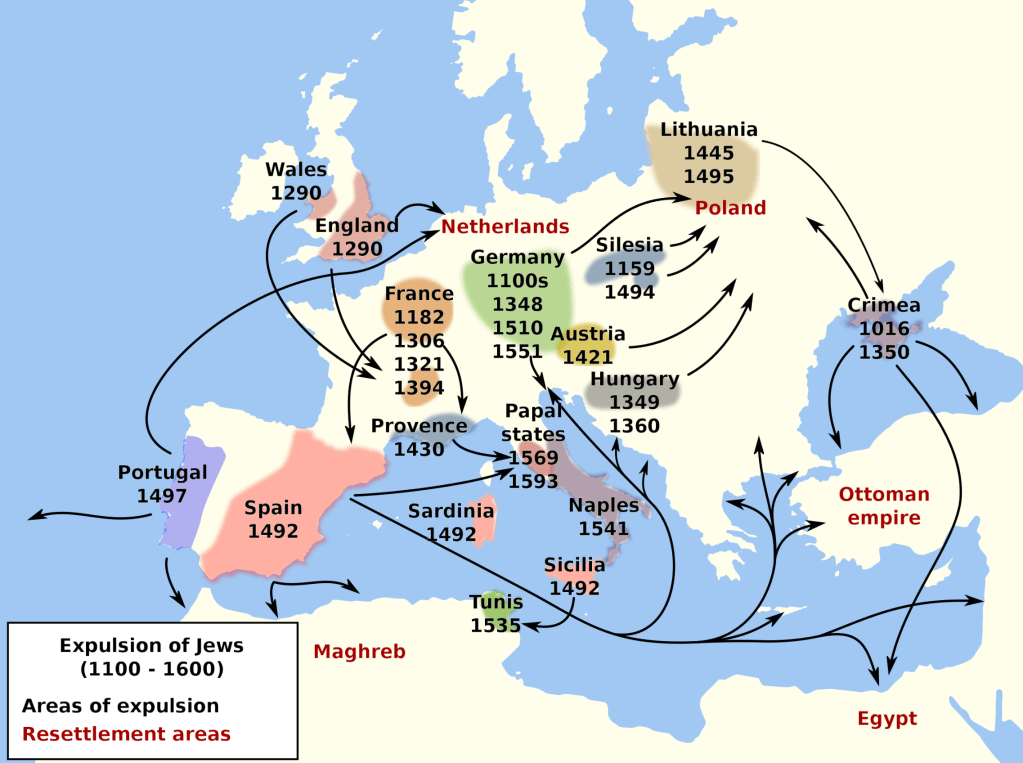
A note on the header art. I posted that map to the header as a reminder of how pervasive antisemitism is throughout history, of how much we have to answer for. How great our responsibility, in Krister Stendahl’s words. I have read more than one Palestinian author remind us that for centuries, Jewish people were better received in the Ottoman Empire and other Muslim nations than they were in Europe. Antisemitism, they commonly maintain, is a European vice exported to the Middle East. I have no argument to offer to the contrary.
More Links and Citations
Anti-Semitic Incidents in the United States, Graph (1979 – Present), Jewish Virtual Library, The American-Israeli Cooperative Enterprise https://www.jewishvirtuallibrary.org/anti-semitic-incidents-in-the-united-states-graph.
“Baptist Leader Claims God ‘does Not Hear the Prayer of a Jew’,” Jewish Telegraph Agency, Sept. 19, 1980 https://www.jta.org/archive/baptist-leader-claims-god-does-not-hear-the-prayer-of-a-jew.
Giovanni B. Bazzana, Benjamin H. Dunning, Mohsen Goudarzi and Annette Yoshiko Reed, “Harvard’s Legacy of Antisemitism,” Harvard Crimson, Jan. 24, 2024 https://www.thecrimson.com/article/2024/1/24/reed-bazzana-dunning-goudarzi-antisemitism/.
Patty Housman, “Antisemitism at New All-Time High in US,” news release, Jan. 13, 2023, College of Arts and Sciences, Amercan University https://www.american.edu/cas/news/antisemitism-at-new-all-time-high-in-us.cfm.
[Uplinked May 15, 2024]

 Ordinary Time