Comes now Adam Gopnik of the New Yorker and gives powerful evidence it’s time to start taking the comparisons of ex-President Donald Trump and Hitler more seriously, Godwin’s Law notwithstanding. Godwin’s Law, similar to a logical fallacy known as the Reductio ad Hitlerum, holds that sooner of later “a comparison involving Nazis or Hitler” will come up in any argument and, as soon as it does, the discussion is over.
But Mike Godwin, the attorney who coined the phrase, says Godwin’s law shouldn’t be used as a conversation stopper: “It still serves us as a tool to recognize specious comparisons to Nazism – but also, by contrast, to recognize comparisons that aren’t,” he later told the Los Angeles Times. Call it Godwin’s Law was amended.
Whatever you call it, Gopnik offers a compelling, factual, closely reasoned analysis of the 1932 parliamentary elections in Germany, in which Hitler’s Nazi party came to power with 35 percent of the vote. He doesn’t mention Trump by name, but the parallels are chilling. Even frightening. So as far as I’m concerned, Godwin’s law is a bum rap and we need to pay attention to the lessons of history.
For one thing, Adam Gopnik isn’t a partisan shill. Nor is he a political junkie. An award-winning New Yorker staff writer since 1986, he has written books on Abraham Lincoln and Charles Darwin as well as a children’s fantasy novel and a musical comedy. In literary circles, he’s considered one of our leading essayists and cultural critics.
For another, Trump all but invites the comparisons.
As early as August 2015, when then-candidate Trump called for a ban on Muslims entering the US, people were sounding the alarm. James Creedon of France24, the French public broadcasting service, quoted several, including a headline in the New York Daily News, “Trump has gone full blown Nazi on us,” and an article in the Financial Times of London comparing Trump to far-right French politician Marine LePen and warning “The rise of political extremists says something disturbing about liberal democracies in the west” in a subhead. “It’s s pretty strong condemnation for somebody to compare a mainstream politician to Adolph Hitler,” said Creedon, “but it’s happening across the board.”
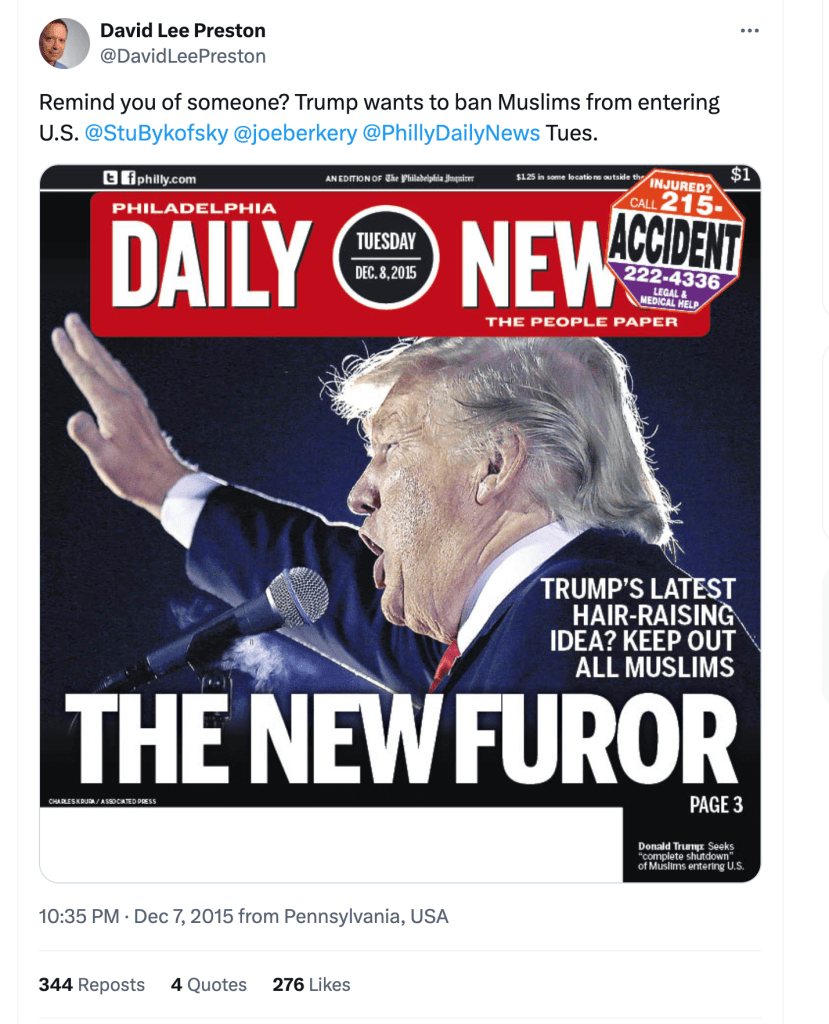
Another headline was cited by Creedon on French TV. “Remind you of someone? Trump wants to ban Muslims from entering the US,” tweeted David Lee Preston, an editor at the Philadelphia Daily News, over a picture of the tabloid’s front page headlined “The New Furor.”
So in 2015, so in 2024. What’s different this time? The answer lies not so much in the stars, or in Trump’s admiration for authoritarian leaders past and present, which has only “amped up” as he enters his “third presidential election season,” according to a recent article in the Times of Israel (a publication that has an obvious interest in latter-day admirers of Hitler). What’s different about Gopnik’s article: It’s narrowly focused and relentlessly factual.
Like many of Gopnik’s essays, it’s a book review. Headlined “The Enablers” in the March 25 print edition, it reviews Timothy W. Ryback’s Takeover: Hitler’s Final Rise to Power. Ryback isn’t just a garden-variety historian — he’s the director of the Institute for Historical Justice and Reconciliation in The Hague, and previously served as the Deputy-Secretary General of the Académie Diplomatique Internationale in Paris, and Director and Vice President of the Salzburg Global Seminar. He’s written books on Hitler, the Dachau concentration camp and, early in his career, a tome entitled Rock Around the Bloc: A History of Rock Music in Eastern Europe and the Soviet Union. I’d say he knows his way around authoritarian regimes.
Ryback’s latest book, Takeover: Hitler’s Final Rise to Power, focuses narrowly on one year, 1932, which saw Hitler come in second for president while the Nazis won a plurality in the Reichstag, or parliament, with 37.3 percent of the vote. A few months later, after a bewildering series of political manipulations, Hitler was appointed chancellor, and 1932 was Germany’s last free election. Gopnik is similarly focused in his review. He says:
Ryback details, week by week, day by day, and sometime hours by hour, how a country with a functional, if flawed, democratic machinery handed absolute power over to someone who could never claim a majority in an actual election and whom the entire conservative political class regarded as a chaotic clown with a violent following. (32)
Sound like anybody we know? Gopnik never mentions Trump by name, but the parallels couldn’t be clearer. For the most part he just presents the facts, closely paraphrasing Ryback’s narrative; the closest he comes to presenting his own hypothesis, his own take on an autocrat’s rise to power in a democratic election, is when he says:
The decent right thought that [Hitler] was too obviously deranged to remain in power long, and the decent left, tempered by earlier fights against different enemies, thought that, if they forcibly stuck to the rule of law, then the law would somehow by itself entrap a lawless leader. In a now familiar paradox, the rational forces stuck to magical thinking, while the irrational ones were more logical, parsing the brute equations of power. And so the storm never passed. In a way, it still has not. (32)
The storm still hasn’t passed. Chilling thought.
Unlike Adam Gopnik, I am a certified (and certifiable) political junkie, and I spend more time than I like to admit studying survey data, cross tabs and demographic analyses. And I see distinct parallels between German’s parliamentary election of 1932 and what seems to be shaping up for us this year in America. They are even more chilling, as Gopnik says:
The political scientists and historians who study it tell us that the election [of 1932] was a “normal” one, in the sense that the behavior of groups and subgroups proceeded in the usual way, responding more to the perception of political interests than to some convulsions of apocalyptic feeling. […] The Germans were voting, in the absent-minded way of democratic voters everywhere, for easy reassurances, for stability, with classes siding against their historical enemies. They weren’t wild-eyed nationalists voting for a millennial authoritarian regime that would rule forever and restore Germany to glory, and, certainly they weren’t voting for an apocalyptic nightmare that would leave millions of people dead and the the cities of Germany destroyed. They were voting for specific programs that they thought would benefit them, and for a year’s insurance against the people they feared. (73)
Gopnik concludes by quoting the saying commonly attributed to Mark Twain, that history doesn’t repeat itself, but it rhymes. (In the process, by the way, he notes that Mark Twain probably didn’t say it.) Again without mentioning Trump by name, he notes several rhymes, chimes, hints and whispers and concludes:
We see through a glass darkly, as patterns of authoritarian ambition seem to flash before our eyes: the demagogue made strong not by convictions but by being numb to normal human encouragements and admonitions; the aging center left; the media lords who want something like what the demagogue wants but in the end are controlled by him; the political maneuverers who think they can outwit the demagogue; the resistance and sudden surrender. Democracy doesn’t die in darkness. It dies in bright midafternoon light, where politicians fall back on familiarities and make faint offers to authoritarians and say a firm and final no — and then wake up a few days later and say, Well, Maybe this time, it might all work out, and look at the other side! Precise circumstances never repeat, yet shapes and patterns so often recur. In history, it’s true, the same thing never happens twice. But the same things do. (76)
Links and Citations
James Creedon, “Trump Likened to Hitler,” Media Watch, France24, Aug. 12, 2015 https://www.france24.com/en/mediawatch/20151208-trump-likened-hitler
Adam Gopnik, “The Enablers,” New Yorker, March 25, 2024, 72+. [It appears online as “The Forgotten History of Trump’s Establishment Enablers,” New Yorker, March 18 https://www.newyorker.com/magazine/2024/03/25/takeover-hitlers-final-rise-to-power-timothy-w-ryback-book-review.
David Lee Preston, “Remind you of someone? […],” Twitter, Dec. 7, 2015 https://twitter.com/DavidLeePreston/status/674084900144865280?ref_src=twsrc%5Etfw%7Ctwcamp%5Etweetembed%7Ctwterm%5E674084900144865280%7Ctwgr%5E046a183e598295ff1bd1b5c67fa6cbe21c844c0a%7Ctwcon%5Es1_&ref_url=https%3A%2F%2Fwww.hollywoodreporter.com%2Fnews%2Fgeneral-news%2Fphilly-daily-news-likens-donald-846683%2F.
“Trump admires Hitler, is infatuated with Putin, former staff claim in new book,” Times of Israel, March 12, 2024 https://www.timesofisrael.com/trump-admires-hitler-is-infatuated-with-putin-former-staff-claim-in-new-book/.
Wikipedia Adolph Hitler’s rise to power, Godwin’s Law, July 1932 German federal election, Reductio ad Hitlerum, Timothy W. Ryback.
[Uplinked March 29, 2024]

 Ordinary Time