As Rome fell, a pope fought with Huns, Vandals and Byzantine Christians who had a slightly different version of the creed
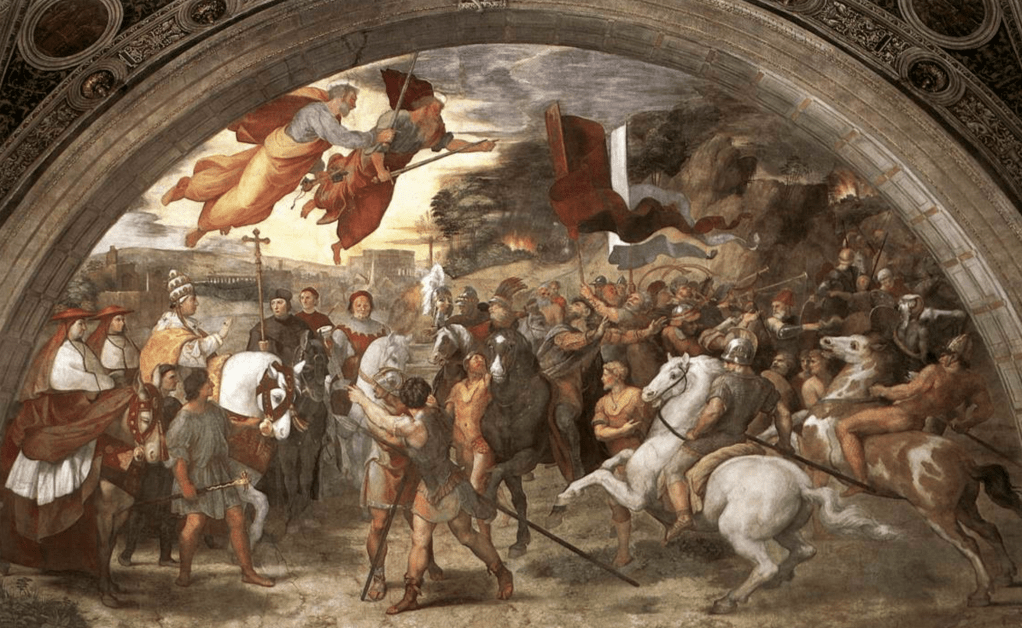
Raphael, Leo the Great and Attila, Vatican, 1514 (Wikimedia Commons)
At this point, we begin to move from the religion of Jesus (love your neighbor, turn the other cheek, prepare for the End of Days) to the religion about Jesus (he was the Son of God who died to absolve us of our sins). The key figure in this shift was a Jew named Paul, known in Christian tradition as Saint Paul, author of many of the books of the New Testament. […] He brilliantly combined the strenuous moral teachings of the Jewish tradition with familiar elements of pagan religion that had not been part of Jesus’ original message — the leader, forn of a divine father and human mother, who dies and comes back to life. — Harold Kushner, To Life!: A Celebration of Jewish Being and Thinking (Boston: Little Brown, 1993): 286.
Our Zoom course on Church History from the apostolic age to the present is off and running at a pretty fast clip. The classes are an adult faith formation ministry of ELCA’s Southern/Central Illinois Synod (roughly equivalent to a diocese), and I’m auditing them; one of the assignments is to journal on the readings before class, and I’m putting them online. The first session, last week, covered the ground from the beginning to the late Roman (or early Byzantine) emperor Constantine and the Council of Constantinople in 381 CE. (I blogged about it HERE.) This week we’re reading up on the period from the first sack of Rome in 410 to the great schism between the Latin Catholic and Greek Orthodox churches in 1054.
Frankly, it just wasn’t an inspiring period of church history.
At least it doesn’t inspire me.
As Justo L. González, author of our textbooks, notes, it was “a period of chaos,” when Germanic tribes established kingdoms in the Western parts of the old empire. It was “an age of little learning and much superstition,” too, even though it was the church that kept a semblance of civilized society alive throughout the period in Western Europe.
The age was also marked by endemic theological squabbling over such important matters as “the meaning of the word Filioque (“and from the Son”), which the Latin West had added to the Nicene Creed, thus saying that the Holy Spirit proceeds ‘from the the Father and the Son‘” (CHEG 41, 44).
We’ll get back to that in a minute or two. The Nicene Creed was adopted in 325, and its final form was hammered out at the Council of Chalcedon in 451. My basic attitude toward the Christological debates of the fourth and fifth centuries is basically that of Rabbi Harold Kushner, who suggests that early Christians changed the religion of Jesus into a religion about Jesus, and Franciscan Fr. Richard Rohr, who quotes the Apostle’s Creed and notes the “huge leap the creed makes between ‘born of the Virgin Mary’ and ‘suffered under Pontius Pilate’.” Rohr adds:
A single comma connects the two statements, and falling into that yawning gap, as if it were a mere detail, is everything Jesus said and did between his birth and his death! Called the “Great Comma,” the gap certainly invites some serious questions. Did all the things Jesus said and did in those years not count for much? Were they nothing to “believe” in? Was it only his birth and death that mattered? Does the gap in some way explain Christianity’s often dismal record of imitating Jesus’ life and teaching?
I’m auditing the course, and I’m tempted to skip the journal assignment, reflecting on questions like “What new insights have I gained about this event?” and “How has it impacted the world I live in and my church?”
Not much, the answer springs to mind.
But that’s too easy. “Out of all this, a new civilization of would arise, one which was heir to classical Greco-Roman antiquity as well as to Christianity and to Germanic traditions,” says González in his wrap-up of a discussion of the Arian heresy and the transfer of effective power from Rome to Byzantium, renamed Constantinople in honor of Constantine. “This process took the thousand years known as the Middle Ages, to which we now must turn” (SOC 1:161)
Surely, there’s something worth learning here.
After all, it was in late antiquity and the early Middle Ages that such institutions as monasticism, the papacy and the translation of the bible into what was then the vernacular language had their beginnings. (All of this interests me, both as a Dominican lay associate and a Lutheran steeped in sola scriptura.) Moreover, for better or worse the Middle Ages were the seedbed for what we now call Western civilization.
González has an interesting take on monasticism I hadn’t seen before. He calls to mind the persecutions that came before Constantine was emperor, when Christianity became not only safe but popular. “How is one to witness to the crucified Lord,” asks González, “to the one who had nowhere to lay his head, at a time when many leaders of the church live in costly homes and when the ultimate witness of martyrdom is no longer possible?” The answer? Go to the desert (SOC 157-58).
In time the monks’ attention turned to town and/or communal living — González makes the point it’s hard to serve your neighbor when you’re camped out by yourself in the desert (SOC 1:161) — and the evolution began that would ultimately give us religious orders like the Benedictines, the Franciscans and the Dominicans.
Part of that milieu was St. Jerome, who was highly educated by the standards of late antiquity, scholarly, sarcastic and deeply interested in monasticism. Educated in the classical rhetoric of late antiquity, Jerome “engaged in the superficial escapades and sexual experimentation of students in Rome,” as Wikipedia delicately puts it, but he was consumed by guilt and worked it out by visiting the graves of apostles and martyrs in the catacombs.
He gained the ear of some highly influential Romans, mostly women, but his sharp tongue got him more-or-less run out of town in the 380s. He wound up in Bethlehem, where he set up a monastery and a convent, in cooperation with St. Paula and her daughter St. Eustochium, who followed him from Rome. In a cave under what is now the Latin Catholic Church of St. Catherine, next to the Basilica of the Holy Nativity, he translated the bible into the vernacular Latin of the day from the original Hebrew and Greek.
So score one for the Christianity of late antiquity.
Along with monasticism, the papacy had its beginnings in the 300s and 400s; as Rome decayed and fell, it soon “became the guardian of what was left of ancient civilization, as well as of order and justice” (SOC 1:282). There were some colorful popes, too. Like Leo I the Great, who met with Attila the Hun in 452 and somehow persuaded him not to sack the city of Rome. Says González:
What was said in that interview is not known. Legend has it that Attila saw Saints Peter and Paul marching with the pope, and threatening the Hun. Whatever was said, Attila decided not to attack Rome, and turned toward the north, where he died shortly thereafter. (SOC 1:283)
The legend is vividly imagined by the Renaissance painter Raphael, who shows Leo with a retinue of cardinals behind him and the saints flying above while he meets Attila. (The painting is displayed at the top of this post.) Wikipedia quotes an early 20th-century Anglo-Irish historian who noted that “[p]lague broke out in the barbarian host and their food ran short, and at the same time [Roman] troops arrived from the east.”
While the historicity of the legend is far from convincing, the historical Leo must have been a skilled negotiator. In 455, according to Wikipedia, he persuaded the Vandals, a Germanic tribe whose name that has resonated through history down to the present, not to burn the city and to spare “the Basilicas of St Peter, St Paul and St John, in which part of the terrified population sought refuge.”
Against a different kind of adversary, Leo was able to get the Byzantine Christians to agree to a compromise on the nature of Christ at the Council of Chalcedon in 451. González quotes it as follows:
Following, then, the holy Fathers, we all with one voice teach that it is to be confessed that our Lord Jesus Christ is one and the same God, perfect in divinity, and perfect in humanity, true God and true human, with a rational soul and a body, of one substance with the Father in his divinity, and of one substance with us in his humanity, in every way like us, with the only exception of sin, begotten of the Father before all time in his divinity, and also begotten in the latter days, in his humanity, of Mary the Virgin bearer of God. (SOC 1:301)
(Got that?) Leo, no doubt wisely, called this compromise a Declaration of Faith rather than a creed. At any rate, it reaffirmed the Nicene Creed with some artful language (SOC 1:283, 300-02). And through all the legend and hagiography, something of Leo’s personality shines through.
LInks and Citations
Harold Kushner, To Life!: A Celebration of Jewish Being and Thinking (Boston: Little Brown, 1993).
Justo L. González, Church History: An Essential Guide. Nashville: Abingdon Press, 1996. (CHEG)
Justo L. González, Story of Christianity: Volume 1, The Early Church to the Dawn of the Reformation. Revised and Updated. New York: HarperOne, 2010. (SOC1)
Justo L. González, The Story of Christianity: Volume 2, The Reformation to the Present Day. Revised and Updated. New York: HarperOne, 2010. (SOC2)

 Ordinary Time