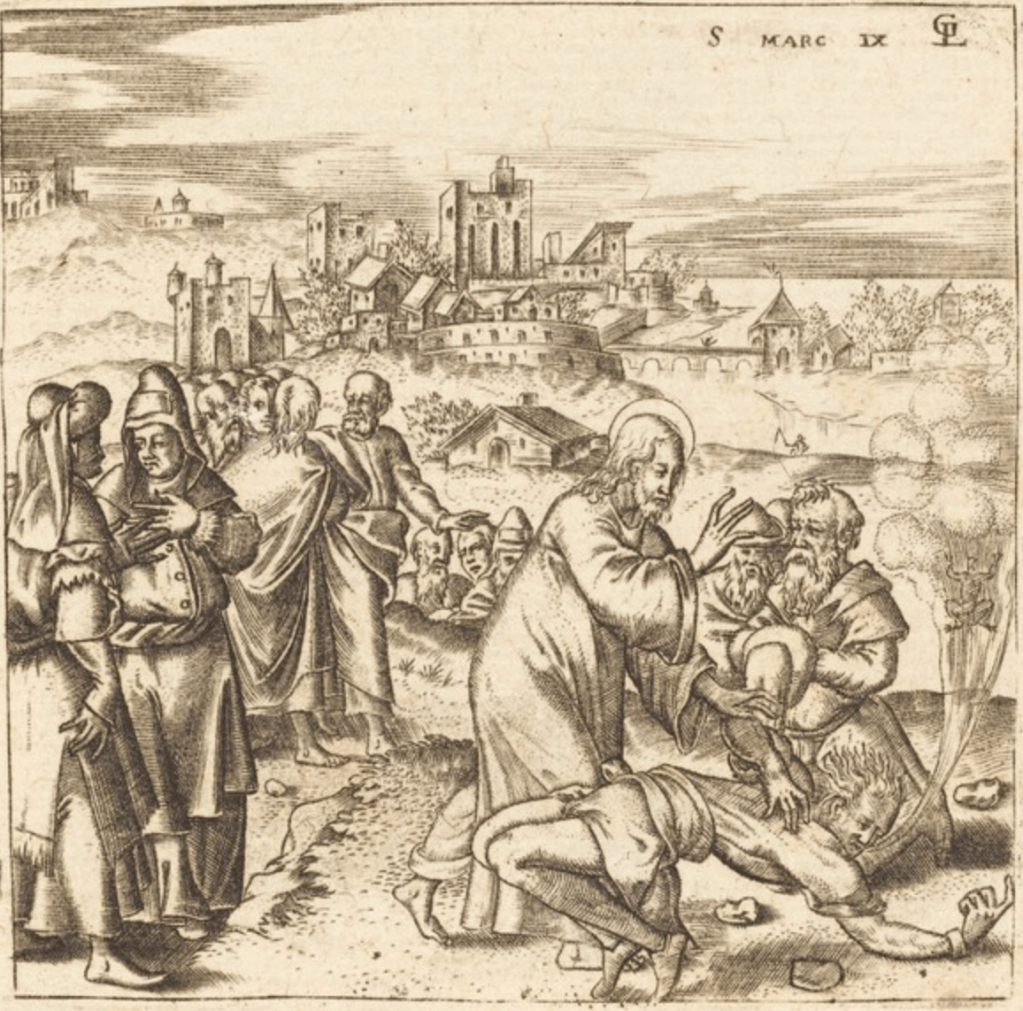
Mark 9 (NRSVUE): 14When they came to the disciples, they saw a great crowd around them and some scribes arguing with them. 15When the whole crowd saw him, they were immediately overcome with awe, and they ran forward to greet him. 16He asked them, “What are you arguing about with them?” 17Someone from the crowd answered him, “Teacher, I brought you my son; he has a spirit that makes him unable to speak, 18and whenever it seizes him, it dashes him down, and he foams and grinds his teeth and becomes rigid, and I asked your disciples to cast it out, but they could not do so.” 19He answered them, “You faithless generation, how much longer must I be with you? How much longer must I put up with you? Bring him to me.” 20And they brought the boy to him. When the spirit saw him, immediately it convulsed the boy, and he fell on the ground and rolled about, foaming at the mouth. 21Jesus asked the father, “How long has this been happening to him?” And he said, “From childhood. 22It has often cast him into the fire and into the water, to destroy him; but if you are able to do anything, help us! Have compassion on us!” 23Jesus said to him, “If you are able! All things can be done for the one who believes.” 24Immediately the father of the child cried out, “I believe; help my unbelief!”
Let’s start with a quiz — which historical figure has been characterized as “possibly the best theologian of the New Testament?”
- John the Baptist
- St. Paul
- Honi the Circle-Drawer
- The father of a boy possessed by a spirit in Capernaum
You can probably guess where I’m going with this. But hear me out. Each of the four has a more-or-less plausible reason (some less than more) to be on the list.
John the Baptist’s message, “repent, for the kingdom of heaven is at hand,” is good theology. St. Paul has a credible claim, too; his epistles introduced the concept of justification, which profoundly influenced Martin Luther and other Christian theologians ever since. (We’ll get back to him in a minute.) And Honi the Circle-Drawer was a Jewish sage of the first century BCE who famously “drew a circle in the dust, stood inside it, and informed God that he would not move until it rained.” (Spoiler alert. It rained.) He isn’t mentioned in the New Testament, so that disqualifies him, but he was a legendary miracle-worker.
Finally (and I’ll bet you knew this was going to be the right answer all along), there’s the father whose son was healed in the presence of a “great crowd […] and some scribes arguing with them” in Capernaum, according to Mark. In his discussion of Luther’s catechism, Timothy J. Wengert of Lutheran Theological Seminary of Philadelphia, says the father is “possibly the best theologian of the New Testament,” and Paul is “another, equally good theologian.”
Wengeert’s context is complex, relating to Luther’s concept of the Holy Trinity, and the passage may require some unpacking. Says Wengert:
[…] the Holy Spirit, who contends with the world concerning sin (John 16:8-10), wrests a different confession out of us — “I believe that I cannot believe” — and thus destroys both an anthropocentric and a theocentric beginning point for theology and instead insists and drives us to join our voices with possibly the best theologian of the New Testament (Mark 9:24), the father who cried out, “I believe; help my unbelief!” […]
Wengert goes on to quote Paul — “No one can say Lord Jesus except by the Holy Spirit” — but that’s the substance of it. I believe; help my unbelief. And we’re deep enough in the theological weeds already, without adding Paul to the mix.
Wengert’s context is Luther’s doctrine of justification by faith through grace. A definition or two may be in order here. Justification, according to Webster’s, means to “judge, regard, or treat as righteous and worthy of salvation.” And Luther says we are justified by the grace of God and not our own works (that’s the anthropocentric part of Wengert’s equation). Since our attempts to understand God (the theocentric part) are futile, the Holy Spirit comes in as our advocate since the anthropocentric and theocentric approaches didn’t get us anywhere.
Wingert’s paraphrase of Luther — “I believe that I cannot believe” — is from his explanation in the Small Catechism of 1529 of the third article of the Apostles’ Creed (the one that reads “I believe in the Holy Spirit, the holy catholic church, the communion of saints, the forgiveness of sins, the resurrection of the body, and the life everlasting”). Says Luther:
I believe that by my own understanding or strength I cannot believe in my Lord Jesus Christ or come to Him, but instead the Holy Spirit has called me through the gospel, enlightened me with his gifts, made me holy and kept me in the true faith, just as he calls, gathers, enlightens, and makes holy the whole Christian church on earth an keeps it with Jesus Christ in the one common, true faith. […] This is most certainly true.
So in a way, “I believe that I cannot believe” is a paraphrase of a paraphrase. It also sounds like a contradiction in terms. (As an old English teacher, I’d stick in an elipsis to flag the omitted words. But Wengert’s readers probably don’t need it, they’ll know what they are if they know their catechism.) It’s catchy, anyway, and it works for me. It perfectly matches my ambivalence. And, I think, the father’s in the story of the boy who was possessed by an unclean spirit.
What do you mean, ‘if’?
The story of exorcising a boy possessed by a demon (as Wikipedia describes it, reflecting the language of the King James bible), comes at a pivotal point in Mark’s gospel — right after the Transfiguration and shortly before Jesus and the disciples leave Galilee for Jersusalem, Gethsemane and Gogoltha.
John P. Meier, who has analyzed the story in his magisterial A Marginal Jew: Rethinking the Historical Jesus, says as written it clearly originated with Mark; shorter versions appear in Matthew and Luke, but they’re both dependent on Mark. That said, Meier hazards the guess that it “went through a lengthy and complicated evolution in the oral tradition before it reached Mark’s hands and so may even reach back as far as the life of Jesus.” I’d like to think that that’s true. So I’ll go with the story as Mark wrote it.
As Jesus returns from the Mount of Transfiguration, where he appeared to Peter, James and John radiant in glory with Moses and Elijah, he comes upon a crowd of squabbling scribes, disciples and bystanders. They’re arguing, as Mark tells the story, because the disciples who remained in Capernaum were unable to heal the boy.
If I’m the boy’s father, I’m feeling pretty desperate by then. Nothing is working out, and I’ve had it up to the keister with these bickering scribes and disciples. So when Jesus and his buddies finally show up, I’m not exactly in a good mood.
“Teacher,” I yell, “my son has a spirit that makes him unable to speak!”
I’m getting Jesus’ attention, but it’s all I can do to be heard over the babbling crowd. So when I can get a word in edgewise, I snap at him.
“if you’re able to do anything, help us!”
Jesus doesn’t look any too happy when he hears that. “What do you mean, ‘if’?” he says. “All things can be done for the one who believes.”
Oops! Now I’ve offended him. And there’s my son, who’s still rolling around on the ground in an epileptic fit. I’m desperate, and this Jesus guy looks pretty confident. In for a dime, in for a dollar, I figure. In for a shekel, in for a drachma.
“I believe,” I cry out, and this time I’m not being sarcastic. “Help my unbelief!”
With that Jesus commands the spirit, or demon or whatever it is, to leave my son. The kid stops writhing around and just lies there. Jesus walks over, takes him by the arm, and he stands up. Glory, hallelujah. He’s healed.
There’s some more chitchat, but that, to me, is the gist of it.
Matthew’s gospel has Jesus rebuking the disciples and adding, “For truly I tell you, if you have faith the size of a mustard seed, you will say to this mountain, ‘Move from here to there,’ and it will move, and nothing will be impossible for you” (Matt. 17:20 NRSVUE). The scholars of the Jesus Seminar suggest that quote, which doesn’t appear in Mark, reflects a popular adage that “must have enjoyed widespread circulation in the Jesus movement,” even though the “incidental dialogue ascribed to Jesus in this story is the creation of the narrator who is exercising the storyteller’s license.” It certainly fits the context of the story, and I can see why Matthew tacked it on to the account he got from Mark.
There’s also some conversation between Jesus and the disciples about prayer. Meier agrees that part of the story doesn’t come from Jesus. But he suggests in a chapter endnote, “The redactional tacking-on of a moral lesson on prayer, which has no anchorage in the story proper, is a sure sign of Mark’s redaction of a pre-Marcan narrative for his own purposes.”
‘I believe that […] I cannot believe’
I’ve wrestled before with Mark’s story of the boy possessed by a demon. The first time was toward the end of my first round of chemotherapy, when I joined a non-denominational cancer support group affiliated with Cancer Companions, a ministry that offers “Christian tools and services created so every cancer patient can have more smiles, hugs and hope.” (I’ve blogged about it HERE.) It’s sponsored locally by one of the Missouri Synod Lutheran churches in town, and the participants’ guide, by Karen Tripp, a licensed marriage and family therapist of St. Louis, has a literal reading of scripture that’s different from my own. But it was more than helpful as I came to terms with my diagnosis.
In the fourth week of a nine-week curriculum, we took up a reading titled “Is God Powerful Enough to Heal Cancer?” Tripp begins by retelling Mark’s story from the viewpoint of the doubting father. A couple of quotes will give the flavor:
- “Could a rabbi from Galilee be the solution? I doubted it. […] Some people said that [Jesus] was more than a healer or a rabbi. They said He was the Messiah. I didn’t care what he was. I just wanted my son healed”; and
- “This miracle wasn’t about healing my son’s body; It was about healing all our spirits. […] Jesus healed my son so I might believe and everyone who saw the miracle or heard of the miracle could throuw aside their doubt and BELIEVE!”
Tripp answers her question with a resounding yes. “Let me just say God is bigger than any load you are carrying. […] No prognosis or percentage can change that truth.”
I have nothing but respect for people who pray for healing. I envy their faith, and I’m not about to disbelieve their stories of miraculous cures. “Pray BIG,” says Tripp. But, she also says, “Submit to God’s Will.” (She recommends confession, too; it never hurts, no matter what your theological leanings, to pray with a clean slate.)
In the end, Tripp winds up in a place not far from my own understanding. “I ask for His peace to calm my desperate thoughts, seek His guidance so I will know what to do and offer myself as a tool for Him to use to accomplish His will, regardless of the outcome.”
So count me with the doubting father.
Count me in with Luther, too. “I believe that by my own understanding or strength I cannot believe in my Lord Jesus Christ or come to Him, but instead the Holy Spirit has called me through the gospel, enlightened me with his gifts, made me holy and kept me in the true faith.”
And with Timothy Wengert. “I believe that I cannot believe.” With or without the elipsis.
And finally, count me in with Cardinal Newman. On Sacred Space, a website that features short meditations on scripture, the Irish Jesuits have this meditation on Mark’s story of the boy possessed by an unclean spirit:
The last words of the this story have been a common prayer for so many people. We are a mixture of faith and unbelief. We pray from a combination of faith and doubt, on days when faith is dry and prayer seems useless. We can ask for help; we know we cannot exist on unbelief. In prayer we come as we are, with the different levels of faith, and pray for help. When we pray we are heard. John Henry Cardinal Newman prayed, ‘the night is dark and I am far from home, lead thou me on.’
The night is dark, that I can relate to. And I am far from home. That, too. Lead me on, I pray, lead me on. I believe I cannot believe; help thou my unbelief.
Links and Citations
Robert W. Funk, Roy W. Hoover and the Jesus Seminar, The Five Gospels: The Search for the Authentic Words of Jesus (San Francisco: HarperSanFrancisco, 1997): 82, 221.
“Mark 9:14-29 NRSVue,” Sacred Space: A Ministry of the Irish Jesuits https://sacredspace.com/scripture/mark-914-29/.
John P. Meier, A Marginal Jew: Rethinking the Historical Jesus (5 vols. New Haven: Yale University Press, 1994): 2:653-56, 667-71 n. 41.
Small Catechism of Martin Luther, in Evangelical Lutheran Worship (Minneapolis: Augsburg Fortress, 2006): 1162.
Karen Tripp, Seeing God in Your Cancer Journey (Grover, Mo.: Fresh Water Press, 2012): 50-53, 54, 61.
Timothy J. Wengert, Martin Luther’s Catechisms: Forming the Faith (Minneapolis: Fortress Press, 2009): 45-46.
Wikipedia Apostles Creed, Calvary, Exorcising a boy possessed by a demon, Léonard Gaultier, Honi HaMe’agel, Jesus Seminar, Justification (theology), Mount of Transfiguration, John Henry Newman and Transfiguration of Jesus.
[Uplinked Jan. 22, 2024]

 Ordinary Time
Thank you, Pete, for sharing your research, your experiences, your insights. I wholeheartedly agree with you.
Blessings abound in the midst of the serious challenges and you and Debi are certainly a blessing for so many of us. So grateful you are Springfield Dominican Associates.
With loving supportive prayers,
Bernice
Sent from my iPad
LikeLike
Thanks, sister! I wanted to say miracles *do* happen today, but they look like coincidences. It was getting long enough, though, and that would be a whole another journal topic.
LikeLike
Thanks! This is good!
Sent from my iPad
<
div dir=”ltr”>
<
blockquote type=”cite”>
LikeLike
Thanks, Nina. It was one of those pieces where I’d write a word, think for 10 minutes, delete the word, think for 10 more minutes, write another word … and go on to the next word. Took me forever to get it done!
LikeLike
❤
LikeLike
Thanks, Debi. (I can’t find my cat emoji!)
LikeLike