‘I believe, help my unbelief’: Of Pascal’s wager, prayer, empirical evidence and a New Testament miracle
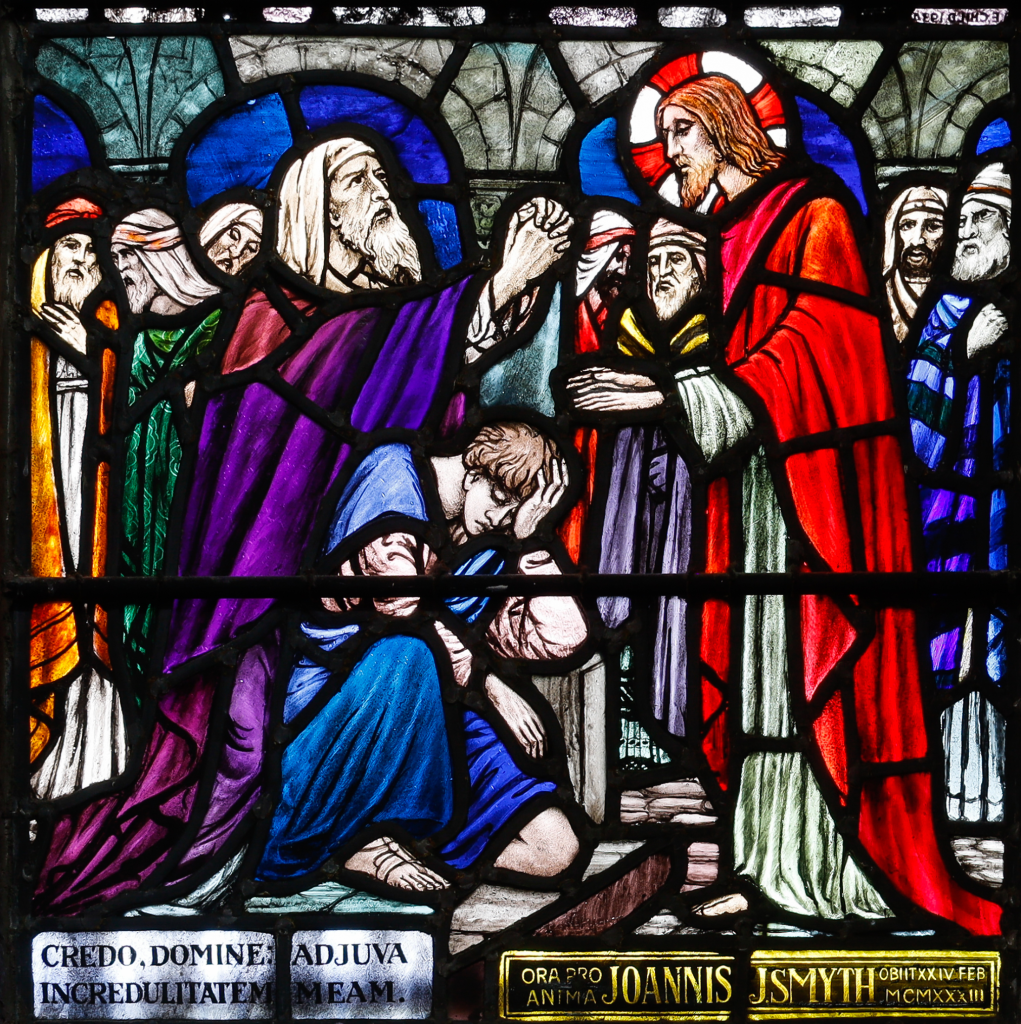
Window, Loughrea St. Brendan’s Cathedral, Ireland (Wikimedia)
Mark 9 (NRSV).Jesus[f] asked the father, “How long has this been happening to him?” And he said, “From childhood. 22 It has often cast him into the fire and into the water, to destroy him; but if you are able to do anything, help us! Have compassion on us!” 23 Jesus said to him, “If you are able! All things can be done for the one who believes.” 24 Immediately the father of the child cried out,[g] “I believe; help my unbelief!”
Earlier this year Debi and I were part of a non-denominational cancer support group affiliated with the Cancer Companions program. It struck me as grounded in a literal-minded approach to the bible that’s quite different from my own, but I admired the deep personal faith of others in the group, and they were accepting of my struggles with doubt and spiritual dryness. All of which leads me to look at my own faith in a new perspective.
Where does my mix-and-match blend of mainline Protestant theology and Catholic spirituality fit into the overall scheme of things? What can I learn from other faith traditions, especially evangelical Protestant, that deepens my own faith?
One passage we read that has stayed with me is the account in Mark of Jesus’ healing a boy possessed by a demon, or unclean spirit. (It also appears in Matthew and Luke.) There’s a lot to unpack there. The disciples have been unable to heal they boy, and his father pleads with Jesus, “if you are able to do anything, help us!” If? Jesus replies, quoting the father, “If you are able?” All things, Jesus adds, are possible by faith.
It’s a nice bit of dialog, and it comes at a crucial moment in Mark’s narrative — immediately after the Transfiguration, as Jesus is about to set out for Jerusalem, death and resurrection. But what sticks with me is the father’s ambivalence. If you are able to help us. If, if, if. Coulda, shoulda, woulda. I believe, help my unbelief. It matches my own ambivalence.
I’m perfectly willing to accept the story as told in the gospels, as a story. In fact, I think the story is all we’ve got. Modern commentaries suggest the boy was epileptic, but I don’t think first-century reports of miraculous healings lend themselves to empirical analysis 20 centuries later. I’d rather just read them at face value. Afterward, the disciples ask Jesus why they weren’t able to heal him the boy. “This kind [of healing] can come out only through prayer,” replies Jesus. And I’m more than willing to accept that, too.
All miracles aside, I think this is a story that hints at the power of prayer. Perhaps that reflects my own struggles with doubt. After all, it is about a miraculous healing. But I’d like to suggest an alternative reading — call it a subtext that sheds light on the main story.
I believe. Help my unbelief. That, to me, is a prayer. And, as Mark, Luke and Matthew tell the story, the boy is healed. But let’s concentrate on the father for a moment.
As I imagine the scene, things aren’t looking too good for him when Jesus shows up. Efforts to heal the boy have failed, and a bickering crowd has gathered. “You faithless generation, how much longer must I be with you?” says Jesus when he takes in the scene. “How much longer must I put up with you? Bring him to me.” If I were the father, I’d be skeptical, too.
But maybe it’s worth a try. Nothing else has worked. If you are able to do anything, help us! As I try to put myself in the scene, I’m reminded of Pascal’s wager: We can’t prove the existence of God, but we should bet on the proposition that God does in fact exist. “If you gain, you gain all; if you lose, you lose nothing,” argues 17th-century French philosopher Blaise Pascal. In other words, as Wikipedia summarizes it, “Pascal argues that a rational person should live as though God exists and seek to believe in God.”
And what if you still don’t believe? Try harder, says Pascal. But don’t overthink it (my paraphrase, admittedly pretty loose). “Endeavor then to convince yourself, not by increase of proofs of God, but by the abatement of your passions.” Follow the example of people of faith, he says, who have overcome similar doubts:
These are people who know the way which you would follow, and who are cured of an ill of which you would be cured. Follow the way by which they began; by acting as if they believed, taking the holy water, having masses said, etc. Even this will naturally make you believe, and deaden your acuteness.
Can it start with prayer? I think it can. I’ll be the first to admit I’m a novice at this whole business of prayer, but I think something very much like it is happening in Mark’s story of the boy who was cured of possession by an unclean spirit. The father acts as if he believes. I believe, help my unbelief.
I know I’ve done something very much like it, too, even when I was most critical of organized religion. I had no concept of God in those years, other than a vague creative principle that gave order to the universe, but that didn’t stop me from calling up half-remembered prayers in times of crisis. Dear God, help me! Get me out of this mess! Or, when the crisis abated, Thank you, Jesus. Later, in 12-step recovery, I learned to pray for knowledge of God’s will and the strength to carry it out.
And still later, I rejoined the church.
But there’s something important about prayer I didn’t discover until quite recently. In a brief introduction titled “What is prayer? How does it work?” on the Springfield Dominican Sisters’ website, Sr. Mary Jean Traeger, OP, sums it up neatly.
When we learn to pray as children, says Traeger, we learn prayers by rote memory. And “we often start by asking God for help.” That’s certainly how it worked for me. As we go along, sooner or later, we learn how to approach God through prayer:
We start when someone—a parent or a friend, perhaps—introduces us to the person called “God.” It starts with a child’s relationship and grows deeper and deeper as we mature and connect with our innate sense that there is a Holy Mystery beyond and within us.
Is God a person? Well, yes and no. A holy or sacred mystery, according to Wikipedia, my go-to source for matters theological, is a religious belief that “cannot be easily explained by normal rational or scientific means.” We can’t explain the nature of God, but if we do what Pascal recommended back in the 1600s and act as if we believe, we can have a personal relationship with God.
In other words, I don’t think prayer is transactional — a simple matter of asking God for something, and God giving it to us (or not) — as much as it’s relational. Prayer, according to one definition I like, is a conscious conversation with God. It puts us in touch with the Holy Mystery that created the universe and also resides within us; in the Christian tradition, we can approach God through the persons of the Trinity, Father, Son and Holy Spirit. At least that’s as near as I can come to it.
So in the gospel story, the father asks Jesus to heal his son; there’s some back-and-forth; and he asks Jesus to strengthen his faith. Help my unbelief. The boy is healed. Is this transactional. Is it relational? I’d say it’s both.
In her essay on the Springfield Dominican website, Traeger suggests we don’t pray to change God’s mind; instead, we pray to establish a closer relationship with God:
We pray for people who are seriously ill both far away and close at hand. We might ask ourselves, “What good does it do to pray for others? How does it help them or us?” The answer has to do, first, with what prayer does for us. Prayer draws our attention to the God who loves us deeply. When we pray for ourselves or for another, we pay attention to God. We remember the God who loves us and reflect on the fact that God loves every single person in the world.
In other words, prayer “helps us change our own minds and hearts.” Traeger adds:
It deepens our trust in God and our confidence that God really does love us. Even if we think we don’t get what we pray for, our consciousness of God’s nearness is heightened and transforms us into conduits of God’s love and care. We become aware that God is near, that God never turns away from us and is, indeed, within us. That can bring us deep peace, even in difficult circumstances.
***
A footnote. More information about Cancer Companions, which offers “Christian tools and services created so every cancer patient can have more smiles, hugs and hope,” is available online at https://www.cancercompanion.org/.
Hi, Pete,
Your “musings” so resonate with me. How timely your post is as I’m on retreat this week and we’re centering on “praying with and among….”
I agree that praying involves establishing and deepening relationships with God and others. And isn’t it a both/and: Praying to and for and with?Certainly has the potential for “I do believe; help my unbelief.”
So Pete, I am praying with and for you and Debi and am counting on mutual praying.
Can’t wait to share your post with Mary Jean Traeger.
Loving thoughts and positive energy- isn’t that praying too?
Bernice
Thanks, Sister! I’ve really appreciated your prayers — have also been praying through Sr. Joan’s prayer requests when they come in the email, and it helps me feel connected to the community. When they were wheeling me into the OR at St. John’s yesterday, the passage from Mark came to me — I believe, help my unbelief — and I felt like it couldn’t have been more appropriate to the occasion!

 Ordinary Time
Good post! The cancer support group turned out to be pretty good, I thought. I wasn’t too fond of the book we used, but I loved the people.
LikeLiked by 1 person
Same here!
LikeLike
Hi, Pete,
Your “musings” so resonate with me. How timely your post is as I’m on retreat this week and we’re centering on “praying with and among….”
I agree that praying involves establishing and deepening relationships with God and others. And isn’t it a both/and: Praying to and for and with?Certainly has the potential for “I do believe; help my unbelief.”
So Pete, I am praying with and for you and Debi and am counting on mutual praying.
Can’t wait to share your post with Mary Jean Traeger.
Loving thoughts and positive energy- isn’t that praying too?
Bernice
Sent from my iPhone
LikeLiked by 1 person
Thanks, Sister! I’ve really appreciated your prayers — have also been praying through Sr. Joan’s prayer requests when they come in the email, and it helps me feel connected to the community. When they were wheeling me into the OR at St. John’s yesterday, the passage from Mark came to me — I believe, help my unbelief — and I felt like it couldn’t have been more appropriate to the occasion!
LikeLike