Finally! I’ve had time this morning to pull together the information I’ve got about Bestefar, answer your questions and add a couple of thoughts of my own.
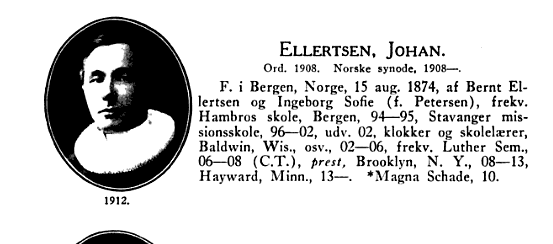
He was born 15 Aug. 1874 in Bergen, according to the attached Norwegian-language directory. He studied at a school for missionaries in Stavanger and emigrated (udvandret) in 1902. He was a teacher and klokker in Baldwin, Wis., from 1902 to 1906. (I believe klokker is usually translated sexton, but in Norwegian churches the klokker was a song leader and kind of an all-round assistant to the pastor; the online Norwegian Genealogy Dictionary has this definition of a klokker: “lay person assisting the minister during church service. In the time before church organs he led the congregation in singing. From 1812 he kept a copy of the church record”). According to a genealogy my father put together in the 1970s, Bestefar also taught at Beaver Creek and Hardies Creek near LaCrosse from 1903 to 1906.
He went to Luther Seminary from 1906 to 1908. The rest of his career is detailed in his obituary in the Brooklyn Eagle and a family tree that Dad apparently put together around 1980. I have some family stories from Dad that fill in details, which I’ll get to below. But first, here’s a list of the attached material: — Family Records – BW Ellertsen (c1980). A detailed family tree that Dad apparently put together after he retired in 1974. — Brooklyn Eagle Obit. I think I found this online, it’s a wide shot that shows the date (Feb. 3, 1939) — Bestefar – obit. A more readable closeup of the Brooklyn Eagle obit. — Bestefar 02 – “norw directory.” From a directory of Norwegian Synod pastors apparently published in the 1920s. I found it online and made the attached screen shot. — Bestefar1 Eagle 4-32. First take from the Brooklyn Eagle profile. I don’t have the full date, but from internal evidence I’d estimate it was published in April 1932. — Bestefar2 Eagle 4-32. Second take of the profile in the Eagle.
To your questions. I’m guessing Bestefar saved enough money from his teaching job to pay tuition at Luther Seminary. Don’t know that for a fact, but it was common practice in the old Norwegian and Swedish immigrant synods. Dad said he wanted to be a pastor before he left Norway, but he couldn’t afford to read theology at the university in Oslo so he went to that mission school in Stavanger and got certified to teach in foreign missions. (There was something about how America was his second choice after a job in what is now Uganda fell through, but the Norwegian sense of humor may have been at work there.) Ironically, I checked out the websites a couple of years ago and it would cost slightly more per year for a kid to study for a year at Luther, including tuition, than it would to go to Oslo and spend a year in the faculty of theology there.
[‘ve been playing with Google Maps, BTW, and Trondhjem is in a rural area with one of those gosh-awful rural addresses (87740 170th Street) southeast of Hayward and about equidistant from Hayward and Austin. Oakland and Moscow are east-northeast of Hayward — Oakland has a rural Albert Lea address and Moscow has a rural Austin address.
Did some keyword searches and also found the communities in Wisconsin where Bestefar taught. The map I attached shows Lutheran churches along Beaver Creek and Hardies Creek (note spelling), and Baldwin is on I-35 about 30 miles east of the Twin Cities. I’m sure all of these schools would have been parochial schools that mostly operated in the summer, since the Norwegians, like other Scandinavians, preferred to send their children to public schools to learn English. I’ve seen a parochial schoolhouse that was moved to the Vesterhiem museum in Decorah, Iowa. The Swedes had them, too, and called them “Swede schools.” The kids would learn Swedish, memorize the catechism and that was about it. I’m sure the curriculum was about the same in the Norwegian schools.]
The area was of mixed ethnicity: I remember Dad’s saying the next town over from Hayward was Bohemian and therefore terra incognita when he was a boy, but when he and Mother visited there in the early 70s he noticed there would be a Norwegian name on the mailbox, then a Czech name, then maybe a couple of Norwegian names, Czech name, Norwegian, Czech names all mixed up; he asked someone about it and they said yeah, sure, they intermarried a couple of generations ago.
One more memory I got from Dad, which I’ll add to the revised draft. When he got old enough to be confirmed, Bestefar told him he was delighted because now they could share a bottle of beer for Sunday dinner. Before, he would drink half the bottle, cork it and save the rest for the next Sunday, but it would go flat during the week. But with both of them sharing the bottle, they could drink while the carbonation lasted.
Another time, he or my mother mentioned they always had red cabbage on Sundays. They didn’t say so, but I’m guessing they had it with boiled potatoes. Roast beef or meatballs (like Swedish meatballs without the white sauce — we called them norskebiff.) Dad always had a cheese sandwich for breakfast, and I never figured out why till the summer I studied in Norway.
[Uplinked March 8, 2024]

 Ordinary Time